Completing a Schengen visa application form is not primarily a test of sophisticated language. It is an exercise in documentary precision. Every answer creates a factual proposition that the consulate may compare with the passport, travel itinerary, accommodation, invitation, employment evidence, bank statements, insurance and previous immigration history. A form can therefore be grammatically immaculate yet materially deficient if its dates, destinations or financing arrangements contradict the supporting file.
This guide explains how to fill the Schengen visa application form in 2026, field by field, for a short stay of no more than 90 days in any 180-day period. It applies to applicants worldwide and to applications directed to any of the 29 Schengen states. The common legal structure is the same whether an applicant lives in Pakistan, India, China, Nigeria, South Africa, the United Arab Emirates, the United Kingdom, the United States or another country. What changes locally is the appointment system, accepted language, service provider, supporting-document checklist and, in some jurisdictions, the sponsorship or accommodation form.
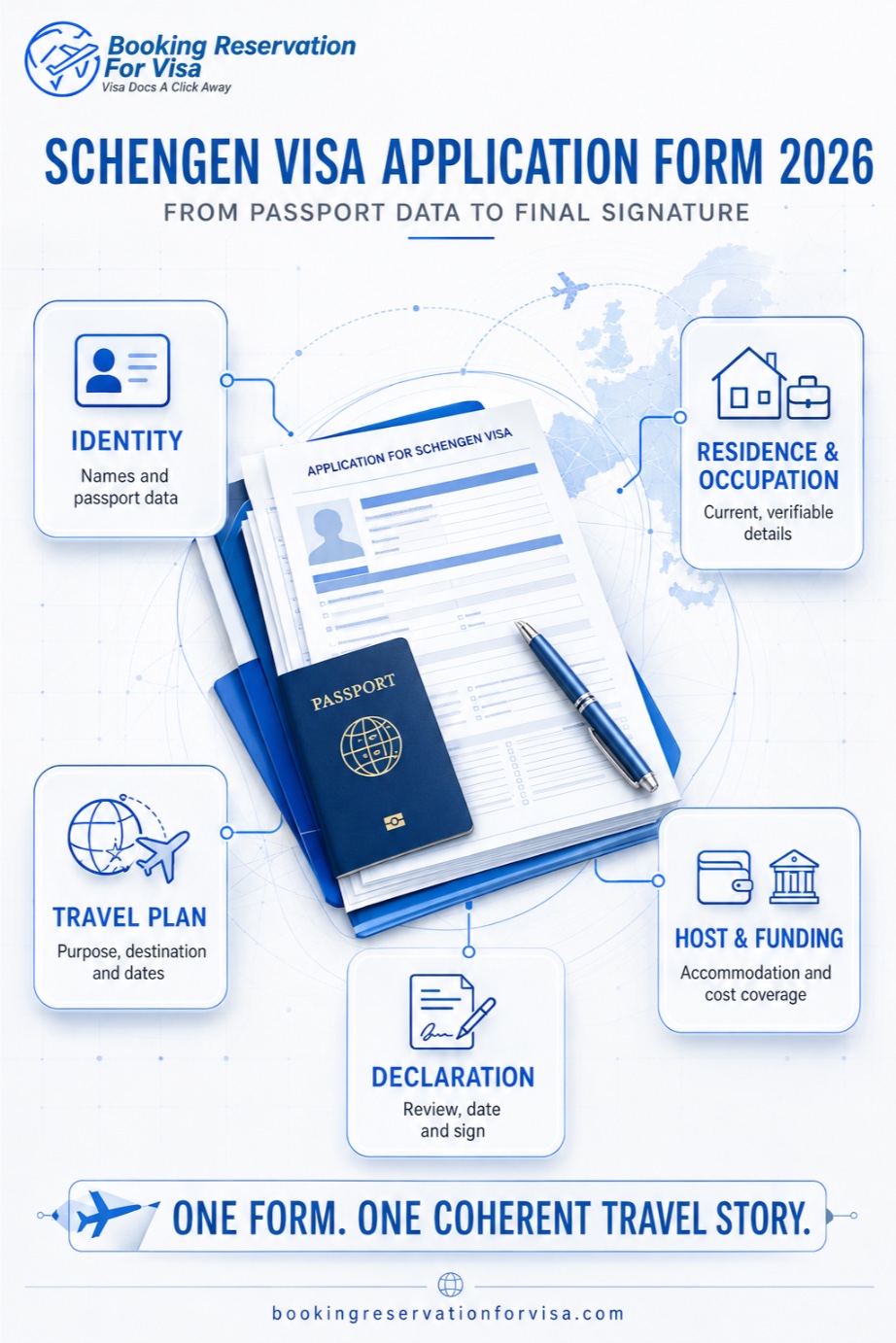
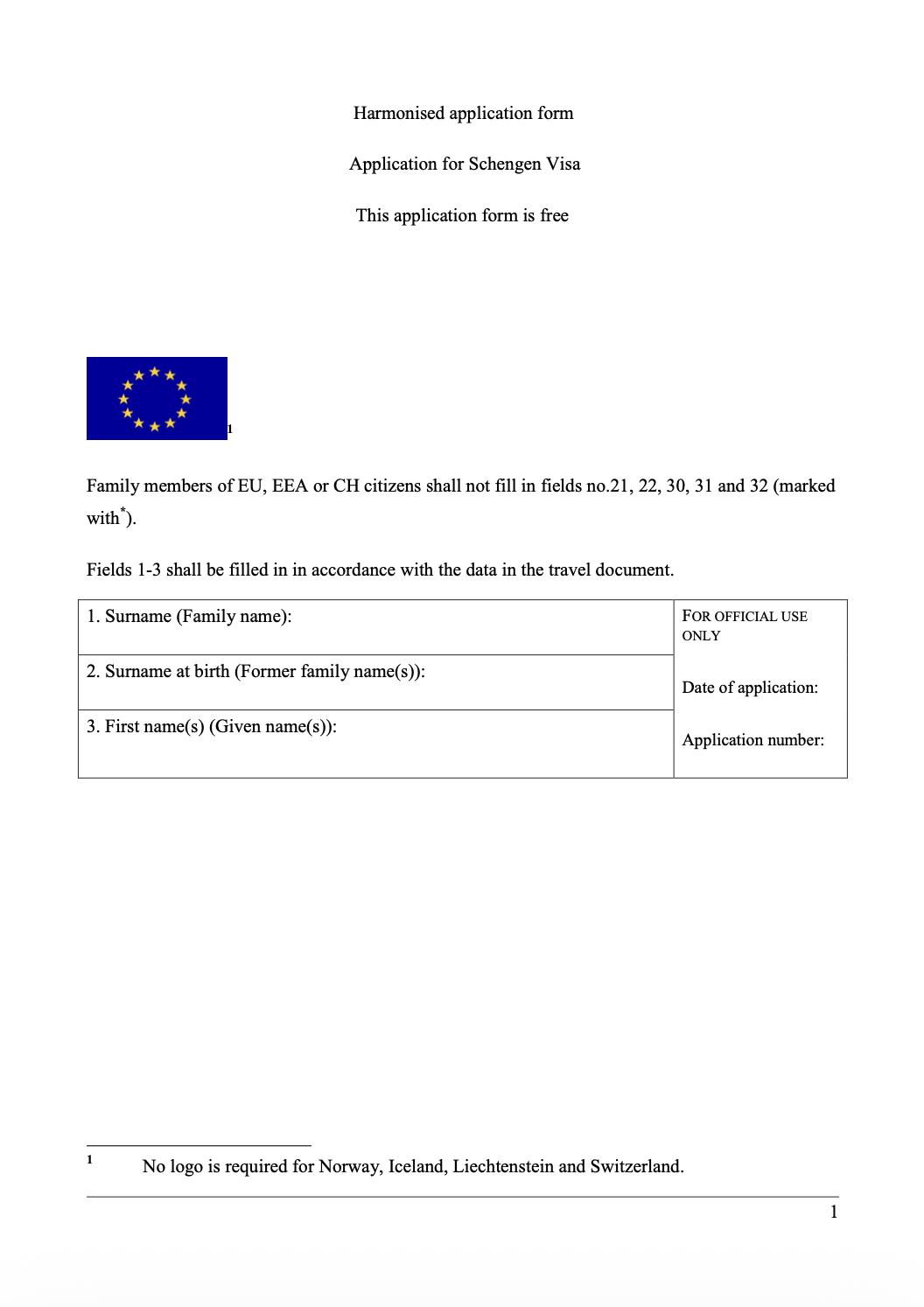
The current official form contains 33 numbered fields, followed by declarations, place, date and signature. It is a harmonised form: a consulate cannot replace its substance with an unrelated questionnaire, although a national online portal may collect the same information in a different visual sequence. Applicants should always download or complete the version linked by the competent embassy, consulate or authorised visa application centre rather than relying on an old form saved by a friend.
Important: This is a completion guide, not a guarantee of visa issuance. A truthful form and coherent reservations support examination; the competent diplomatic authority alone decides the application.
What Is the Short-Stay Schengen Visa Application Form?
A short-stay Schengen visa, normally identified as a Type C visa, permits an intended visit within the 90-days-in-any-180-day-period ceiling. The allowance is collective across the Schengen area, not 90 days in each state. The European Commission describes a Schengen visa as an entry permit for a temporary visit of up to 90 days in any rolling 180-day period. Its official short-stay calculator can assist travellers with previous or proposed stays.
The uniform Schengen visa application form is used for tourism, business, family or friend visits, short study or training, cultural and sporting events, medical travel, official visits and other qualifying short purposes. It is not the correct form for employment, permanent settlement, family reunification or study exceeding 90 days; those are generally governed by the destination state’s national long-stay procedure.
In 2026, 29 states issue Schengen visas. Bulgaria and Romania have been full Schengen members since 1 January 2025. Cyprus and Ireland are EU countries, but they do not issue Schengen visas; they operate national entry regimes. This distinction prevents one of the most elementary but consequential filing errors.
| 2026 category | States covered | Form position |
| EU states issuing Schengen visas | Austria, Belgium, Bulgaria, Croatia, Czechia, Denmark, Estonia, Finland, France, Germany, Greece, Hungary, Italy, Latvia, Lithuania, Luxembourg, Malta, the Netherlands, Poland, Portugal, Romania, Slovakia, Slovenia, Spain and Sweden | The harmonised 33-field application form applies, with national portals and local checklists where prescribed. |
| Non-EU Schengen states | Iceland, Liechtenstein, Norway and Switzerland | They participate in the common Schengen visa system and use the harmonised form. |
| EU states outside the Schengen visa-issuing system | Cyprus and Ireland | A Schengen application form is not a substitute for their national visa forms. |
The country list above follows the Council of the European Union’s current Schengen visa overview. Because diplomatic representation arrangements can change, applicants should still verify which mission or provider accepts applications in their country of legal residence.
Before Filling the Form: Make Five Decisions First
- Confirm That a Short-Stay Visa Is the Correct Category
Calculate the complete itinerary, including arrival and departure days. Each day of presence counts. If a proposed course, job, research placement or family stay will exceed 90 days, do not force it into a short-stay form; consult the relevant state’s national visa rules. Likewise, an airport transit visa is not equivalent to a short-stay visa because it ordinarily does not permit departure from the international transit area.
- Identify the Competent Schengen State
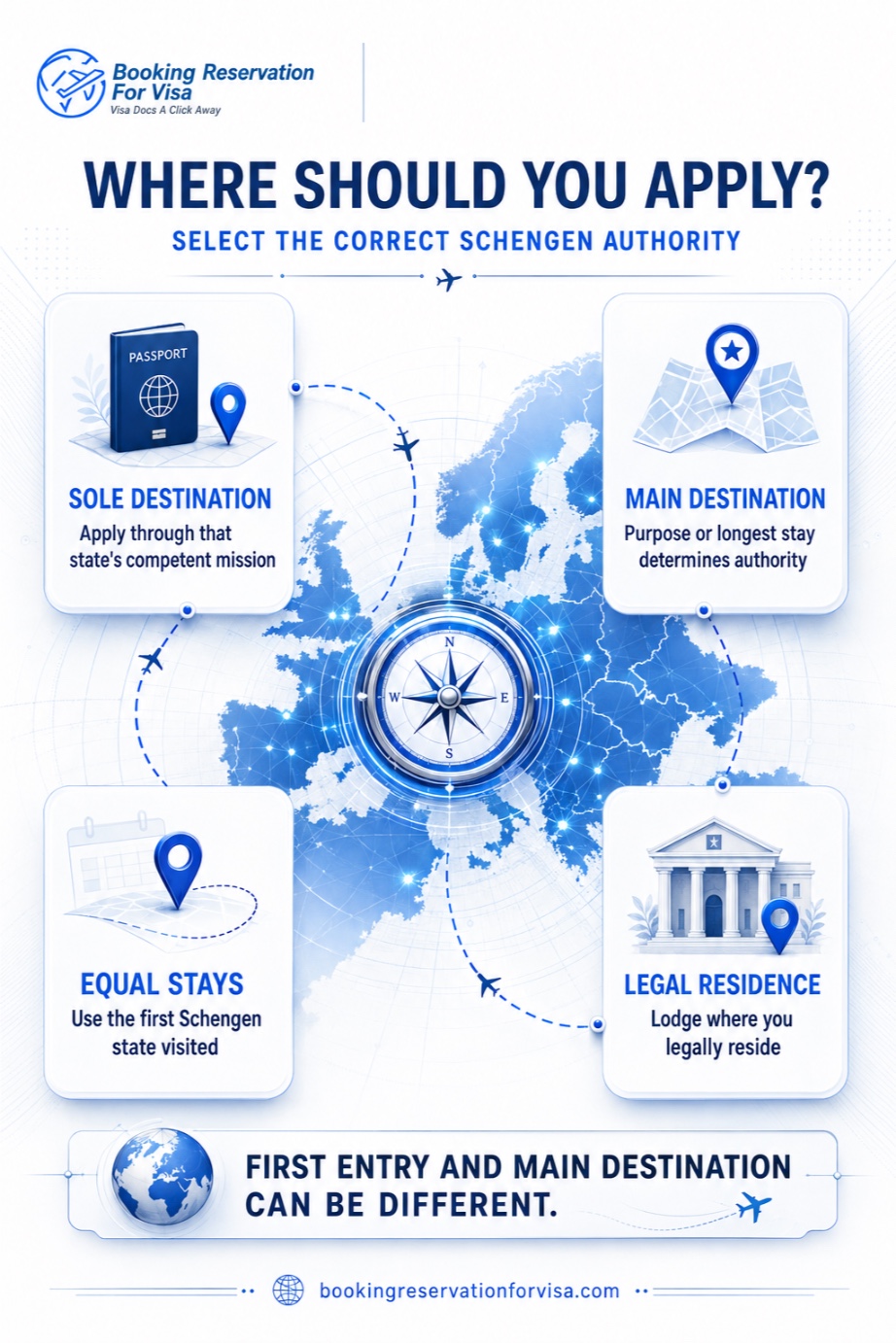
Visa applicants do not acquire jurisdiction by choosing the embassy with the earliest appointment or highest perceived approval rate. Competence follows the actual trip:
- Apply to the state that is the sole destination.
- For several destinations, apply to the state constituting the main destination by purpose or length of stay.
- If no main destination can be determined, apply to the state whose external border will be crossed first.
Purpose can outweigh arithmetic. A traveller attending a five-day trade exhibition in Germany and then taking a six-day incidental holiday in France may still have Germany as the main destination because the business event is the trip’s controlling purpose. Explain such an itinerary clearly instead of allowing hotel-night totals to tell an incomplete story.
| Proposed journey | Normally competent state | Reason |
| Seven nights entirely in Italy | Italy | Italy is the sole destination. |
| Eight nights in France and four in Belgium | France | France is the longest stay and main destination. |
| Four nights in Spain and four in Portugal, entering through Spain, with the same tourism purpose | Spain | The stays are equal and Spain is the first Schengen state visited. |
| Business conference in Germany followed by incidental tourism elsewhere | Germany, if the conference is the principal purpose | Main purpose may determine competence even when the route includes other states. |
| Flight lands in Amsterdam before an internal connection to Denmark | Denmark may remain the main destination; the Netherlands is recorded as first entry | First entry and main destination are separate form questions. |
The EU Visa Code establishes these competence rules. Deliberately presenting an artificial itinerary to a convenient mission can create doubts about credibility and may amount to visa shopping.
- Establish Where You Are Entitled to Apply
Nationality and filing location are not always the same. As a general rule, submit to the territorially competent consulate for the country where you legally reside. Thus, an Indian national holding lawful residence in the UAE usually applies through the mission or authorised provider responsible for the relevant UAE jurisdiction, not automatically in India.
A person legally present but not resident in a jurisdiction may be considered only when there is a defensible reason for filing there. Do not assume that a visitor visa, short business visit or transit status confers an unrestricted right to apply. Obtain confirmation from the mission before paying for appointments or reservations.
If the destination state has no visa section in the country of residence, another Schengen state may represent it, or an authorised external service provider may collect applications. Representation affects where the file is lodged, not the answers about the genuine destination.
- Obtain the Correct Official Form and Local Checklist
Start with the competent state’s embassy or consulate website. It may direct applicants to a national portal, a downloadable PDF, or an authorised centre. Some systems require online completion followed by printing and signing; others accept a manually completed official PDF. The Visa Code permits manual or electronic completion, and electronic submission where available, but the locally announced procedure controls.
The form should be free. A service fee may be charged for appointment-centre functions, but the blank official application form itself is not a product that must be purchased.
- Assemble a “Source Sheet” Before Typing
Place the passport, residence permit, proposed itinerary, accommodation details, employer or university information, host or company invitation, insurance and financial plan beside you. Write one verified chronology: departure, first Schengen entry, each destination, hotel nights, final Schengen departure and return. This preliminary reconciliation prevents the common practice of improvising answers and repairing contradictions later.
How to Fill the Schengen Visa Application Form in 2026, Field by Field
Complete applicant fields in the language accepted by the mission, ordinarily using Latin characters where required. Keep the “For official use only” column blank. If a question is genuinely inapplicable, follow the portal’s instructions: select “No,” use “Not applicable,” or leave the field empty only where permitted. Never invent data merely to satisfy a mandatory box.
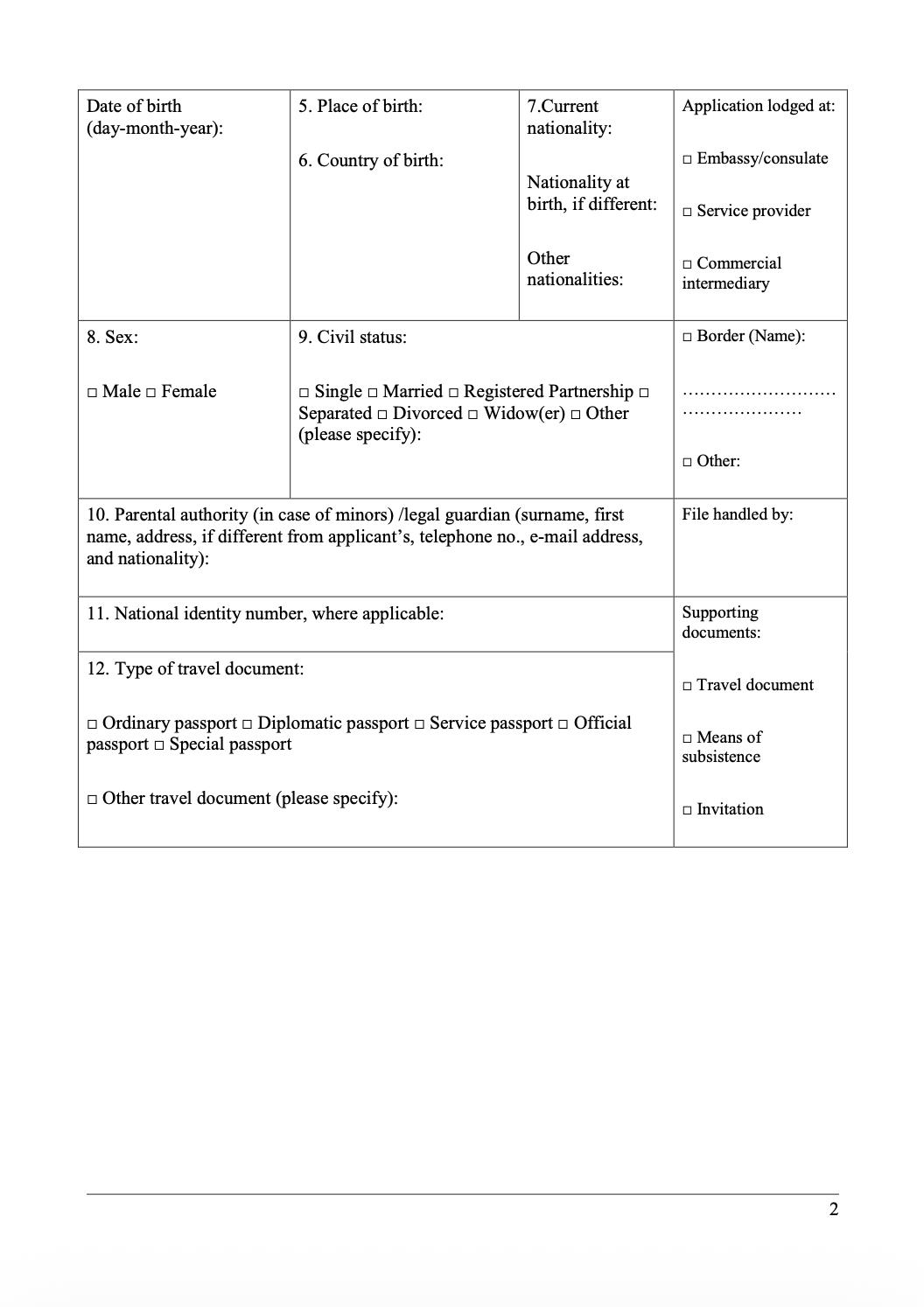
Fields 1-3: Surname, Surname at Birth and Given Names
Field 1 – Surname (family name): Copy the current surname from the passport biographical page exactly. Preserve the passport’s spelling, order, hyphens and spaces. Do not replace it with a married name that has not yet been incorporated into the travel document.
Field 2 – Surname at birth or former family name: Enter the family name held at birth and any previous surnames, where applicable. If it has never changed, many forms expect the present surname to be repeated; follow the mission portal’s prompt. A former married surname, adopted surname or officially changed name should not be concealed merely because it no longer appears prominently in daily use.
Field 3 – First names or given names: Enter every given name shown in the passport, not only the name commonly used. Middle names appearing as given names belong here. Fields 1–3 are explicitly required to follow the travel document, making nickname substitution particularly hazardous.
Applicants with a single name, patronymic naming structure or no conventional family name should follow the allocation shown on the passport and the mission’s technical instructions. Do not arbitrarily duplicate or split the name to make it resemble a Western naming pattern.
Fields 4-9: Birth Details, Nationality, Sex and Civil Status
Field 4 – Date of birth: Use the requested day-month-year sequence. A date such as 7 April 1992 should be entered as 07-04-1992 where numeric formatting is required. Do not interchange day and month when using a portal designed for European date order.
Field 5 – Place of birth: Copy the town or city recorded in the passport or civil record. If the passport uses a district rather than a municipality, reproduce the document’s entry rather than substituting a nearby, better-known city.
Field 6 – Country of birth: Select or write the relevant country. Where geopolitical borders or country names have changed, use the option supported by the passport and the portal’s current dropdown list. Add an explanation only if a genuine historical discrepancy could otherwise appear misleading.
Field 7 – Current nationality, nationality at birth and other nationalities: Record the current nationality, state the nationality held at birth if different, and disclose any additional nationality. Dual citizens should not omit a second citizenship. The passport used for the application must remain identifiable even if another passport will also be carried.
Field 8 – Sex: Select the entry corresponding to the travel document and the options offered by the official form: male, female or other.
Field 9 – Civil status: Choose the legally correct status: single, married, registered partnership, separated, divorced, widowed or other. A social description such as “engaged” does not replace legal civil status. Where “other” is selected, specify the recognised position concisely.
Field 10: Parental Authority or Legal Guardian for a Minor
This field is completed for applicants under 18 or under the applicable age of majority. Provide the guardian’s surname, given names, address if different from the minor’s, telephone number, email and nationality. Where both parents exercise authority, include both if the form or local checklist requires it.
The minor needs a separate application even when included in a parent’s passport or travelling with the family. Supporting papers may include a birth certificate, parental consent, custody order, parents’ identity documents and proof of who will accompany the child. Adults should mark this field inapplicable in the manner required by the form.
Field 11: National Identity Number
Enter the government-issued national identity number, where one exists. This is not the passport number and not a tax, social security, employee or student number unless the competent authority expressly treats it as the national identifier. If the applicant’s country does not issue such a number, record “Not applicable” where the form permits.
Fields 12-16: Travel Document Information
These fields should be transcribed directly from the passport used for travel.
Field 12 – Type of travel document: Most applicants select “ordinary passport.” Diplomatic, service, official, special or other travel documents should be chosen only when that is the actual document category.
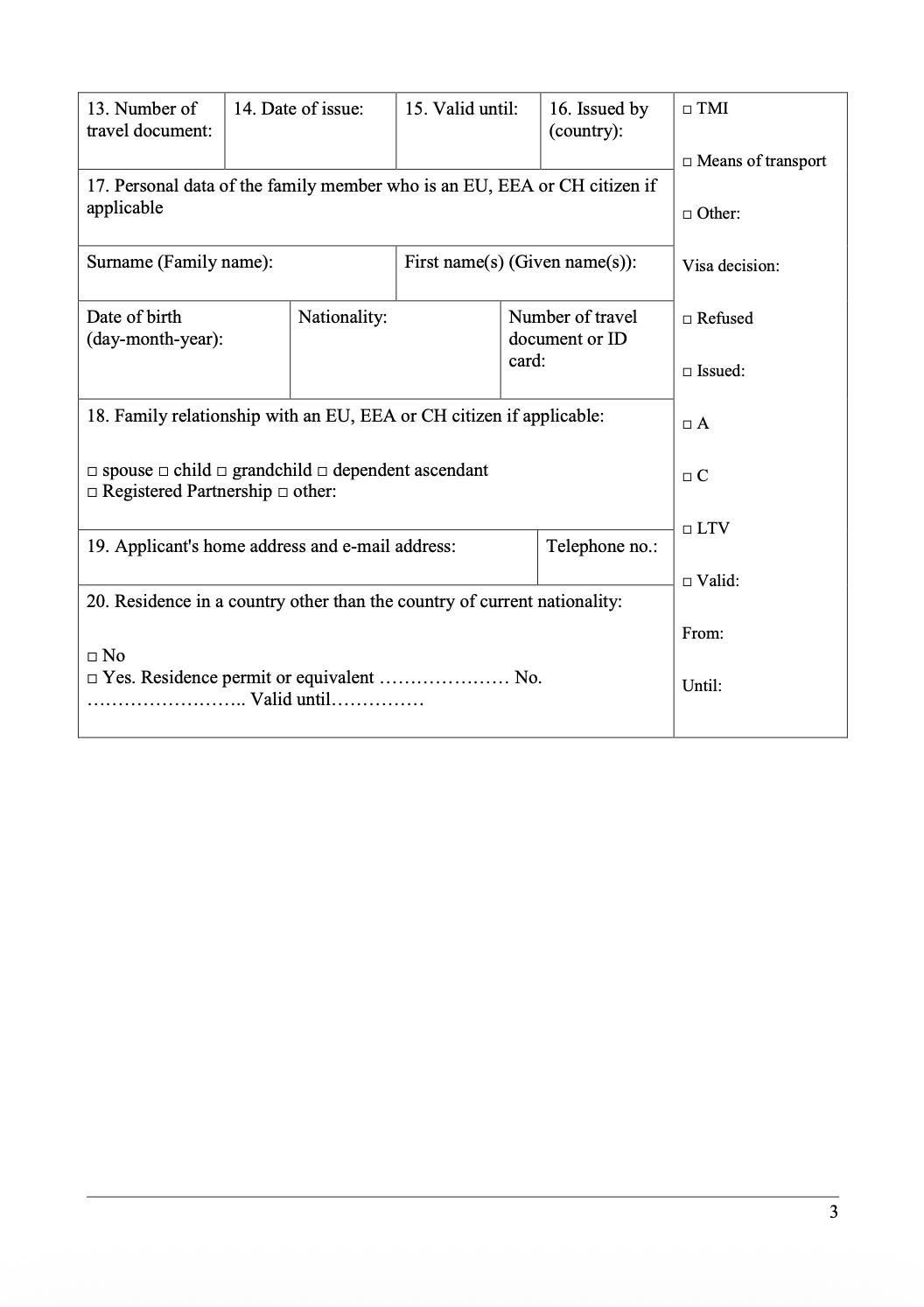
Field 13 – Travel document number: Enter the passport number precisely, distinguishing zero from the letter O and one from the letter I. Avoid decorative spaces unless the official portal inserts them automatically.
Field 14 – Date of issue: Copy the issue date in the required format.
Field 15 – Valid until: Copy the expiry date. For an ordinary application, the passport should remain valid for at least three months after the intended departure from the Schengen area. It must also contain at least two blank pages.
Field 16 – Issued by: The current harmonised form asks for the issuing country. Use the country identified by the passport, not the travel agent, city of application or employer that facilitated issuance.
Under the Visa Code, an acceptable travel document should have been issued within the previous ten years. Extending an old passport does not necessarily cure the ten-year issuance rule. Resolve passport validity before constructing the application around it.
Fields 17-18: Family Member Who Is an EU, EEA or Swiss Citizen
These fields are relevant only when the application relies on a qualifying relationship with an EU, EEA or Swiss citizen, or with a UK national protected by the EU–UK Withdrawal Agreement.
Field 17: Give the family member’s surname, given names, date of birth, nationality and passport or identity-card number.
Field 18: Select the legal relationship, spouse, child, grandchild, dependent ascendant, registered partner or other.
Do not complete these fields merely because a friend, distant relative or business contact holds European citizenship. Conversely, an applicant who genuinely falls within a facilitated free-movement category should not complete the form as an ordinary tourist without checking the applicable procedure. The official form indicates that qualifying beneficiaries do not fill fields 21, 22, 30, 31 and 32, but the exemption must not be claimed without the requisite relationship and travel circumstances.
Field 19: Home Address, Email and Telephone Number
Provide the actual residential address, not only a postal box, agent’s office or employer’s headquarters. Use an email account and telephone number that the applicant checks regularly because the mission may request clarification or additional documents under a deadline.
The contact details should agree with the appointment profile and cover letter. A recent move is not inherently problematic, but unexplained addresses scattered across the form, bank record, employment letter and residence permit can create avoidable uncertainty.
Field 20: Residence Outside the Country of Current Nationality
Select “No” if you live in your country of nationality. Select “Yes” if you legally reside elsewhere and provide the residence permit or equivalent document number and expiry date.
This field is central to worldwide applications. For example, a Pakistani citizen residing lawfully in Qatar should disclose the Qatari residence authorisation. Ensure that it remains valid for the period prescribed by the local mission; some checklists require residence validity extending beyond the intended Schengen return.
Fields 21-22: Occupation, Employer or Educational Establishment
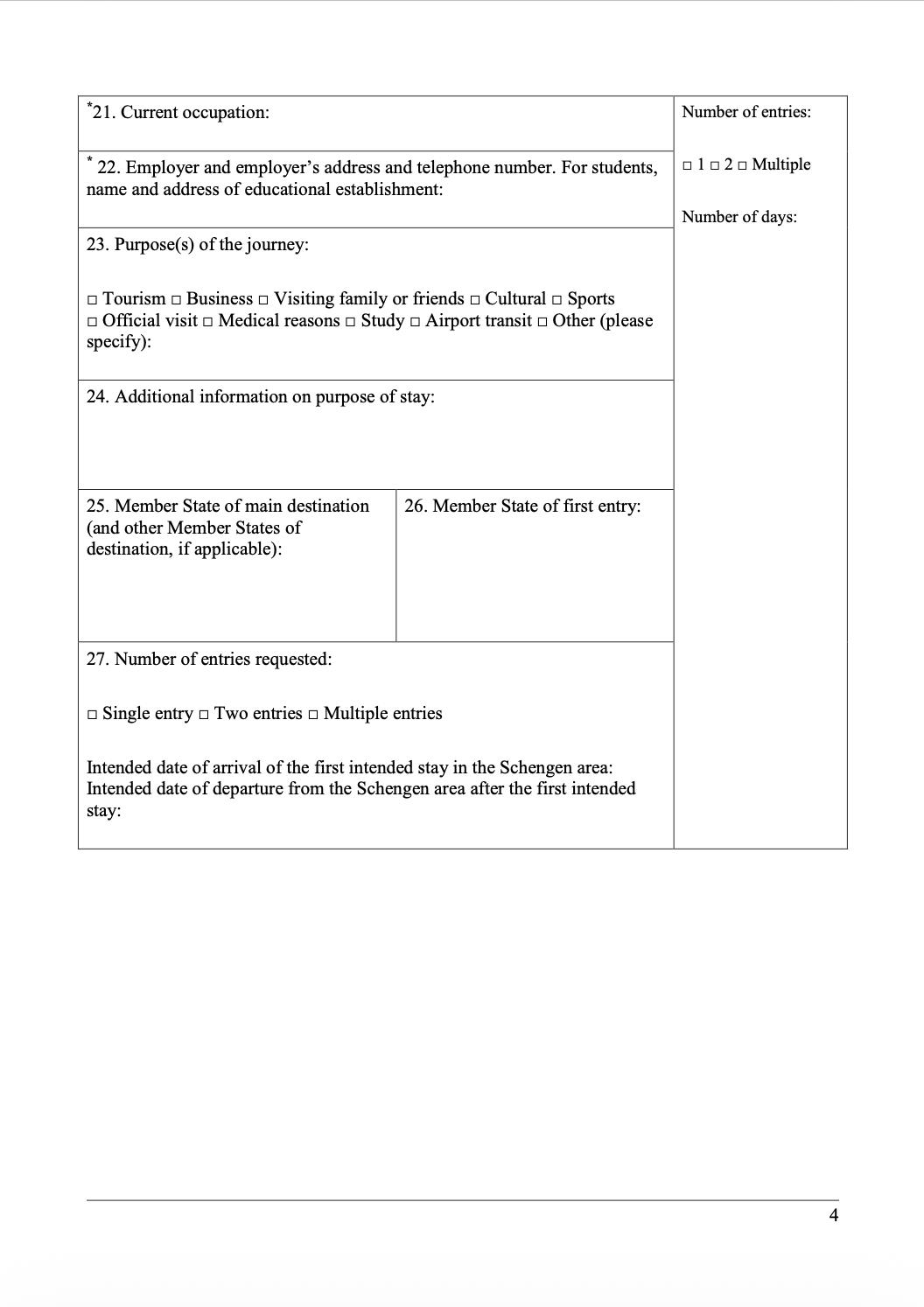
Field 21 – Current occupation: Use a specific, verifiable description such as “software engineer,” “secondary-school teacher,” “self-employed architect,” “university student,” “retired” or “unemployed.” Inflated designations unsupported by the employment letter or payslips impair
credibility.
Field 22 – Employer or educational institution: Provide the official name, complete address and telephone number of the employer. Students enter their school, college or university details. Self-employed applicants may state the registered business name and address; freelancers should describe the status truthfully and support it with contracts, tax registration, invoices or other locally appropriate evidence.
The form is not a place to disguise unemployment, a career break or unpaid domestic work. A candid description supported by finances and ties is preferable to an invented employer that can be disproved by a routine verification call.
Fields 23-24: Purpose of the Journey
Field 23 – Purpose: Select the genuine principal purpose: tourism, business, visiting family or friends, cultural, sports, official visit, medical reasons, study, airport transit or other. More than one box may be relevant, but ticking several unrelated purposes without hierarchy can make the application appear unfocused.
Field 24 – Additional information: Add a concise explanation that identifies the purpose without reproducing the entire cover letter. Examples include:
- “Ten-day self-funded holiday in France and Belgium.”
- “Attendance at the ABC Technology Conference in Berlin, 12–14 October 2026.”
- “Private visit to my sister in Stockholm during annual leave.”
- “Four-week summer language course at the named institution.”
The description should correspond with invitations, enrolment confirmation, leave approval, itinerary and accommodation. Avoid emotional narratives, promotional claims or assertions that the visa “must” be issued.
Fields 25-26: Main Destination and First Entry
Field 25 – Member state of main destination and other destinations: Name the state responsible for the application and list other Schengen states that form part of the same planned trip. The main destination should be defensible by purpose or duration.
Field 26 – Member state of first entry: State the Schengen country where the external Schengen border is expected to be crossed. It can differ from the main destination. A traveller whose itinerary begins with immigration clearance in Frankfurt before a connecting flight to Italy may record Germany as first entry and Italy as main destination.
Do not change field 25 merely because the cheapest flight enters through another state. The reservation, hotels and daily programme should allow an officer to understand both answers without inference.
Field 27: Entries Requested and First-Stay Dates
Choose single entry, two entries or multiple entries according to a real travel need.
- Single entry is generally appropriate for one continuous visit, even if the traveller moves among several Schengen states without leaving the area.
- Two entries may be needed when the traveller leaves the Schengen area and returns once.
- Multiple entries may be requested for several distinct journeys, but the request should be supported by travel history or a credible recurring need.
Requesting multiple entry does not create an entitlement to a multiple-entry visa. The authority determines the entries and validity ultimately granted.
Enter the intended arrival date of the first stay and the departure date from the Schengen area after that stay. For a multi-entry request, these are not the dates of every hypothetical future trip. They must match the initial flight itinerary, insurance and accommodation. Remember that both the arrival and departure dates count toward the stay calculation.
Field 28: Previous Schengen Fingerprints
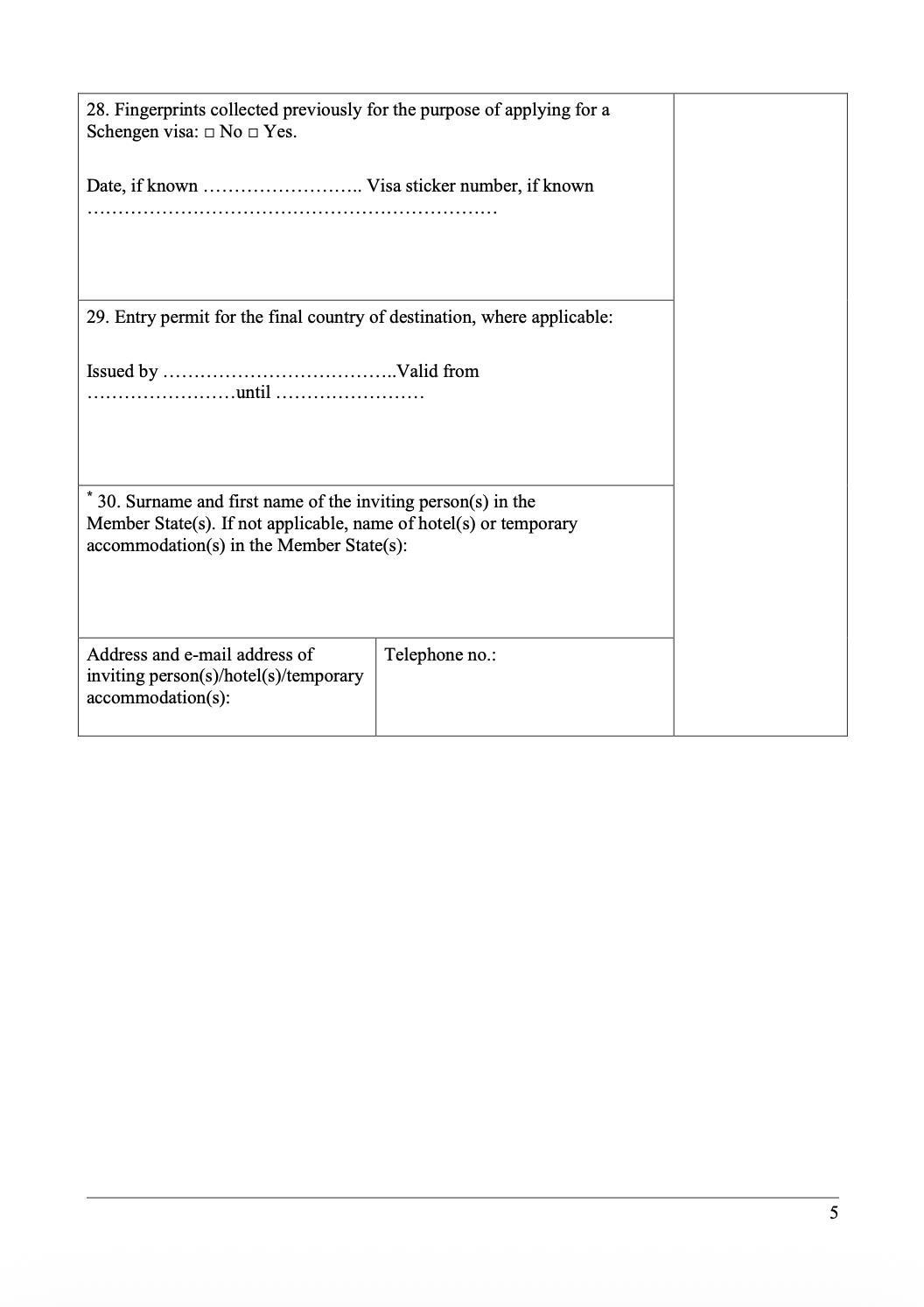
Select “Yes” if fingerprints were previously collected for a Schengen visa application, and provide the date and previous visa number if known. Select “No” only if they have not been collected. Do not answer “No” simply because the former collection occurred several years ago.
Fingerprints entered in the Visa Information System less than 59 months before a subsequent application can ordinarily be copied, although the authority may require a fresh collection when identity is uncertain or the previous record cannot be confirmed. Children under 12 and persons for whom fingerprinting is physically impossible are among the exempt categories. An appointment centre may still require personal attendance for reasons unrelated to fingerprint reuse.
Field 29: Entry Permit for the Final Country of Destination
This field applies when the Schengen area is an intermediate stage before a country for which the applicant needs an entry permit. Provide the issuing authority and validity of that visa or residence authorisation. For an ordinary holiday ending with a return to the applicant’s country of residence, the field is normally not applicable.
Example: a traveller enters France, later departs for the United Kingdom and requires a UK visa. The valid UK permission may belong in field 29. Do not enter the Schengen visa being requested as the “final-country permit.”
Field 30: Inviting Person, Hotel or Temporary Accommodation
For a family or friend visit, enter the inviting person’s full name. For tourism without a private host, enter the hotel or temporary accommodation. Add the address, email and telephone number requested by the form.
Where several hotels are involved, use the main or first accommodation as permitted by the form and attach a complete accommodation schedule. Do not compress multiple unrelated properties into unreadable text. Every night should be reasonably accounted for, including overnight trains or other exceptional arrangements explained in the itinerary.
The data must reproduce genuine reservation records. A hotel name with incorrect dates, a property in a city absent from the route, or an invitation address inconsistent with the host’s evidence will weaken the file.
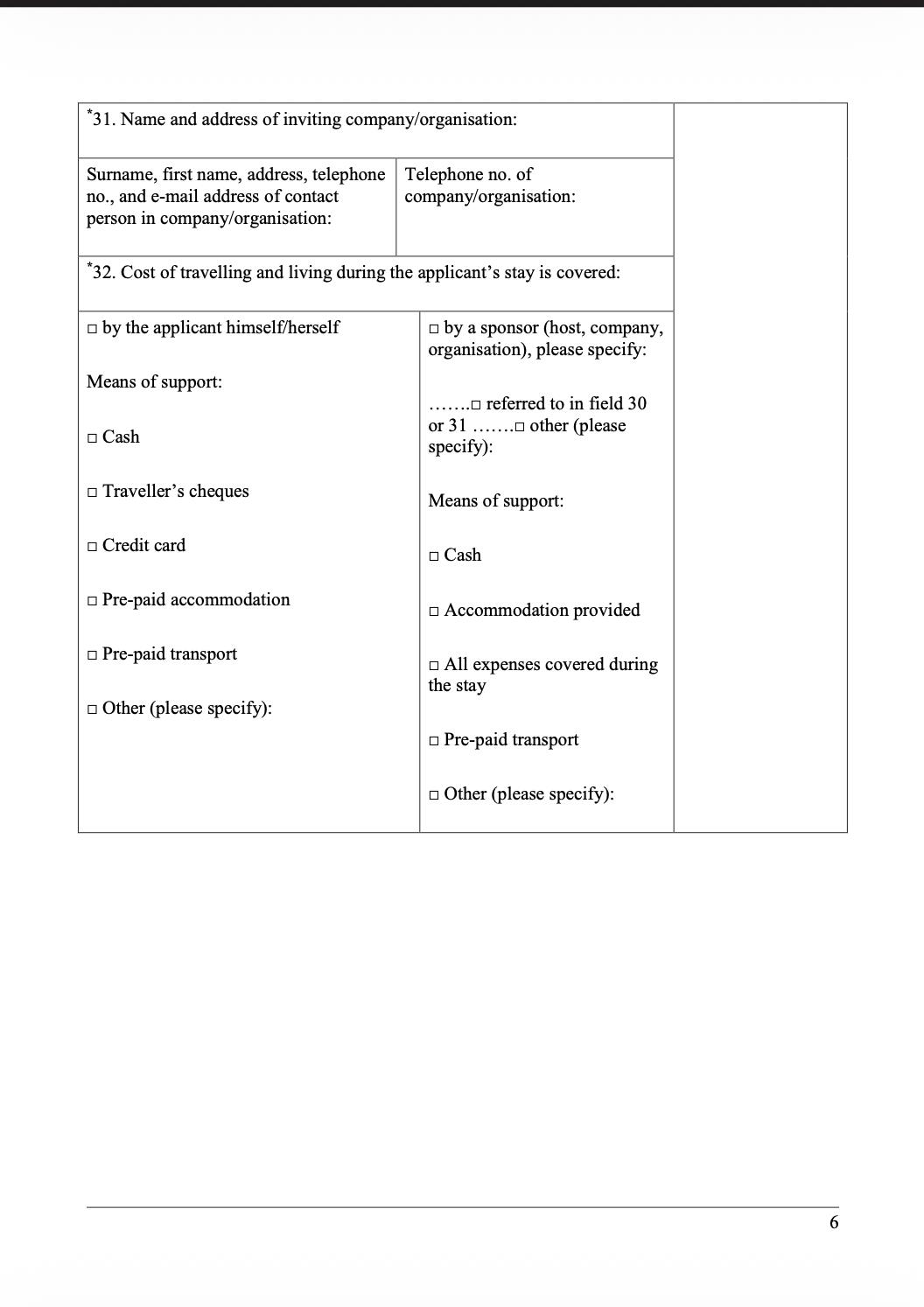
Field 31: Inviting Company or Organisation
Business, conference, cultural, sporting and official applicants should provide the organisation’s name and address and the contact person’s surname, given name, address, telephone number and email, plus the organisation’s telephone number.
Tourists with no inviting company normally treat this field as inapplicable. Do not place a travel agency here merely because it arranged a reservation unless it is genuinely the inviting organisation connected to the stated purpose.
Field 32: Who Pays for Travel and Living Costs?
Indicate whether expenses are covered by the applicant or by a sponsor, then select the actual means of support. Applicant-funded options include cash, travellers’ cheques, credit card, prepaid accommodation, prepaid transport or another stated means. Sponsor-funded options include accommodation provided, all expenses covered, prepaid transport or another arrangement.
This field must be read together with the bank statements, sponsorship undertaking, invitation and booking status. Select “prepaid” only when payment has truly been made. A reservation held without full payment is not prepaid transport. If the applicant pays for flights while a host provides accommodation, record the mixed arrangement accurately rather than forcing it into a single category.
There is no universal bank balance that guarantees a Schengen visa. Member states apply reference amounts and assess sufficiency against trip length, accommodation, prepaid expenses, income and personal circumstances. Sudden unexplained deposits should be documented rather than presented as self-evident savings.
Field 33: Person Completing the Form, If Different from the Applicant
Enter the name and contact details of the person who filled in the form when that person is different from the applicant, for example, a parent, legal guardian or authorised assistant. If the applicant completed the form personally, follow the form or portal instruction for leaving this field blank or marking it inapplicable.
Assistance does not transfer responsibility. The applicant signs the declaration and remains accountable for the accuracy of the answers. An agent’s error does not become harmless because the agent typed it.
Declarations, Place, Date and Signature
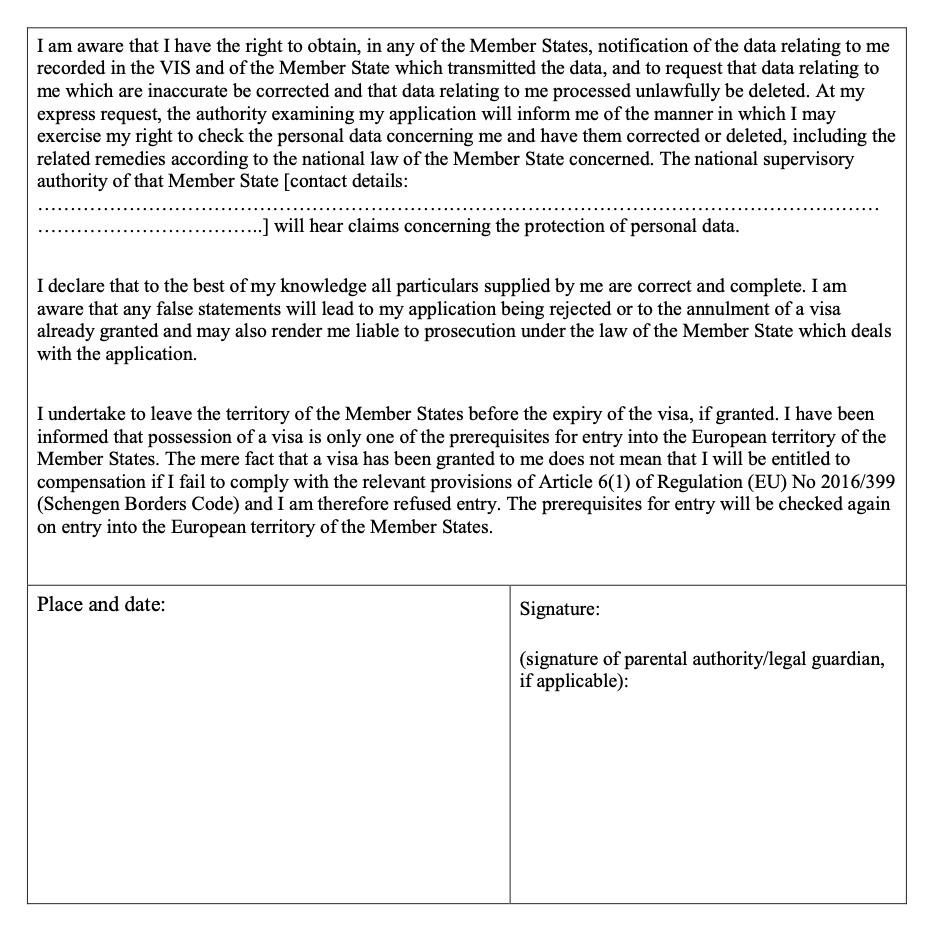
Read the declarations rather than treating them as decorative legal text. They address the non-refundability of the fee following refusal, medical-insurance obligations for future visits under a multiple-entry visa, processing of personal and biometric data, the consequences of false statements, and the obligation to leave before authorised stay expires.
Enter the place and actual date of signature. Sign wherever the mission’s version requires; some printed workflows contain more than one signature location. An adult normally signs personally. A minor’s form is signed by the person exercising parental authority or legal guardianship in accordance with the local instructions. Each family member, including each child, needs a separate form.
Before signing, compare the final printout with the portal data. Truncated hotel names, swapped dates and omitted middle names sometimes appear only after PDF generation.
The Form-to-Document Consistency Audit
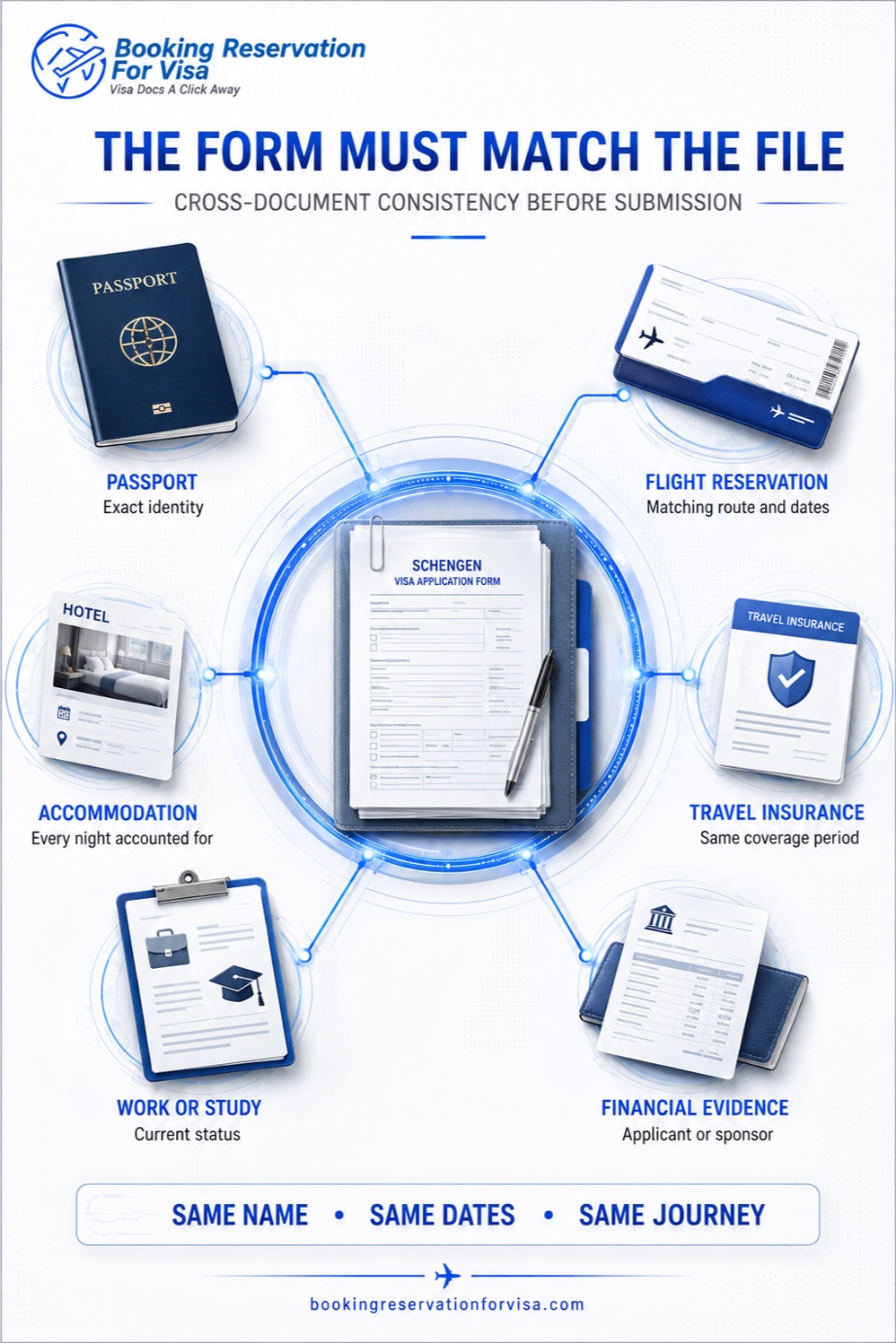
The most reliable way to review a Schengen visa form is not line by line in isolation, but answer by answer against its evidentiary counterpart.
| Form information | Compare it with | Final control question |
| Fields 1–16: identity and passport | Passport, national ID, residence permit and previous visas | Are spelling, dates, document number and nationality exact? |
| Fields 19–22: residence and occupation | Residence card, employer letter, enrolment evidence, business documents and bank records | Does the stated life situation exist and remain current? |
| Fields 23–24: purpose | Invitation, event registration, leave letter, course confirmation or tourism plan | Does the evidence prove the purpose selected? |
| Fields 25–27: destination, entry and dates | Flight reservation, route, hotels, insurance and cover letter | Is one continuous chronology visible across every document? |
| Fields 30–31: host, hotel or organisation | Accommodation confirmation and invitation | Are names, addresses, contact details and stay dates identical? |
| Field 32: cost coverage | Bank statements, sponsorship proof and payment confirmations | Is the declared payer actually capable of meeting the stated costs? |
| Signature and declarations | Passport signature, guardian documents and appointment requirements | Has the correct person signed every required location? |
This audit is particularly important after changing travel dates. Amending only the flight reservation while leaving the form, insurance and hotels untouched creates a fragmented application.
General Documents Required for a Schengen Visa in 2026
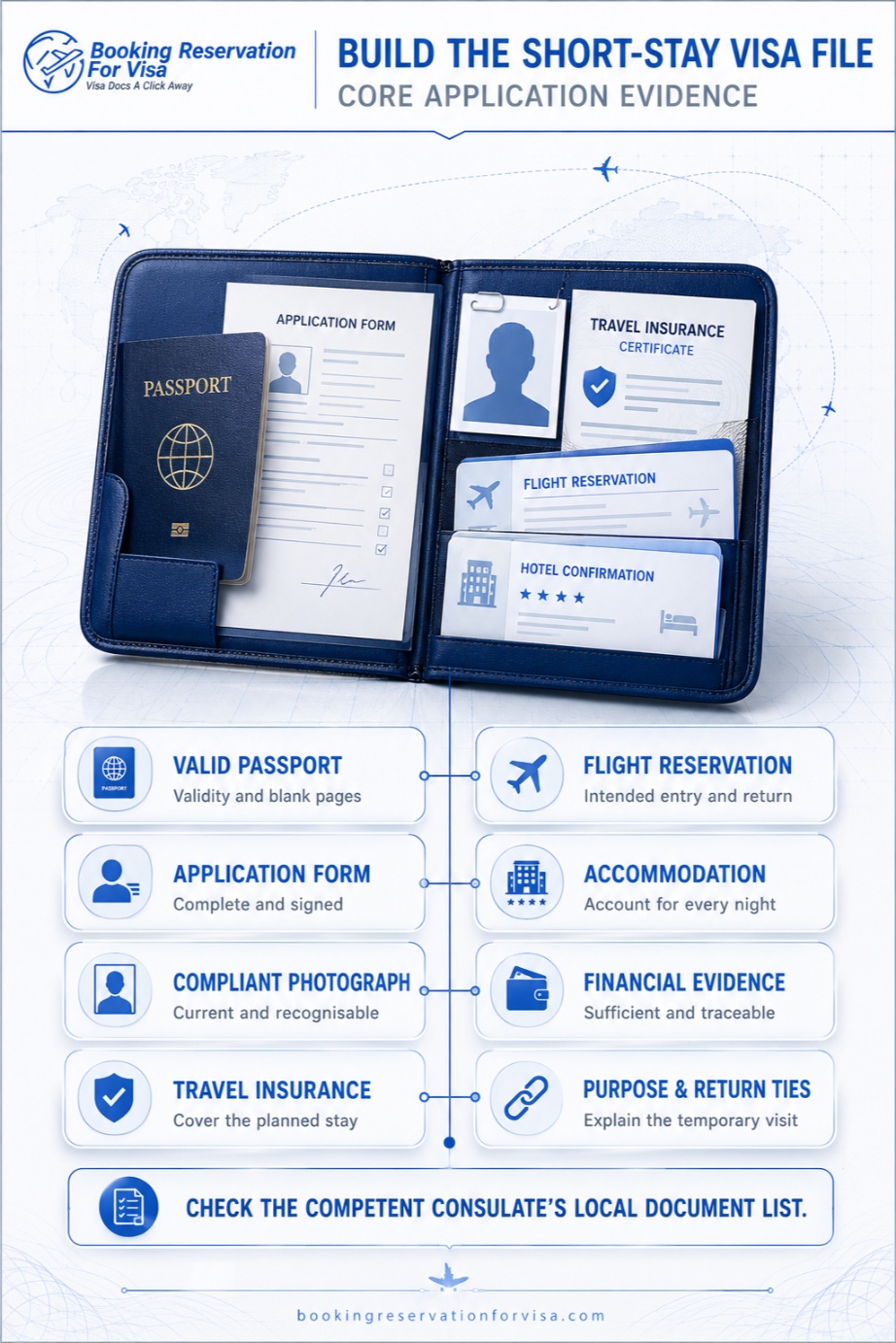
The exact checklist depends on the competent state, purpose, nationality and country of residence. Nevertheless, the following categories form the usual evidentiary architecture.
Valid Passport and Copies
The passport should ordinarily remain valid for at least three months after the planned departure from Schengen, contain at least two blank pages and have been issued within the previous ten years. The mission may request copies of the biographical page, previous visas, entry and exit stamps and earlier passports.
Completed Form and Compliant Photograph
Submit the official form with all required signatures and a recent photograph conforming to the announced ICAO and mission specifications. Do not digitally retouch facial features or reuse a visibly outdated photograph.
Travel Medical Insurance
For a uniform visa, insurance must cover the entire intended stay throughout the Schengen territory, including urgent medical attention, emergency hospital treatment, medical repatriation and death-related repatriation. The Visa Code sets minimum coverage at EUR 30,000. For a multiple-entry application, proof is normally required for the first intended visit, alongside the declaration acknowledging insurance obligations for subsequent trips.
Proof of Transport and Accommodation
The checklist may request a round-trip flight reservation, travel itinerary, rail or other transport bookings, hotel reservations, a host invitation or an official private-accommodation form. Follow the mission’s terminology. A proposed booking should display the applicant’s correct name, logical route and dates consistent with the form.

Applicants should not equate a reservation with a guaranteed visa or misrepresent a fabricated document as a genuine booking. Where a checklist asks for a reservation rather than a purchased ticket, a coherent booking can evidence the proposed journey without the financial exposure of a non-refundable fare. Booking Reservation for Visa can assist with flight and hotel reservation documents based on the applicant’s declared itinerary; the applicant must still verify every detail and comply with the competent mission’s checklist.

Evidence of Purpose
Tourists may provide a realistic itinerary. Private visitors may need an invitation, host identity and relationship evidence. Business applicants commonly submit company invitations, employer letters and event details. Students provide enrolment or course confirmation. Medical applicants need confirmation from the treating institution and evidence addressing costs. Purpose documents should explain why the journey is occurring, not merely where the applicant will sleep.
Financial Means and Sponsorship
Typical evidence includes recent bank statements, payslips, employment confirmation, tax or business records, pension evidence and, where applicable, sponsorship documentation. The required level varies by state and circumstances. Funds should be traceable and proportionate to the declared income and trip.
Evidence of Residence and Intention to Return
Consulates may examine residence authorisation, employment or education commitments, approved leave, family circumstances, property, business obligations and lawful immigration history. No single document proves return intention conclusively; the file should demonstrate a credible life to resume after the temporary visit.
Biometrics and Additional Category Documents
Fingerprints and a photograph are generally collected subject to exemptions and permitted reuse. Minors may require birth and consent documents. Non-citizen residents need proof of lawful residence. Certain nationalities or travel-document holders may be subject to consultation, additional processing or specific documentary lists. The mission can request further evidence even after an application is accepted.
How the Guide Applies to Every Schengen State and Applicants from Every Country
The common form makes the core instructions transferable across Austria, Belgium, Bulgaria, Croatia, Czechia, Denmark, Estonia, Finland, France, Germany, Greece, Hungary, Iceland, Italy, Latvia, Liechtenstein, Lithuania, Luxembourg, Malta, the Netherlands, Norway, Poland, Portugal, Romania, Slovakia, Slovenia, Spain, Sweden and Switzerland.
“Common” does not mean “identical in every operational detail.” Five variables must be checked locally:
- Submission channel: embassy, consulate, national portal, represented mission or authorised external provider.
- Accepted language: the form is available in prescribed official and host-country languages, while the mission states which language may be used to complete it.
- Local supporting list: consulates coordinate locally because employment, banking, civil-status and residence records differ between countries.
- National host or sponsorship forms: a state may require its own formal proof of private accommodation or sponsorship in addition to field 30 or 32.
- Translation and legalisation: rules depend on document type, issuing country and mission instructions.
An applicant should therefore use this sequence from any country:
nationality and residence status → genuine itinerary → competent Schengen state → responsible mission in the country of legal residence → official portal/form → local checklist → appointment.
Do not reverse the sequence by choosing an appointment centre first and designing a trip to fit it afterward.
Common Schengen Visa Form Mistakes to Avoid
- Using an obsolete form: download a fresh copy from the official application route.
- Applying to the wrong state: first entry is not automatically the competent state when another country is the main destination.
- Writing preferred names: fields 1–3 must follow the passport.
- Confusing nationality with residence: disclose the legal residence permit when applying outside the country of nationality.
- Selecting an artificial purpose: the checked box must be substantiated by the dominant evidence.
- Requesting multiple entry without explaining why: a speculative request is not a travel plan.
- Calling an unpaid booking “prepaid”: field 32 should reflect the actual payment status.
- Leaving itinerary gaps: flights, hotels and dates should create one comprehensible route.
- Using inconsistent contact details: host, hotel, employer and applicant information should match the source documents.
- Concealing previous fingerprints or nationalities: uncertainty should be explained, not converted into an inaccurate answer.
- Allowing an agent to sign for an adult applicant: assistance with typing does not ordinarily authorise substitution of the applicant’s signature.
- Changing dates after printing: every affected reservation and supporting document must be synchronised before submission.
Submission Timing, Fees and Processing in 2026
According to the European Commission’s current application guidance, an application should ordinarily be lodged no earlier than six months before the intended visit and at least 15 days before departure. Seafarers performing their duties may lodge up to nine months in advance under the Visa Code. Early preparation is prudent because appointment availability is not the same as legal processing time.
The standard visa fee is EUR 90 for adults and EUR 45 for children aged six to under 12, with exemptions, facilitation-agreement rates and nationality-specific measures applying in defined circumstances. An authorised application centre may charge a separate service fee.
The normal decision period is 15 calendar days from the lodging of an admissible application and can be extended to 45 calendar days when further scrutiny is required. A submission receipt is not a promise that the passport will be returned before a particular flight, so avoid a non-refundable purchase unless the relevant authority specifically requires it.
Frequently Asked Questions About Filling the Schengen Visa Application Form
Is one application form valid for all Schengen countries in 2026?
The substantive 33-field form is harmonised across all 29 Schengen states. However, applicants must use the version or online workflow supplied by the competent state’s official mission and comply with its local checklist.
Can I fill the Schengen visa form by hand?
Manual completion is legally contemplated, but a particular mission may require its national online portal. If handwriting is accepted, write legibly and consistently in the permitted language, without correction fluid or ambiguous alterations.
What should I write when a field does not apply?
Use “Not applicable,” select “No,” or leave it blank only as directed by the official form or portal. Never enter a false hotel, employer, sponsor or identity number to bypass a mandatory field.
Do I need a separate form for each family member?
Yes. Every traveller, including a child included in a parent’s travel document, requires a separate application. The appropriate parent or legal guardian signs for the minor according to the mission’s rules.
Should I tick “multiple entries” for a multi-country Schengen holiday?
Not necessarily. Movement between Schengen states does not itself constitute a new entry. One continuous trip through France, Belgium and the Netherlands can require only a single entry if the traveller never exits the Schengen area.
Must I buy a fully paid flight ticket before applying?
Follow the competent mission’s checklist. The Visa Code’s non-exhaustive supporting-document list recognises a reservation of a return or round ticket as possible evidence of intention to leave. Do not describe an unpaid reservation as a purchased ticket, and never submit a fabricated itinerary.
What happens if my hotel or flight changes after I complete the form?
Update the affected form fields and every connected document before submission. If a material change occurs after lodging, contact the mission or application centre for instructions rather than silently allowing the file to become inconsistent.
Final 2026 Checklist Before You Submit
Confirm that:
- the official current form has been used;
- the competent state and filing jurisdiction are correct;
- fields 1–16 reproduce the passport and identity documents;
- the purpose, main destination and first-entry answers reflect the real trip;
- first-stay dates match flights, accommodation and insurance;
- host, hotel, employer and sponsor contact details are verifiable;
- the payer selected in field 32 matches the financial evidence;
- previous fingerprints, residence status and other nationalities are disclosed accurately;
- every adult and minor has a separate form;
- all required declarations and signature locations are completed; and
- the complete application has been reviewed after printing.
Conclusion
The strongest Schengen visa application form is not the one containing the most elaborate prose. It is the one in which every field is exact, every omission is defensible and every answer is corroborated elsewhere in the file. The harmonised form creates a common procedure for all 29 Schengen states, but applicants must still respect the competent mission’s country-specific submission route and documentary checklist.
Fill the form from verified source documents, decide jurisdiction before booking an appointment, and audit the completed application as one integrated travel narrative. That discipline cannot guarantee approval, but it can eliminate the preventable discrepancies that make an otherwise credible short-stay application difficult to assess.