A visa application often asks the traveller to demonstrate an intended journey before permission to make that journey has been granted. Must the applicant purchase a fully paid airline ticket, or will an embassy accept a flight reservation, booking confirmation or proposed itinerary?
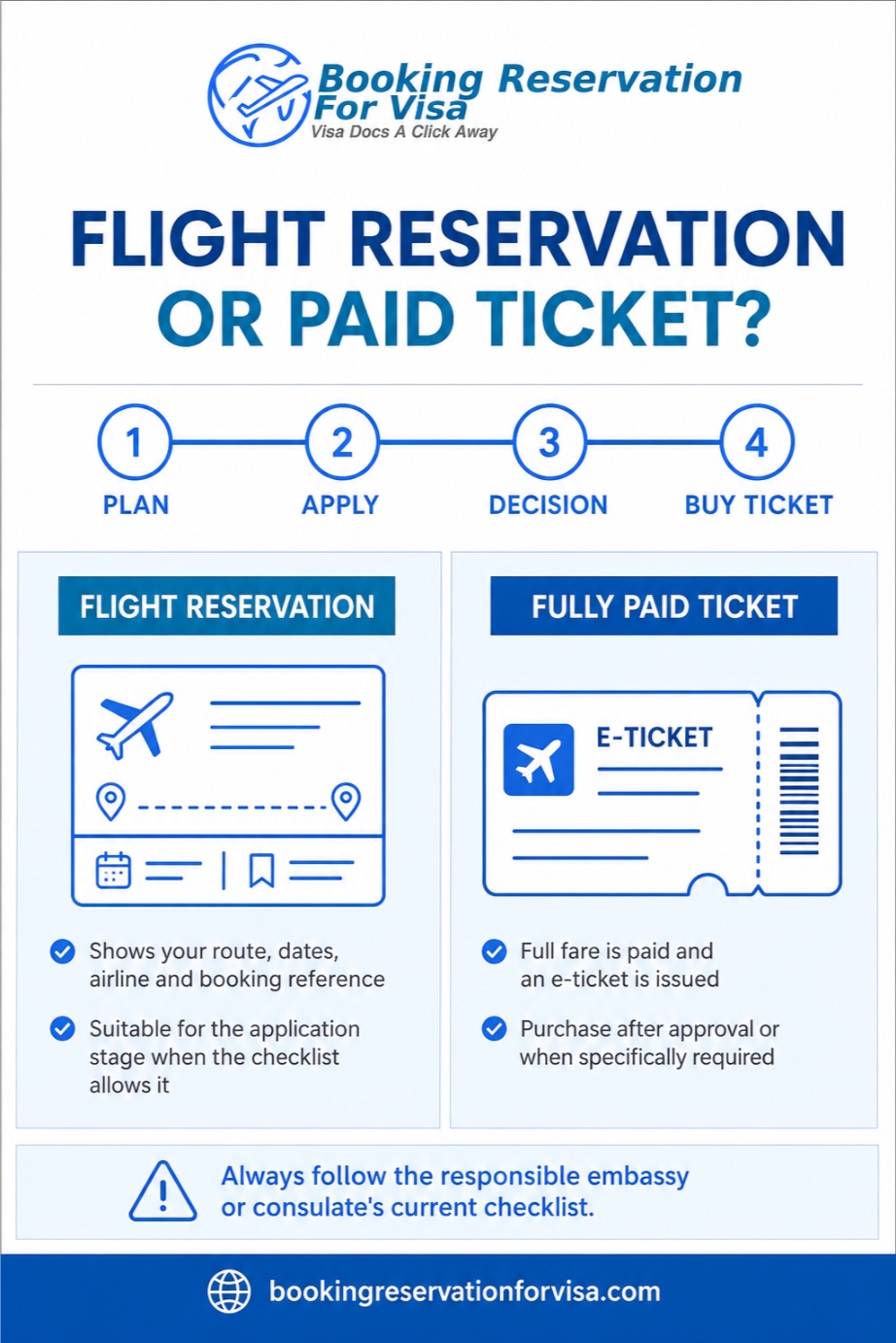
For many short-stay applications, the authoritative answer is reassuring. Numerous Schengen diplomatic missions expressly request a flight reservation and several explicitly advise applicants not to buy the ticket before visa approval. The United States Department of State likewise warns visitor-visa applicants not to make final travel plans or buy tickets until a visa has been issued. Immigration, Refugees and Citizenship Canada lists flight details among the documents that can establish a visitor’s itinerary, without imposing a universal requirement for a ticket already paid in full.
That answer, however, needs qualification. “Accepted” does not mean “guaranteed to secure approval.” A reservation is one component of a larger evidential record. It must correspond with the application form, accommodation, insurance, invitation, leave approval, financial capacity and declared purpose of travel. A consulate can also request an issued ticket later, apply a jurisdiction-specific checklist or ask for supplementary evidence. The governing instruction is always the current checklist of the embassy, consulate or authorised visa centre handling the individual application.
The Short Answer: Do Embassies Accept Flight Reservations as Proof of Travel?
Yes. Many embassies and consulates accept a genuine flight reservation or travel itinerary at the application stage instead of demanding a fully paid flight ticket. The clearest examples include official guidance published for Austria, Belgium, Bulgaria, Croatia, Czechia, Denmark, Germany, Greece, Iceland, Italy, the Netherlands, Norway, Poland, Portugal, Slovakia, Slovenia, Spain and Switzerland. Each authority is examined below with a direct official source.
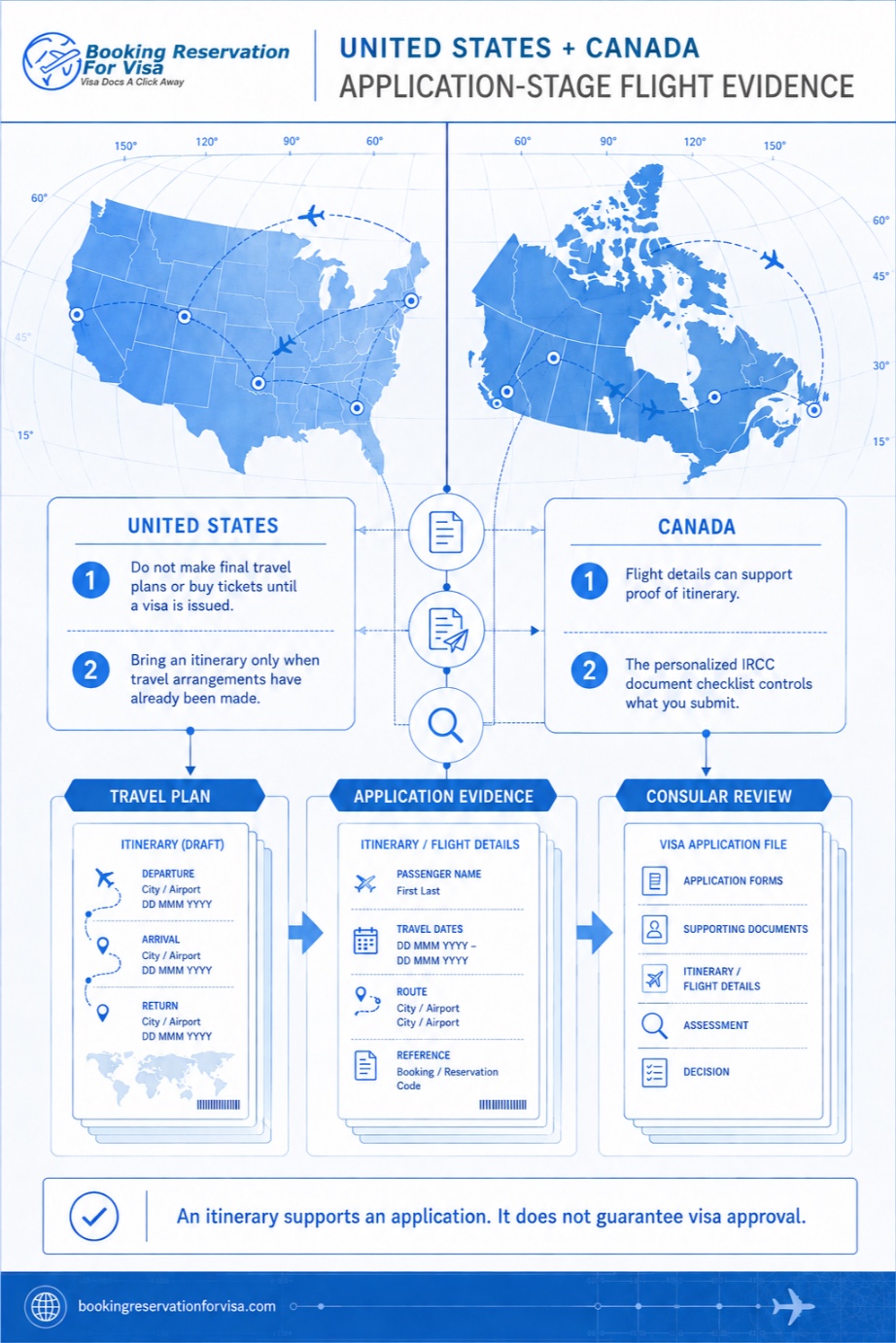
For a Schengen visa, a return or round-trip reservation commonly helps establish the proposed dates, route, principal destination and intention to leave the Schengen area. For a United States visitor visa, a purchased ticket is not a standard prerequisite; the Department of State expressly cautions against buying tickets before issuance. For a Canadian visitor visa, IRCC treats flight details as possible itinerary evidence, while the applicant’s personalised portal checklist remains controlling.
The accurate conclusion is not that “embassies approve dummy tickets,” but that a number of visa authorities permit a reservation or itinerary to evidence intended travel before final ticket purchase, subject to the responsible post’s current instructions.
Flight Reservation, Flight Itinerary and Paid Ticket: The Material Difference
Visa terminology is not perfectly standardised. One mission may ask for a “flight reservation,” another for a “round-trip booking,” and another for “proof of travel arrangements.” Applicants sometimes use “dummy ticket” as an informal umbrella term, although official authorities generally prefer reservation or itinerary. The underlying documents are not always interchangeable.
| Document | What it normally represents | Typical identifiers | Suitable visa use |
| Flight reservation or booking confirmation | A proposed journey held or recorded in a reservation system without necessarily being fully ticketed | Passenger name, airline, route, dates, flight numbers and often a PNR or booking reference | Commonly accepted where the checklist asks for a reservation, booking or itinerary |
| Flight itinerary | An organised statement of intended flight sectors; it may be linked to a reservation or may simply describe planned travel | Route, dates, airports, flight numbers and passenger details; a reference may or may not appear | Appropriate when the authority asks for an itinerary or flight details; verify whether a live booking is required |
| Issued airline ticket | A completed ticketing transaction that authorises travel subject to airline conditions | E-ticket number, fare, taxes, ticket status and booking reference | Required only when the post expressly asks for a paid or issued ticket, or requests one after approval |
| Fare quotation or search screenshot | A price or schedule captured from a booking engine, with no passenger-specific reservation | Indicative fare and schedule, usually without passenger name or PNR | Usually too weak where a confirmed reservation is requested |
| Fabricated or altered document | A manually invented confirmation that has no genuine underlying record | False PNR, copied logo, altered dates or unverifiable data | Never appropriate; it can create a misrepresentation or fraud concern |
A reservation is not simply a ticket with the price removed. A Passenger Name Record or booking reference links passenger and itinerary data in a reservation environment; an e-ticket number normally evidences completed ticketing. Some posts ask for a booking reference, but no universal rule prescribes one code format for every visa itinerary.
Why Embassies Ask for a Flight Reservation Before a Visa Decision
Travel evidence is analytical rather than ceremonial: it permits several parts of the proposed visit to be assessed together.
It Defines the Intended Period of Stay
Arrival and departure sectors define the proposed visit. They can be compared with the requested validity, days entered on the form, accommodation and insurance. A return reservation does not prove departure, but it supplies a concrete statement of intention.
It Helps Establish the Competent Schengen Consulate
The European Commission says a multi-country applicant should ordinarily apply to the country of the longest stay; where stays are equal, the application goes to the country of first entry. A multi-city itinerary can therefore show whether the correct authority has been selected. Read the official European Commission guidance on where to apply before constructing the route.
First entry is not automatically the main destination. A traveller can land in Amsterdam and legitimately apply to Spain if Spain is the principal destination by duration or purpose. The difficulty arises when the flight reservation, hotel bookings and cover letter tell three incompatible stories.
It Makes the Journey Economically and Logistically Intelligible
A credible route should be feasible in time, distance and cost. Arrival after the stated hotel check-in, an implausible connection or departure from an unexplained city can undermine an otherwise orderly file.
It Connects the Travel Plan to Financial Evidence
Airfare forms part of the anticipated expense. A route involving several travellers, premium sectors or internal flights should remain proportionate to the financial and sponsorship evidence. The reservation does not itself prove sufficient funds.
It Avoids Forcing Applicants Into Premature Financial Risk
Visa issuance is discretionary and travel dates may change. Several authorities therefore distinguish a reservation from a purchased ticket and caution against early payment.
The Schengen Legal Framework: Reservation Is a Recognised Form of Evidence
Schengen visa practice begins with a common legal framework, although document lists are harmonised locally and individual consulates retain authority to request additional evidence. Annex II of the consolidated EU Visa Code contains a non-exhaustive list of supporting documents that may be requested. Under documentation used to assess an applicant’s intention to leave, it includes a reservation of, or a return or round ticket. The current text is available on EUR-Lex, Regulation (EC) No 810/2009.
The significance of this wording is frequently misunderstood. It demonstrates that a reservation is a recognised evidential form; it does not create an entitlement to submit any informal page and demand acceptance. Nor does it prevent a consulate from requesting an issued ticket in a particular case. Annex II is expressly non-exhaustive, and local supporting-document decisions may impose more specific requirements based on the applicant’s residence, purpose and diplomatic post.
The European Commission also directs applicants to consult the embassy or consulate of the main destination. As of the source review for this article, the Schengen area comprises 29 states and the normal short-stay processing period is 15 days, extendable to 45 days where closer examination or additional documents are necessary. A reservation hold can expire before that process ends; the legal framework does not promise that an airline will preserve an unpaid seat throughout visa adjudication.
Which Schengen Embassies and Consulates Officially Accept a Flight Reservation?
The following directory is intentionally conservative. It includes only Schengen authorities for which an official source expressly mentions a reservation, an itinerary, an unpurchased ticket or a choice between ticket and reservation. Several sources are local mission checklists rather than universal national rules. Their inclusion proves what the named authority publishes for that jurisdiction; applicants elsewhere must still open the checklist for their own place of residence.
| Schengen authority with explicit official guidance | What the published instruction permits | Practical implication | Official source |
| Austria | A flight reservation is listed as a tourist-visa requirement | Submit passenger-specific reserved travel, not merely a fare search | Austrian Embassy Kuala Lumpur tourist checklist |
| Belgium | A flight reservation or itinerary may be filed instead of a paid return ticket at the application stage | The cited Hong Kong post may request a paid return ticket when the visa is collected, so follow that post’s later instructions | Belgian Consulate General Hong Kong and Macao FAQ |
| Bulgaria | A round-trip flight reservation is listed for the relevant short-stay purpose | Reservation language is explicit; the remaining purpose-specific evidence is still required | Bulgarian Ministry of Foreign Affairs mission guidance |
| Croatia | A copy of the flight ticket or flight reservation, including the return journey | Either form may satisfy the travel-arrangement line in the cited guidance | Croatian Ministry of Foreign and European Affairs |
| Czechia | A return or round-trip flight reservation; official guidance says the ticket should be bought after visa issuance | The reserved route should show travel and return clearly | Czech Consulate General Shanghai application guidance |
| Denmark | A return flight reservation; the Danish mission recommends not buying the ticket before approval | This is one of the clearest reservation-not-purchase policies | Embassy of Denmark in Pakistan document checklist |
| Germany | Only a flight reservation is necessary in the cited checklist; buying flights before the passport is returned is discouraged | A paid ticket does not create preferential processing | German missions in Japan business-trip guidance |
| Greece | A copy of a flight ticket or flight reservation, including the return flight | The official wording recognises either document | Greek Ministry of Foreign Affairs tourism guidance |
| Iceland | A reservation for a return or round-trip flight and intra-Schengen transport where relevant | Multi-state journeys should include the connecting transport evidence requested | Iceland tourist visa application checklist |
| Italy | An application may include only a flight reservation; the consulate reserves the right to request a ticket before issuance | Early purchase does not ensure approval, and a later ticket request must be obeyed | Italian Economic, Trade and Cultural Promotion Office in Taipei |
| Netherlands | A reservation in the applicant’s name or another document showing travel plans; a paid ticket is unnecessary | The official tourism checklist draws an unambiguous distinction between reservation and paid travel | NetherlandsWorldwide tourism checklist |
| Norway | A flight reservation; the cited checklist says not to buy the ticket until the visa is granted | Use the current checklist for the Norwegian post serving the applicant’s residence | Norway business visa checklist for the UAE |
| Poland | A reservation carrying a passenger reservation number; the embassy advises against paying before approval | Dates in the reservation can influence the issued visa dates, so accuracy is consequential | Embassy of Poland in Iran C-type visa guidance |
| Portugal | A round-trip flight reservation is listed in official consular visa guidance | A reservation can document international and relevant internal sectors | Consulate General of Portugal in Newark |
| Slovakia | A flight reservation, expressly described as not being purchased tickets | The distinction appears directly in the embassy’s published instructions | Embassy of Slovakia in Baku |
| Slovenia | A flight reservation is specified in the applicable supporting-document checklist | The reservation must be read with the rest of the purpose-specific checklist | Embassy of Slovenia in Manila visit checklist |
| Spain | A flight reservation is requested and the cited embassy page tells applicants not to buy tickets until the visa is granted | Provide the reservation at filing and purchase only when the post’s instruction permits | Embassy of Spain in Nicosia Schengen guidance |
| Switzerland | A confirmed round-trip reservation; the official checklist cautions against buying the ticket before issuance | Passenger name should correspond exactly with the passport | Swiss business-visa checklist |
Why Are Some Schengen Countries Not Named in This Directory?
Omission is not a declaration that an embassy demands a fully paid ticket. France, Finland, Sweden and the other Schengen states operate within the common visa framework, and local harmonised lists frequently refer to transport bookings or travel plans.
Representation arrangements further complicate blanket country lists. One Schengen state may receive applications on behalf of another in a particular jurisdiction; an external service provider may collect documents without deciding the case; and the same country may publish different checklists for tourism, family visits, business, study, medical travel and airport transit. The correct question is not simply “What does Country X accept?” but “What does the competent post accepting my visa category in my country of legal residence currently require?”
The Most Explicit “Do Not Buy Yet” Schengen Policies
The Netherlands says directly that a paid travel ticket is unnecessary. Denmark, Norway, Spain and Switzerland discourage purchase before approval or issuance. German guidance says only a reservation is necessary and a booked ticket does not accelerate processing; Poland advises against early payment. These policies dismantle the misconception that an expensive non-refundable ticket makes an application more credible.
Policies That Permit a Reservation but May Later Require a Ticket
Belgium and Italy illustrate why applicants must read beyond a headline. The Belgian post cited above accepts an itinerary at submission but may require a paid return ticket at collection; Italy’s Taipei office may request a ticket before issuance. Applicants should monitor official messages and comply with any verified later request rather than assuming the initial reservation concludes the matter.
Does the United States Embassy Accept a Flight Reservation Instead of a Paid Ticket?
The United States should not be described as if it followed the Schengen document checklist. A B-1/B-2 visitor-visa application is assessed under a different legal and procedural system. A flight reservation is not a universal mandatory document for the interview, and purchasing a ticket does not establish eligibility.
The official US Department of State visitor-visa page identifies the core application documents and explains that additional evidence may be requested concerning the purpose of the trip, the intention to depart and the ability to meet trip costs. Crucially, it warns applicants not to make final travel plans or buy tickets until they have a visa. The DS-160 frequently asked questions tell applicants to have a travel itinerary available if travel arrangements have already been made.
The word “if” matters. It does not command a flight purchase for the DS-160. Applicants should enter truthful proposed dates and take any itinerary requested by their specific US post, without pretending the Department of State has made a reservation universally mandatory.
For a US visitor visa, the officer is principally concerned with a credible temporary purpose, funding and intended departure. A reservation can clarify logistics; it cannot cure weak ties, contradictory answers or an impermissible purpose.
Does the Canadian Embassy Accept a Flight Itinerary Without a Fully Paid Ticket?
Canada also uses a distinct process. IRCC’s official visitor-visa guidance treats an itinerary as documentation showing how long the applicant plans to stay and what the applicant will do in Canada. It lists flight details, proof of accommodation and event registration as examples. The source is the current IRCC page on applying for a visitor visa.
This supports flight information or an itinerary without imposing a general requirement to buy non-refundable airfare. A regional checklist may be more specific, particularly for transit where onward travel is intrinsic to the purpose.
Applicants must follow the personalised IRCC Portal checklist. Flight evidence remains one item among travel history, finances, employment, purpose and proof of departure; pre-booked travel neither guarantees issuance nor compels expedited processing.
In summary, Schengen rules recognise reservation evidence but local checklists control; the United States treats an itinerary as supplementary and warns against early ticket purchase; and Canada lists flight details as itinerary evidence while relying on the applicant’s personalised checklist.
What an Embassy Acceptable Flight Reservation Should Contain
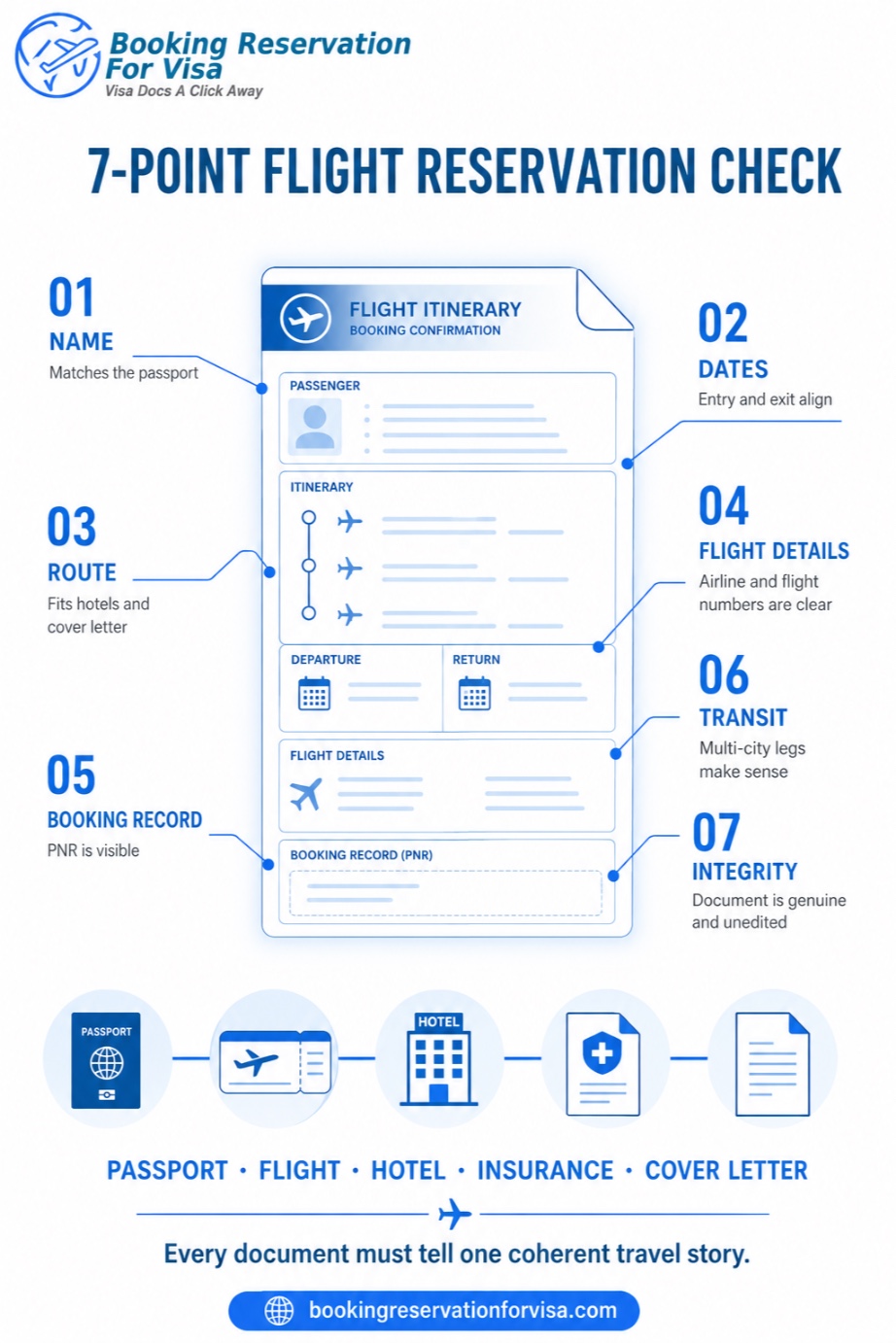
A persuasive reservation is legible, passenger-specific and congruent with the entire visa file. Although checklists differ, the following information normally makes the proposed journey intelligible:
- The traveller’s full name written as it appears in the passport.
- Airline name and, where applicable, operating carrier.
- Departure and arrival airports, preferably with airport codes and city names.
- Proposed departure and arrival dates.
- Flight numbers for each relevant sector.
- Clearly ordered connections and transit points.
- Return or onward sector for a short temporary visit.
- Booking reference or PNR where the issuing system provides one.
- Reservation status or issuance details sufficient to identify the record.
- Travel-agent or provider contact information where applicable.
Not every authority demands every field, and applicants should not add invented information to imitate a ticket. A genuine reservation without an e-ticket number is more defensible than a manipulated PDF containing a fictitious ticket number. The required standard is documentary integrity, not decorative complexity.
Exact Passport Name
Name discrepancies are disproportionately damaging because they cast doubt on whether the reservation belongs to the applicant. Surname, given names and order should be entered according to the passport and the carrier’s accepted format. Where an airline system omits spaces or combines names, the applicant should retain the original confirmation rather than manually “correcting” it in an editor.
Entry and Exit Dates That Match Every Other Document
The outbound date should align with the application form, cover letter, insurance start date and first accommodation. The return date should align with the final hotel night, insurance end date and requested duration. If an overnight flight arrives the next calendar day, hotel and insurance dates should reflect the actual arrival not merely the departure date printed at the origin.
A Route That Supports the Main Destination
For a multi-country Schengen journey, the route should disclose rather than obscure the trip. It may include the international arrival, travel between Schengen states and final departure. If the applicant is flying into one country but spending most of the visit in another, hotel bookings and the day-by-day itinerary should make the main destination unmistakable.
A Plausible Return or Onward Journey
Round-trip evidence is normally the most comprehensible format for tourism, business visits and family visits because it closes the proposed period abroad. One-way reservations can be appropriate for certain long-stay, study, work, immigration or relocation processes, but they should not be used reflexively for a short-stay application that asks how and when the applicant will leave.
Reservation Validity: Must the Booking Remain Live Throughout Processing?
There is no single worldwide rule prescribing how many days every flight reservation must remain active. Airline holds and unticketed bookings are governed by fare rules, carrier systems, inventory and ticketing deadlines. Some lapse rapidly; others remain visible longer. Meanwhile, a normal Schengen decision may take 15 days and can take longer. Those two clocks do not necessarily coincide.
The applicant should obtain the reservation near enough to submission that it is current when filed, verify it using the method supplied and preserve the original document. If the booking expires during processing, that fact does not automatically mean the application fails. The consulate may already have assessed the itinerary as a statement of intended travel. Nevertheless, if the authority requests an updated reservation, the applicant should respond promptly with the same route and dates unless a change is explained.
Applicants should be wary of categorical promises such as “this reservation can never expire” or “the embassy must be able to verify the PNR for the entire decision period.” Those claims disregard airline ticketing deadlines and local consular practice. A more responsible service standard is transparent validity, monitoring where offered, and correction or rebooking support when the underlying itinerary changes.
How to Verify a Flight Reservation Before Submitting It
A verification exercise should confirm the actual record, not simply prove that a six-character string fits a website field. The traveller should:
- Read the airline and operating-carrier details on the document.
- Open the official airline website or the reservation-viewing method identified by the provider.
- Enter the booking reference and surname exactly as recorded.
- Compare passenger name, dates, airports and flight numbers with the supplied PDF.
- Check the status language without assuming that “reserved” means “”
- Save the original confirmation and avoid editing it after verification.
- Contact the provider immediately if the record, name or route is inconsistent.
Some reservations involve multiple carriers or systems, and not every airline exposes every partner booking through the same public interface. In that situation, the applicant should use the appropriate operating carrier, booking-viewing platform or issuing provider rather than repeatedly entering data on unrelated airline sites. Verification should be documented honestly; an inability to retrieve a code on one interface does not justify inventing a screenshot.
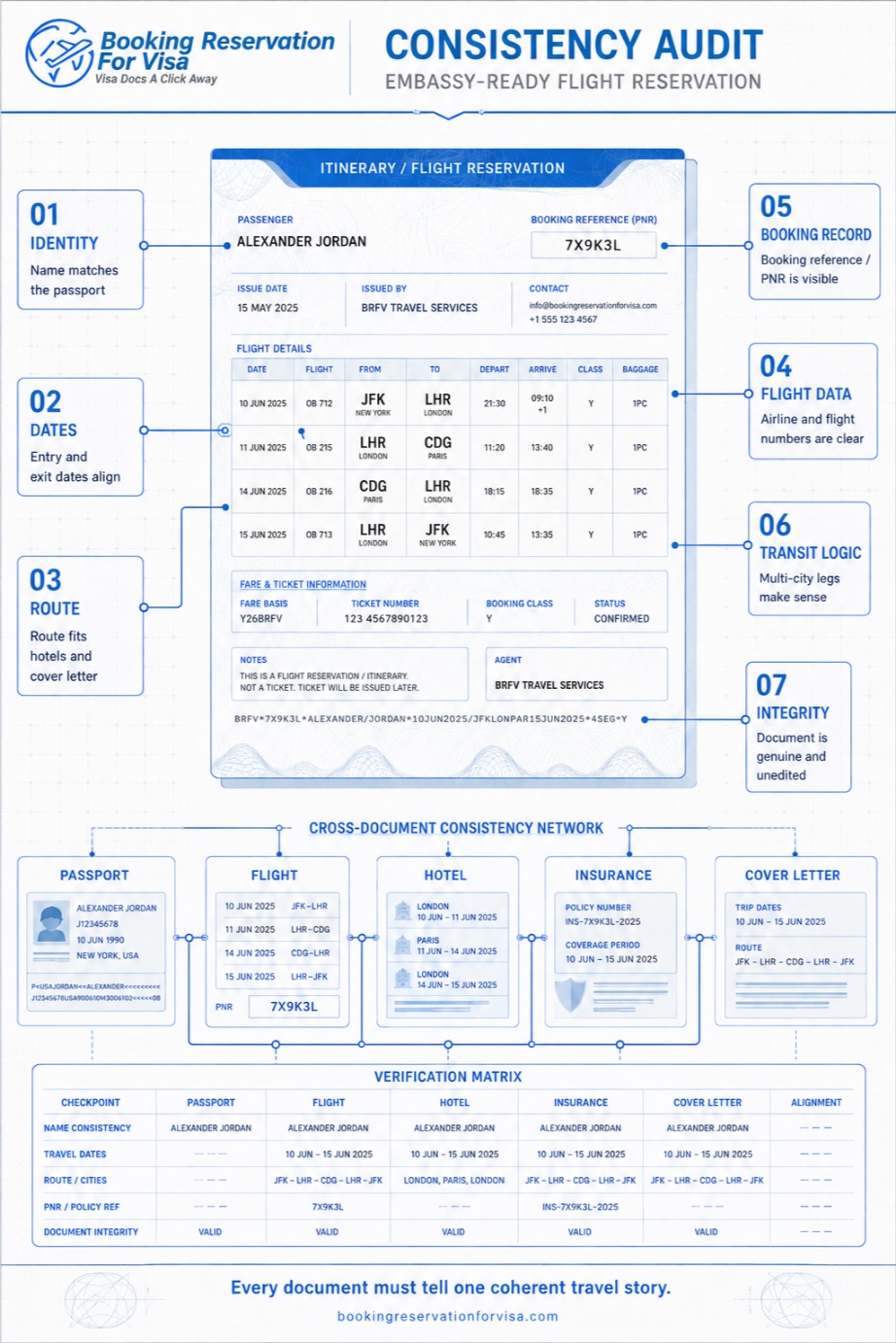
The Consistency Audit Embassies Expect the File to Survive
Before submission, review the application as a consular officer would: horizontally across documents, not vertically one document at a time.
| Point being checked | Flight reservation | Documents it must agree with | Frequent defect |
| Identity | Passenger name | Passport and application form | Missing surname, misspelling or another traveller’s booking |
| Travel window | First departure and final return | Form, cover letter, leave approval and insurance | Different dates across documents |
| Main destination | Arrival, internal sectors and departure | Hotel nights and day-by-day plan | Applying to one state while evidence shows another as principal destination |
| Accommodation sequence | City reached on each date | Hotel check-in and check-out dates | Unexplained nights or hotel before arrival |
| Purpose | Destination and timing | Invitation, conference, business or family evidence | Flight dates do not cover the stated event |
| Financial logic | Route complexity and likely cost | Bank statements, sponsorship and employment | An itinerary disproportionate to available funds without explanation |
| Intention to leave | Return or onward sector | Employment, family, study, property or other ties | One-way route for an ordinary short visit |
This audit is more valuable than adding gratuitous pages. Visa files are weakened not only by missing documents but by documentary discordance: each page looks plausible in isolation, yet the record as a whole cannot be reconciled.
Common Flight-Reservation Mistakes That Can Damage a Visa Application
Applying to the Wrong Schengen Country
An applicant should not design the route around the embassy with the earliest appointment. The competent consulate follows the genuine principal destination. Artificially adding nights or flights merely to manufacture jurisdiction can invite questions about credibility.
Buying an Expensive Non-Refundable Ticket to “Show Commitment”
Official policies cited in this article demonstrate that payment is not a proxy for eligibility. A paid ticket does not oblige a consulate to approve the visa, overlook deficiencies or accelerate processing. Unless the checklist expressly requires ticketing, early non-refundable purchase transfers avoidable risk to the applicant.
Submitting a Fare Search Instead of a Reservation
A screenshot from a comparison website often lacks the passenger’s name and booking reference. It demonstrates that a flight exists, not that travel has been reserved for the applicant. Where the checklist says “reservation,” use a passenger-specific confirmation.
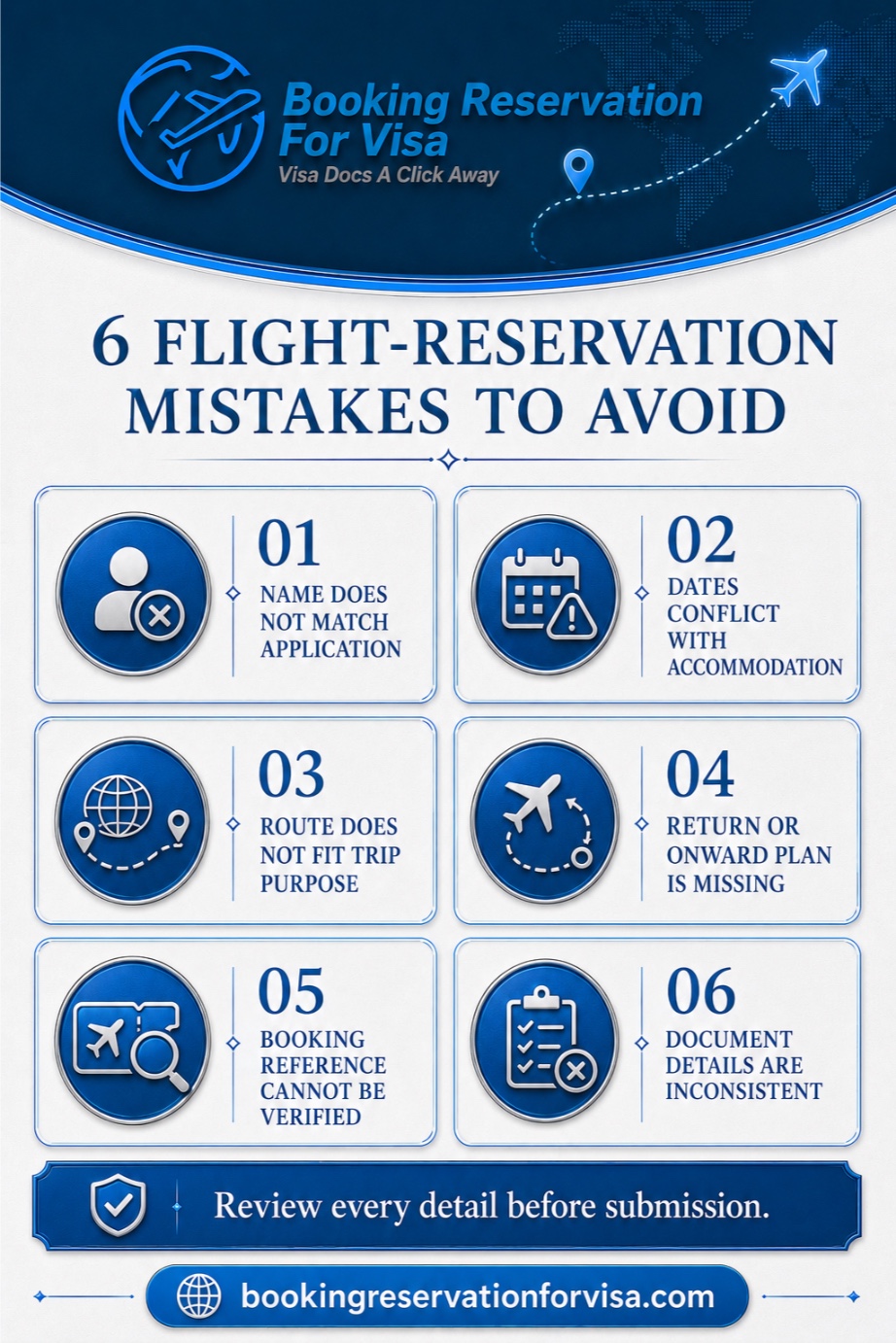
Editing Airline or Agency Documents
Changing a date, name, logo, status or PNR in a PDF severs the page from its source record. Even a seemingly minor manual correction can turn an authentic booking into a misleading document. Ask the issuer to correct and reissue it instead.
Ignoring Overnight Flights and Time Zones
An evening departure may arrive the following day. The return flight may also cross time zones or the international date line. Accommodation, insurance and event dates must be based on actual local arrival and departure, not a superficial reading of the first date shown.
Providing a Route That Contradicts the Stated Purpose
A business applicant invited to a three-day conference should not submit a route that lands after the opening session. A family visitor should be able to explain a return from a distant city. A Canadian tourist itinerary should correspond with the declared activities and accommodation. The flight plan must serve the narrative rather than coexist with it.
Flight Reservation Requirements by Travel Purpose
Tourism
A tourist application normally benefits from a round-trip reservation. For a multi-city Schengen tour, international flights, hotels and internal transport should form one intelligible chronology.
Business, Conference or Trade Event
Arrival should precede the meeting and departure should follow it. The invitation, event registration, employer’s leave authorisation and funding evidence must use compatible dates.
Family or Friend Visit
The reservation should match the host’s invitation period. Distinguish any independent tourist segment and cover its accommodation. A return flight does not replace relationship or home-country evidence.
Short Study, Training or Academic Visit
The route should accommodate enrolment, examination or training dates. Short-stay guidance should not be applied automatically to a national, Canadian or US study visa.
Medical Travel
Dates must fit the treating institution’s appointment and anticipated care. Treatment, funding and accompanying-person evidence remains essential.
Airport Transit
Transit evidence should show the complete onward connection and, where applicable, permission to enter the final country. A reservation omitting the onward sector does not explain transit.
How to Obtain a Verifiable Flight Reservation for a Visa Application
Applicants generally have three legitimate routes. An airline may offer a time-limited hold or refundable booking; a travel agency may create a reservation through its booking system; or a specialist visa-reservation provider may arrange a passenger-specific itinerary. The appropriate choice depends on airline rules, cost, required validity, route complexity and the embassy checklist.
Before paying a service fee, confirm what will be delivered. Ask whether the document will show the complete route, passenger names, flight numbers and booking reference; how verification works; how long the reservation is expected to remain active; and what correction support applies if the provider makes an error. “Cheap” is not a meaningful advantage if the record cannot be checked or the dates contradict the application.
Booking Reservation for Visa’s flight-reservation service is designed for applicants who need a passenger-specific route without purchasing the full airfare at the application stage. One-way, round-trip and multi-city formats are available, with booking details prepared from the traveller’s supplied dates and destinations. Applicants should still compare the completed document with the current official checklist and recognise that neither BRFV nor any travel provider can guarantee visa issuance.
For an application that also requires proof of accommodation, arrange the flight and hotel sequence together rather than treating them as separate purchases. A combined document strategy should ensure that the first hotel begins after arrival, the last stay ends before departure and every intervening night is accounted for.

A Responsible Submission Procedure
Use the following sequence to minimise both financial exposure and documentary inconsistency:
- Identify the correct visa category and competent embassy or consulate.
- Download the current purpose-specific checklist for the applicant’s country of legal residence.
- Decide the authentic route, travel dates and principal destination.
- Prepare accommodation, invitation and event evidence around that route.
- Arrange travel insurance for the dates and territory required by the authority.
- Obtain the reservation only after the plan has stabilised and before the appointment deadline.
- Verify names, sectors, local dates, flight numbers and booking reference.
- Compare the reservation with every other document using the consistency table above.
- Submit the original confirmation without manual alteration.
- Monitor official messages and supply an updated reservation or issued ticket if the authority later requests one.
- Purchase the final flight only after approval or at the specific point directed by the competent authority.
This procedure respects both sides of the visa process. The consulate receives a concrete travel plan, while the applicant avoids treating an uncertain visa outcome as if it were a confirmed journey.
Frequently Asked Questions About Embassies and Flight Reservations
Which embassies accept a flight reservation for a visa application?
Official sources cited in this guide expressly recognise reservations or itineraries for visa scenarios handled by Austria, Belgium, Bulgaria, Croatia, Czechia, Denmark, Germany, Greece, Iceland, Italy, the Netherlands, Norway, Poland, Portugal, Slovakia, Slovenia, Spain and Switzerland. The United States discourages ticket purchase before visa issuance, while Canada lists flight details as possible itinerary evidence. Requirements remain post-, jurisdiction- and visa-category-specific.
Do all Schengen embassies accept a flight reservation instead of a paid ticket?
The EU Visa Code recognises a reservation or return/round ticket as possible evidence, and many missions expressly request reservations. It is still unsafe to state that every post in every jurisdiction accepts the same format. Applicants must follow the local harmonised list and any instructions issued after submission.
Is a fully paid flight ticket required for a Schengen visa?
Often it is not. The Netherlands explicitly says a paid ticket is unnecessary, and several other Schengen missions advise applicants not to buy before approval. A consulate can nevertheless ask for an issued ticket in a particular case or at a later stage.
Can I apply for a US visitor visa without buying a flight ticket?
Yes. The US Department of State tells applicants not to make final plans or buy tickets until they have a visa. The DS-160 guidance refers to an itinerary if arrangements already exist; it does not instruct every applicant to purchase or reserve a flight.
Does Canada require a paid flight ticket for a visitor visa?
IRCC’s general visitor guidance lists flight details as one form of itinerary evidence and does not state that every applicant must upload a fully paid ticket. The personalised IRCC Portal checklist and any request from the processing office govern the individual case.
Is a “dummy ticket” legal for a visa application?
The informal label is not the decisive issue. A genuine reservation that accurately represents proposed travel and is submitted where a reservation is permitted can be legitimate. A fabricated, altered or falsely described ticket is not legitimate and may create serious misrepresentation concerns. Use the official terminology “flight reservation” or “flight itinerary.”
Does a flight reservation need a PNR?
Some official checklists, such as the cited Polish and Spanish guidance, refer to a reservation or booking reference. Other authorities ask more generally for flight details or an itinerary. A PNR strengthens traceability when it genuinely exists, but applicants should not invent one where the document type or system does not provide it.
Will a verifiable flight reservation increase my visa approval chances?
It can improve clarity and eliminate route-related uncertainty when travel proof is required. It cannot guarantee approval or compensate for insufficient funds, an unconvincing purpose, weak return evidence, inadmissibility or contradictions elsewhere in the application.
Should my first Schengen entry be the country whose embassy receives my application?
Not necessarily. The application normally belongs to the country that is the principal destination by duration or purpose. When stays are equal, first entry becomes relevant. The flight reservation and accommodation should make the genuine allocation evident.
Can I submit a one-way flight reservation for a tourist visa?
A round trip is ordinarily more suitable for a short tourist visit because it shows intended departure. A one-way route may be appropriate for certain long-stay, study, work or relocation cases, but only when it fits the visa category and checklist.
What if my reservation expires while the embassy is processing my passport?
Do not alter the original document or create a false status. Keep monitoring official communications. If the embassy asks for refreshed travel evidence, obtain an updated genuine reservation that preserves the intended route and dates, or explain any necessary change.
Can I change my travel dates after receiving the visa?
Only within the visa’s validity, authorised duration and entry conditions, and subject to airline, insurance and accommodation changes. If a post instructed you to provide a final ticket matching approved dates, comply with that instruction. Material changes may require advice from the issuing authority.
Is a flight reservation alone enough as proof that I will return home?
No. It records an intended departure, but consular officers also assess employment, study, family responsibilities, lawful residence, finances, property, immigration history and the overall credibility of the visit. Return evidence is cumulative rather than reducible to one booking.
Final Verdict: Reserve the Journey, Prove the Plan, Purchase at the Proper Time
Embassies ask for travel evidence because a visa application must describe a real, finite and financially intelligible journey. They do not ordinarily need applicants to transform an undecided visa case into an expensive non-refundable commitment. The official policies reviewed here show that many Schengen missions accept flight reservations and that several positively discourage early ticket purchase. United States guidance tells visitor-visa applicants not to buy tickets before issuance, while Canadian guidance accepts flight details as part of itinerary evidence.
The strongest flight reservation for a visa application is not the document with the most ornamental detail or the highest fare. It is the one that is genuine, passenger-specific, appropriately verifiable and perfectly aligned with the declared purpose, dates, accommodation and competent consulate. Use a reservation where the official checklist permits it, purchase the final ticket when approval or a specific consular instruction makes purchase appropriate, and never confuse proof of planning with proof of entitlement to a visa.