A holiday in New York, a university place in Boston, a business meeting in Chicago and a permanent move to the United States involve very different applications. Their travel documents should reflect those differences. A useful flight reservation for USA visa application explains the journey you actually intend to make: your departure point, U.S. arrival airport, proposed dates and any return or onward arrangements.
The first question, however, is whether your particular application needs a reservation at all. U.S. visa procedures do not impose one universal flight booking requirement across visitor, student, work and immigrant categories. Applicants should follow their visa category and the instructions of the embassy or consulate handling their case, rather than borrowing a checklist written for another country.
Where a proposed route is useful or requested, Booking Reservation for Visa, also called BRFV, offers an online way to arrange flight reservations and hotel bookings without purchasing the full airfare or paying the entire accommodation cost in advance. This can help you organize travel details while the visa decision remains pending.
This guide explains the booking process, temporary and permanent visa categories, country-specific planning considerations, reservation verification and common mistakes. Whether you are preparing a B-1/B-2 application from India, an F-1 application from the Philippines, an employment application from Pakistan or an immigrant visa case from Malta, the principle is the same: choose the correct visa route first, then prepare travel information that fits it.
How to Get a Flight Reservation for a USA Visa: The Quick Answer
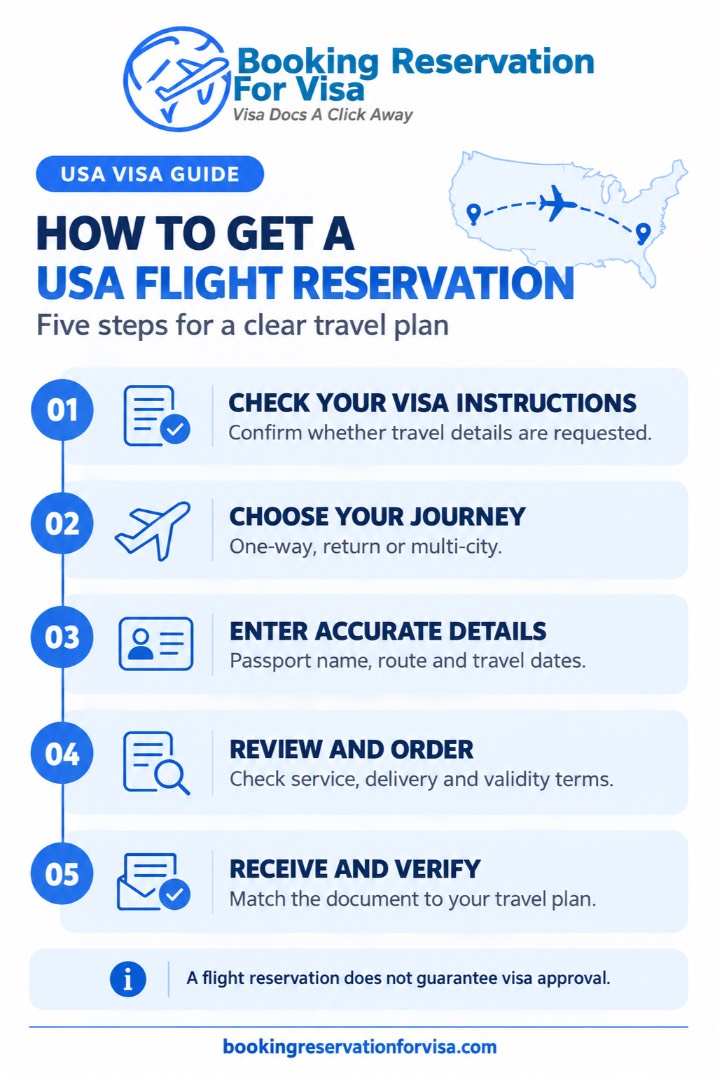
To get a flight reservation for a USA visa, first check whether the embassy requests travel evidence or whether a reservation would help you explain your proposed journey. Then choose flight-only support or a flight and hotel package through BRFV, enter the travelers’ passport names, select a one-way, return or multi-city route, provide the intended travel dates and interview timing, and complete the service payment.
After delivery, check the passenger details, airports, flight sectors, dates and booking reference. Verify the reservation through the airline or the verification method supplied for that booking. Keep the document consistent with your application answers, accommodation arrangements and travel purpose.
A reservation service fee is separate from the airfare. A flight reservation is also separate from an issued airline ticket and from the visa itself.
Is a Flight Reservation Required for Every USA Visa Application?
No. A flight reservation is not a standard compulsory document for every U.S. visa application. The required evidence depends on the visa classification, the applicant’s circumstances and any additional consular instructions.
For example, the DS-160 guidance asks applicants to have a travel itinerary available if they have already made travel arrangements. That condition matters: it does not instruct every applicant to buy a ticket or purchase a reservation before completing the form.
The U.S. Department of State also advises visitor visa applicants to avoid final travel plans and ticket purchases before visa issuance. Buying an expensive fare does not remove the possibility of refusal, further document requests or administrative processing.
A flight reservation may still serve a practical purpose. It can organize a proposed route, make the arrival and departure dates easier to review, or respond to a request for travel information. However, it does not replace the evidence needed to qualify for the visa.
For a visitor, that evidence may concern the purpose and affordability of the trip and the intention to leave after the authorized visit. For a student, it includes the relevant education and SEVIS documents. For a worker, it may depend on a petition or other employment authorization. For an immigrant, the approved immigration process and consular documentation take priority.
The sensible sequence is to read the instructions, understand your application and order a flight reservation only when it serves a clear purpose. BRFV’s role is to help with travel documentation; the embassy or consulate decides the visa application.
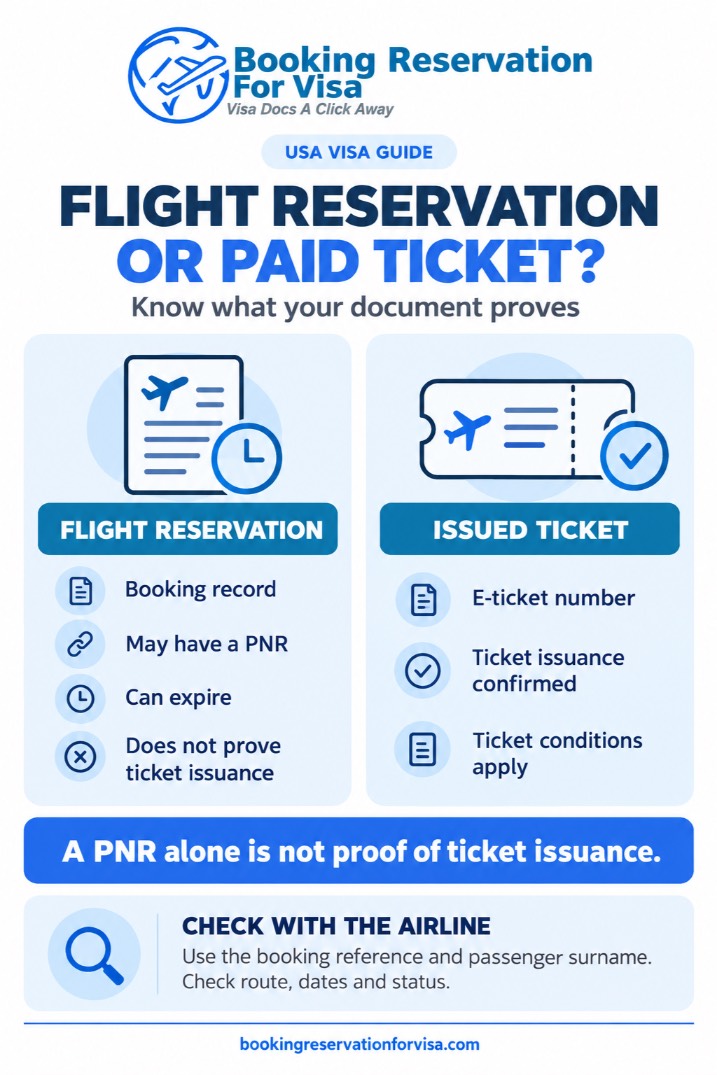
Flight Reservation, Travel Itinerary and Paid Ticket: What Is the Difference?
These terms often appear together in searches, but they describe different things. Knowing the distinction helps you order the right service and explain the document accurately.
| Document | What it represents | What to check |
| Proposed travel itinerary | A plan describing intended movements and dates; it may exist without an airline booking | Whether it is presented honestly as a proposal |
| Flight reservation | A booking record for specified passengers and flight sectors, subject to its terms and expiry | Passenger details, status, reference and validity |
| Issued airline ticket | A ticket issued for the journey, with the applicable fare and ticket conditions | Ticket number, payment, travel restrictions and change rules |
| Boarding pass | A check-in document for a particular flight | Flight, passenger, airport and boarding details |
A PNR, or Passenger Name Record, refers to booking information held in a reservation system. The booking reference is the identifier used to retrieve that record. References are commonly six characters and may contain both letters and numbers, although booking systems vary.
A PNR does not, by itself, prove that a ticket has been issued or that the full airfare has been paid. A reservation can also expire even while a printed copy continues to show the original details.
For that reason, a flight reservation for USA visa preparation should be described according to its actual status. Use it to communicate proposed travel, then arrange a suitable issued ticket when you are ready to travel and your visa position is confirmed.
Start With the Correct USA Visa Application Process
Arranging a flight reservation and applying for a visa are separate processes. Complete the government steps applicable to your category; a travel-document order does not start a U.S. visa case.
Applying for a Nonimmigrant Visa
Nonimmigrant visas cover temporary purposes such as tourism, business visits, education, exchange programs and authorized work. For most categories, preparation involves completing the DS-160, following the local fee and appointment procedure, and assembling the required documents.
Some applicants first need a qualifying school document, exchange sponsorship or an approved employment petition. Others apply under a category with different supporting evidence. Do not assume the same prerequisites apply to every temporary visa.
U.S. guidance generally directs nonimmigrant applicants to schedule interviews in their country of nationality or residence. Applicants relying on residence should be able to demonstrate it. Where routine services are unavailable, designated processing posts may apply.
This distinction is especially important for travelers living abroad. An Indian passport holder resident in France, for example, should consider both nationality and lawful residence when checking where to apply. The airport used for the eventual trip does not determine the correct interview location.
Applying for an Immigrant Visa
Immigrant visas involve permanent residence. Many cases begin with a qualifying family or employment petition and continue through the National Visa Center, consular document review, the DS-260 where applicable, a medical examination and an interview. Diversity Visa cases follow their own selection and processing instructions.
Current interview-location guidance generally places immigrant interviews in the consular district for the applicant’s residence, or the country of nationality when requested, with limited exceptions. Applicants should follow their assigned case instructions rather than independently choosing a post because flights there are convenient.
An immigrant flight reservation is a travel-planning document. It cannot replace an approved petition, a visa number, civil records, sponsorship evidence, a medical examination or a visa decision.
How to Book a Flight Reservation for USA Visa Application With BRFV
BRFV’s order form collects traveler information, journey details and the timing needed to prepare the reservation. Have those details ready before starting, especially if several people will travel together.
Step 1: Decide Whether You Need Flight-Only or Accommodation Support
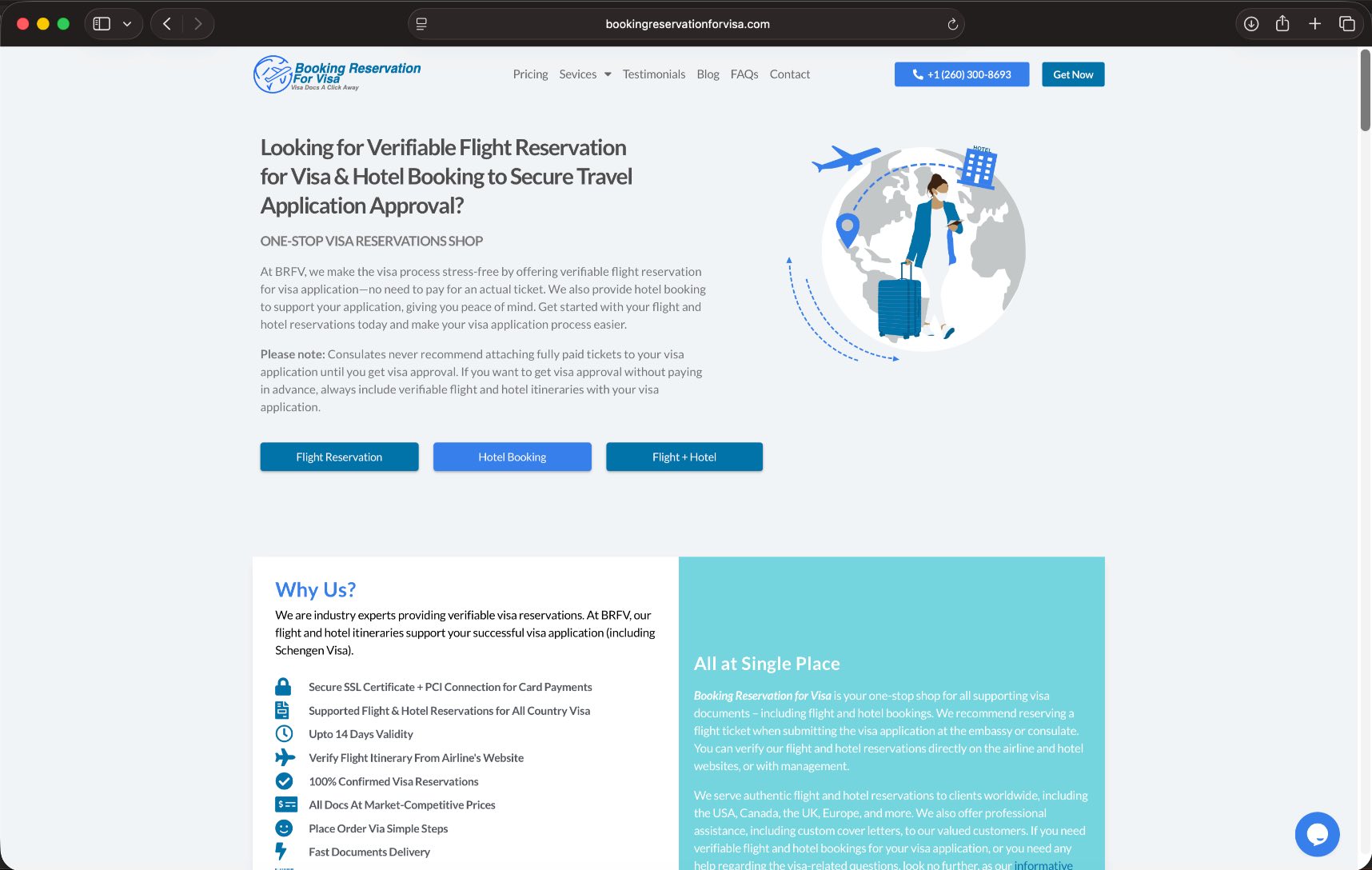
Visit Booking Reservation for Visa and choose the service that matches the trip:
- Flight Reservation: For a proposed air journey to or through the United States.
- Hotel Booking: For genuine intended accommodation where a hotel stay is appropriate.
- Flight Plus Hotel Booking: For travelers who want both parts of the plan arranged together.
A visitor staying with relatives does not automatically need a hotel reservation. A student with university housing should use the real accommodation arrangement. An immigrant moving into a sponsor’s home should not create an unrelated hotel stay simply to purchase a package.
If you only need the flight reservation, keep the order focused on that service. If hotel bookings are appropriate, prepare the route and stay dates together.
Step 2: Enter the Number of Travelers and Contact Details
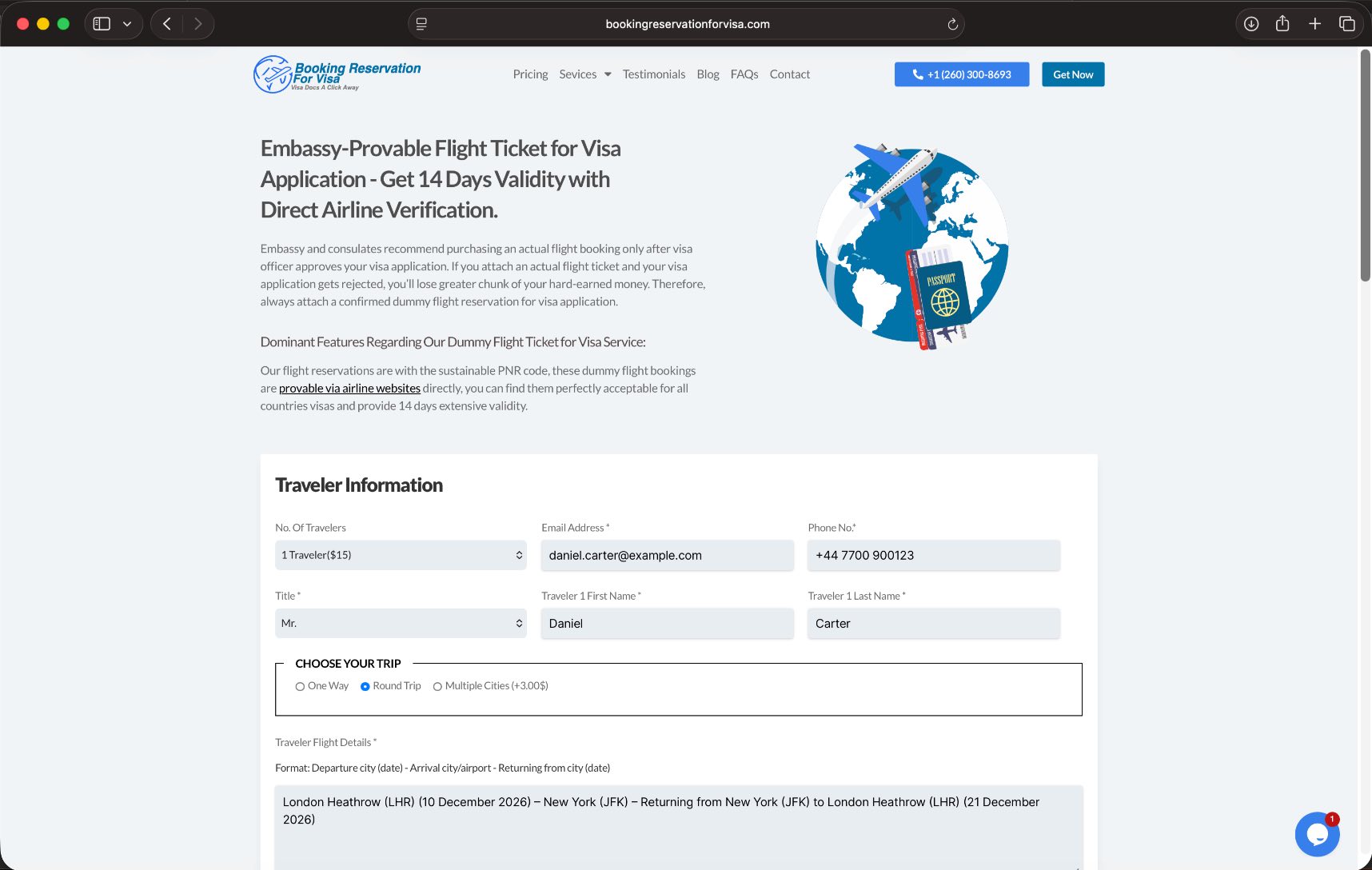
The flight reservation form asks for the number of travelers, an email address, a phone number and passenger names. Use an email account you can access promptly so you can review the document as soon as it arrives.
Enter names according to the passport naming fields. Include the required given names and surname, and ask for guidance if the passport has a single name or an unusual naming structure. Do not improvise a surname to make the form easier to complete.
For a family order, review each person’s spelling separately. Similar names are easy to confuse, particularly when parents and children share a surname or when one family member uses several given names.
Step 3: Select One-Way, Round-Trip or Multiple Cities
BRFV’s form provides one-way, round-trip and multiple-city options. Choose the route that matches the actual purpose of travel.
| Journey type | When it may fit the proposed trip |
| One-way flight reservation | Permanent relocation, an appropriate long-term arrival plan or another genuine one-way journey |
| Round-trip flight reservation | A temporary visit with a reasonably settled return plan |
| Multi-city flight reservation | Different arrival and departure cities, onward international travel or several genuine flight sectors |
These are planning choices, not universal legal requirements for particular visas. A student does not need to invent a return date years in the future, and an immigrant should not add a short tourist-style return merely because another applicant used a round-trip example.
Step 4: Provide the Departure City, U.S. Destination and Dates
The order form requests traveler flight details in the format relevant to the chosen trip. Include the departure city, intended departure date and destination city or airport. For a return journey, also provide the returning city and date.
Be specific where a city has several airports. New York-area airports, for example, are not interchangeable for every connection. If your intended arrival is Newark, provide Newark rather than relying on a general city label.
For a multi-city order, write the sectors in travel order. A clear sequence such as Delhi–New York, New York–Chicago and Chicago–Delhi is easier to understand than a paragraph containing several cities and unlabelled dates.
The proposed journey should also leave enough time for visa processing. Do not select a departure date simply because it makes the reservation look urgent when it is unrealistic for your actual application.
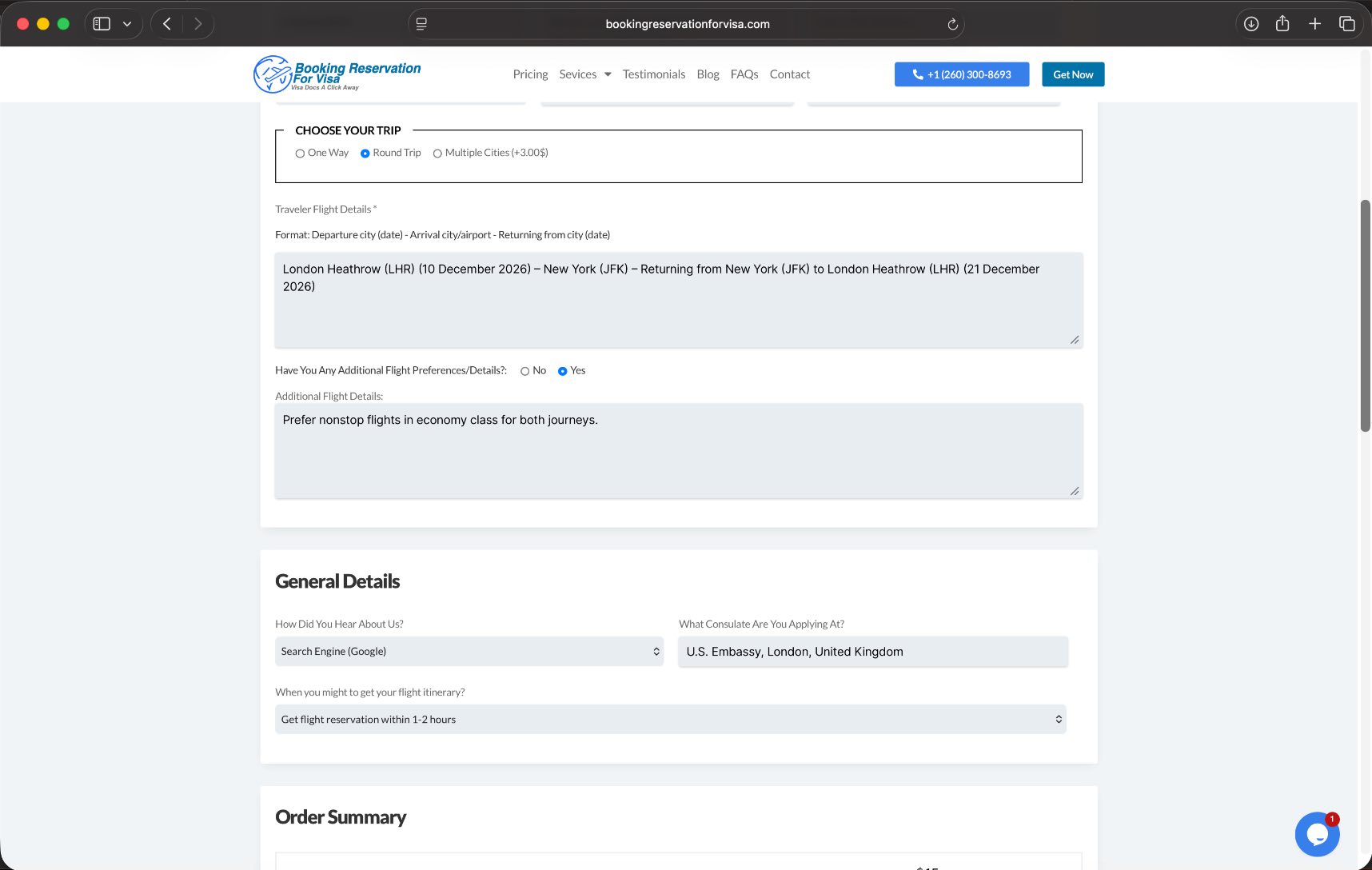
Step 5: Add Airline Preferences and Relevant Journey Details
The form allows additional flight preferences or details. Use that space to explain genuine needs: a preferred airport, a planned connection, travelers arriving together or a particular route you would like considered.
For a student, mention the school destination and intended arrival period. For a business visitor, provide the meeting city and dates. For crew travel, identify the joining location. For an immigrant, clarify that the request concerns permanent relocation so the route is not prepared as an ordinary holiday by default.
Preferences depend on availability. An old sample showing a particular airline or flight number does not establish that the same service operates on your future dates.
Step 6: Provide the Consulate and Interview Timing
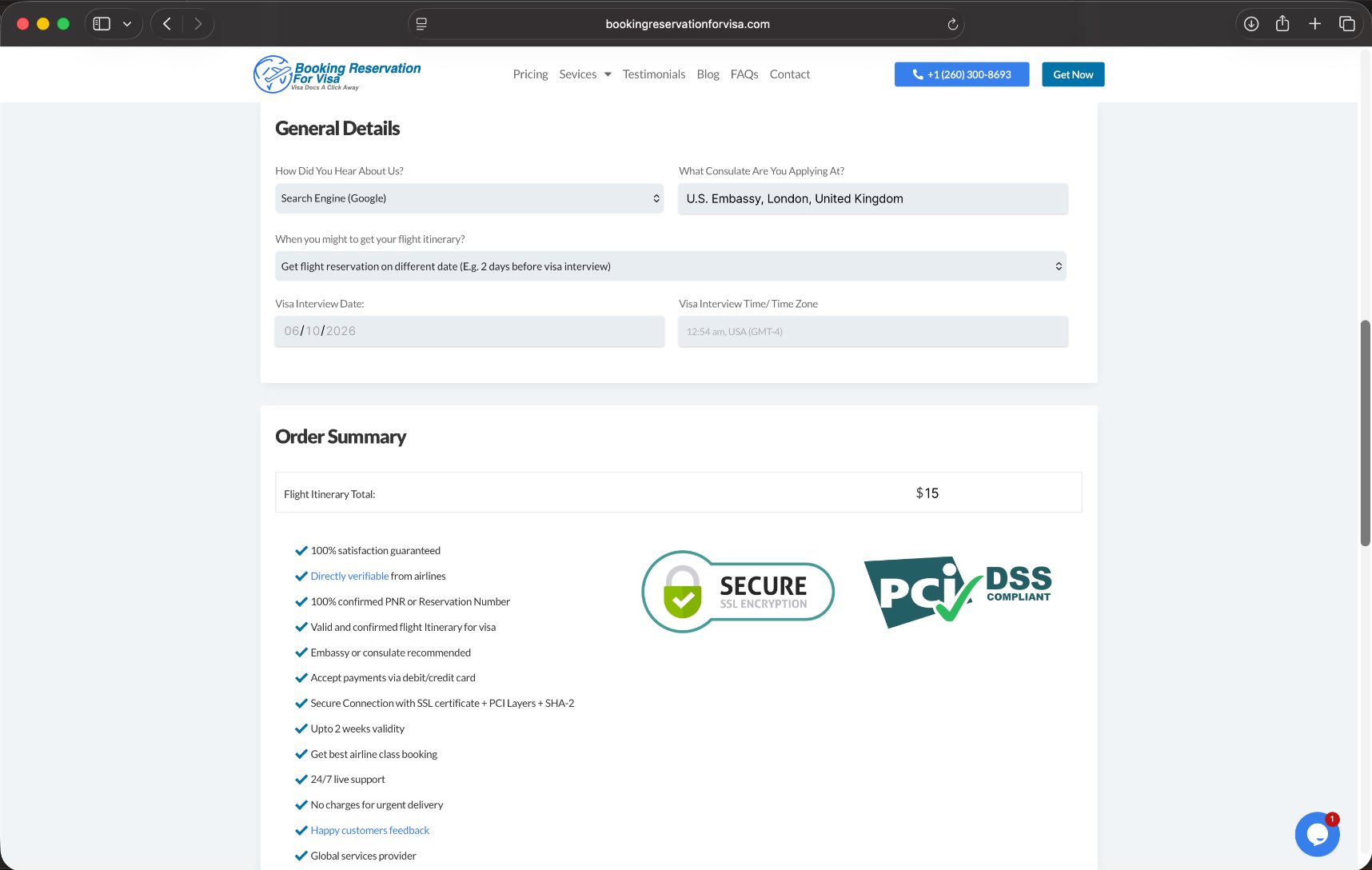
BRFV asks which consulate you are applying at, when you would like to receive the itinerary and the visa interview date, time and time zone. Give the actual information available to you.
Specify the United States as the visa destination and identify the relevant post in the additional details when useful. If your appointment is in Mumbai, Manila or another city, make that clear. The form’s example text is only an example and should not determine your answer.
If the appointment has not been assigned, say so rather than inventing a date. Arrange delivery around the stage when the flight reservation will be useful, allowing time to check and correct it.
Step 7: Review the Order Summary and Pay the Service Fee
Check the selected service, traveler count, route and order total. Read the applicable terms before completing payment. BRFV lists card payment options; use the options available at checkout.
You are paying for the reservation service, not purchasing the full airfare unless a separate ticketing arrangement expressly says otherwise. The same distinction applies to hotel-booking support and the eventual cost of the stay.
Pricing may depend on the selected service and journey details, so use the current checkout total rather than an old screenshot or an amount copied from another website.
Step 8: Receive, Review and Verify the Flight Reservation
BRFV advertises standard delivery within one to two hours after payment confirmation and reservation validity of up to 14 days. Confirm the timing and applicable conditions for your order, especially when the appointment is close or the journey is complex.
Check the completed document immediately. BRFV’s published guidance recommends reporting correction requests promptly, generally within three to four days. Review early enough that any problem can be addressed before you use the reservation.
Compare the document with your passport, application answers and intended travel. Then check the booking through the verification channel supplied for that reservation. A professional layout is useful, but accurate details and an actual booking record matter more than appearance.
Why Use BRFV for a USA Flight Reservation?
BRFV brings the flight reservation and optional accommodation order into one online process. That is useful when you want to organize travel evidence without immediately committing to the full airfare.
Its published service information emphasizes booking references, airline verification, one-way and multi-city options, group-travel support, digital delivery and a reservation window of up to two weeks. Travelers can also choose hotel bookings when those fit the proposed stay.
The practical benefit is coordination. A family can submit the passenger details together; a traveler visiting two U.S. cities can describe the route in sequence; and a business visitor can plan hotel dates around the arrival and departure sectors.
The reservation window should be understood realistically. Fourteen days is a booking-validity period, not a promise that a U.S. visa will be decided within fourteen days. Long appointment waits or administrative processing can extend well beyond it.
Use BRFV for the travel-document task it provides: arranging a flight reservation that reflects your intended journey. Visa eligibility, interview availability and government processing remain separate matters.
What Should a USA Visa Flight Reservation Show?
A useful flight reservation should make the proposed journey easy to follow. Look for the details below and check whether the actual record matches the document.
| Detail | Why it matters |
| Passenger name | Connects the reservation with the traveler and passport |
| Departure and arrival airports | Identifies the actual route and U.S. entry point |
| Travel dates | Shows the proposed timing and sequence of the journey |
| Airlines and flight numbers | Identifies the intended services, including operating carriers where shown |
| Connection sectors | Explains how the traveler reaches the final destination |
| Booking reference | Helps retrieve the booking through the appropriate channel |
| Reservation status and expiry | Clarifies whether the booking remains active and when it may lapse |
| Return or onward sector, when applicable | Connects departure plans with the temporary visit or onward journey |
A reservation does not need to become a crowded brochure. Clear route information is more useful than decorative stamps, approval-style badges or claims that a particular consulate endorses the document.
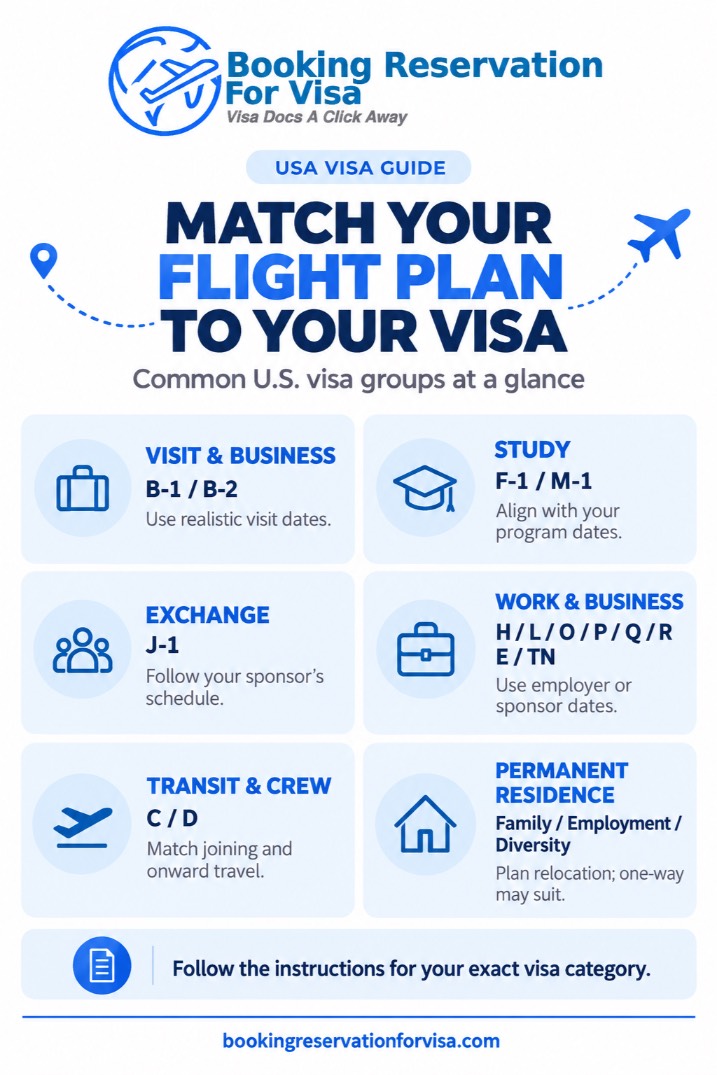
Nonimmigrant Visas: Flight Reservations for Temporary USA Travel
Nonimmigrant visa categories are organized around the purpose of a temporary stay. The same booking form may be used for several categories, but the journey should be tailored to the applicant’s actual reason for travel.
Flight Reservation for B-1 USA Business Visa
The B-1 category covers qualifying temporary business activities such as meetings, consultations, conventions and contract negotiations. It is not a general route for taking a U.S. job.
A flight reservation for a B-1 visa can help organize the arrival before the first business activity and the departure after it. Match the destination with the meeting location and leave sensible time for travel between the airport and the venue.
For example, if the proposed meeting is in Chicago, a reservation showing arrival in a different city should have a clear reason and onward plan. The travel document should support the business explanation rather than introduce an unrelated holiday route.
Flight Reservation for B-2 USA Tourist, Family Visit or Medical Visa
B-2 visitor purposes include tourism, vacation, visiting friends or relatives and medical treatment. A flight reservation for a B-2 visa should reflect the intended length and purpose of the visit.
For tourism, coordinate the dates with the cities you plan to visit and the accommodation you genuinely intend to use. For a family visit, the host’s address may explain the stay more accurately than an unnecessary hotel booking.
Medical travel needs particular care. Prepare the proposed journey around the treatment provider’s expected timing, while allowing for recovery and follow-up. The relevant medical and financial evidence remains essential; a flight reservation cannot establish that treatment is arranged or affordable.
Flight Reservation for Combined B-1/B-2 Visas
A combined B-1/B-2 visa covers qualifying business and visitor purposes. Explain the trip you are actually proposing rather than copying every possible activity associated with the visa.
If the journey combines a conference and a short holiday, show a coherent overall stay. Business dates, sightseeing plans and accommodation should fit the same travel period.
There is no need to purchase several separate flight reservations merely because the visa label includes both B-1 and B-2. Choose the route that represents the intended journey.
Flight Reservation for F-1 USA Student Visa
F-1 visas concern qualifying academic studies and language programs. The relevant Form I-20 and SEVIS information establish the educational context; a flight reservation serves the proposed arrival plan.
For an initial F-1 arrival, new students generally cannot enter the United States more than 30 days before the program start date. Arrange the proposed flight around that limit, the school’s reporting instructions, orientation and housing availability.
A student heading to a university outside the arrival city should plan how to reach campus. If the international flight lands in New York and the institution is in Boston, explain the onward movement rather than presenting New York as the final destination without context.
A one-way flight reservation may suit an initial study journey when the eventual return date is unsettled. It does not remove the need to meet the student visa requirements.
Flight Reservation for M-1 USA Vocational Visa
M-1 visas concern qualifying vocational and nonacademic study, apart from language training. Flight reservation planning should follow the course location, the Form I-20 start date and the institution’s arrival arrangements.
Check the total proposed journey, including any domestic connection after landing in the United States. Choose accommodation that reflects the training arrangement and avoid extending the travel plan beyond what the applicant can explain.
The initial-arrival rule for new F and M students generally limits entry to the 30 days before the program begins. A reservation showing an earlier date should therefore be reconsidered before use.
F-2, M-2 and Border-Commuter Student Categories
Eligible dependents may apply under F-2 or M-2. Their flight reservations should fit the principal student’s travel or show a genuine later joining plan.
The F-3 and M-3 classifications concern qualifying Canadian or Mexican border-commuter students. Such arrangements may involve regular land crossings instead of an international flight. Do not order air-travel documentation for a journey that will actually take place by road.
For family travel, compare every passenger’s proposed dates with the school and housing arrangements. Related visa categories do not mean that all family members must arrive on the same day.
Flight Reservation for J-1 Exchange Visitor Visa
J-1 programs include educational and cultural exchanges such as research, internships, teaching, trainee placements, au pair arrangements and other approved programs. The sponsor’s Form DS-2019 provides the program context.
A flight reservation for a J-1 visa should align with the exchange location and reporting dates. Exchange visitors generally cannot enter in J status more than 30 days before the program start date.
Ask the sponsor about arrival arrangements before selecting the route. An airport convenient for the host organization may be a better choice than a distant city with no connection to the placement.
Flight Reservation for J-2 Dependents
J-2 eligibility depends on the exchange category and the applicant’s relationship to the principal traveler. Where dependent travel is permitted, prepare a flight reservation that reflects whether the family will accompany the J-1 holder or join later.
Use the applicable sponsor documents and real accommodation plans. A shared route can simplify the travel explanation, but it should not be used to hide different arrival dates or unrelated journeys.
Temporary Worker Visas: Match the Reservation to the Authorized Activity
The temporary-worker group includes several distinct classifications. A flight reservation should follow the employment, assignment, training or performance arrangement rather than determine it.
Flight Reservation for H-1B and H-1B1 Visas
H-1B concerns specialty-occupation employment and certain other qualifying roles. H-1B1 is a separate professional category for qualifying nationals of Chile and Singapore.
For either route, check the relevant employment documents and category-specific instructions before fixing the proposed arrival. A job offer alone does not establish that every government prerequisite has been completed.
A flight reservation for an H-1B visa from India, China or another departure country should make the intended work destination understandable. If the airport is far from the work location, include the actual onward plan. Check current petition and entry conditions with the employer or adviser before ordering.
Flight Reservation for H-2A Agricultural Workers
H-2A concerns qualifying temporary or seasonal agricultural work. The arrival plan should be coordinated with the employer and the authorized work period.
Ask whether the employer has already arranged transport before purchasing a separate flight reservation. Duplicate bookings can create confusion, particularly for groups traveling to the same worksite.
Use the intended destination and pickup arrangements, rather than choosing an unrelated U.S. city for a more familiar-looking itinerary.
Flight Reservation for H-2B Nonagricultural Workers
H-2B concerns qualifying temporary nonagricultural work. Flight reservation dates should follow the actual job arrangement and the employer’s travel instructions.
Seasonal employment can involve group arrivals and travel beyond the international airport. Make the proposed route clear and confirm who is responsible for coordinating the journey.
The reservation itself does not prove that the employer has completed the required labor and immigration procedures.
Flight Reservation for H-3 Trainees
H-3 concerns qualifying training or special-education exchange arrangements. The flight reservation should connect the applicant with the location and timing of the authorized program.
Avoid describing the journey as unrestricted employment or as a tourist holiday when the application concerns training. Consistency between the training explanation and the travel plan is more useful than adding extra destinations.
Flight Reservation for L-1A and L-1B Transfers
L-1A concerns qualifying managers and executives transferring within an organization; L-1B concerns qualifying specialized-knowledge staff.
For an L visa flight reservation, use the assignment location and the employer’s proposed reporting date. If family members will join later, prepare their travel details accordingly rather than forcing everyone into one departure date.
Do not apply visitor-visa return assumptions to every L case. The category and the assignment documents should guide the proposed journey.
Flight Reservation for O-1, O-2 and O-3 Visas
O-1 concerns extraordinary ability or achievement. O-2 covers qualifying accompanying support, while O-3 concerns eligible dependents.
A flight reservation for an O visa should align with the approved activity and its destination. A performer with engagements in several cities may need a genuine multi-city plan; someone reporting to one organization may need a simpler route.
Group members should have travel details that correspond with their own role and timing. They do not automatically have identical schedules.
Flight Reservation for P-1, P-2, P-3 and P-4 Visas
P classifications cover qualifying athletes, entertainment groups, reciprocal exchange performers and culturally unique programs. P-4 concerns eligible dependents.
The broader P-1 group includes P-1A athletic and P-1B entertainment arrangements, with qualifying support classifications where applicable. P-2 and P-3 arrangements also have their own approved activities and supporting personnel rules.
Prepare the flight reservation around the actual competition, performance or program schedule. For a tour, include genuine flight sectors in the correct order and keep accommodation consistent with the cities visited.
Flight Reservation for Q-1 Cultural Exchange
Q-1 is a petition-based international cultural exchange category distinct from J-1. The proposed flight should follow the sponsoring organization’s approved program and reporting arrangements.
A cultural exchange is not automatically a tourist visit. Use the travel description associated with the actual application and avoid mixing the Q and J classifications simply because both involve cultural activities.
Flight Reservation for R-1 and R-2 Religious Visas
R-1 concerns qualifying temporary religious work; R-2 concerns eligible dependents. The flight reservation should fit the religious organization’s location and the applicant’s approved purpose.
Check whether the organization is arranging arrival transport or accommodation. A hotel booking may be unnecessary when the intended stay is in genuine organization-provided housing.
Flight Reservation for E-1 Treaty Traders and E-2 Treaty Investors
E-1 and E-2 are nonimmigrant treaty categories with nationality and business requirements. An E-2 investment arrangement is different from the EB-5 immigrant-investor route.
For a flight reservation connected with an E application, choose a route consistent with the business location and the actual proposed arrival. A resident of a treaty country should not assume residence alone creates the nationality qualification.
The reservation supports travel planning; it does not establish treaty eligibility or satisfy the business evidence requirements.
Flight Reservation for E-3 Australian Professionals
E-3 concerns qualifying Australian nationals entering for specialty-occupation employment. The E-3D classification concerns eligible dependents, and E-3R is used for qualifying returning E-3 workers.
Coordinate the proposed arrival with the employer and the applicable employment documents. For travelers departing from a country other than Australia, keep nationality, residence and departure airport clearly distinguished.
Flight Reservation for TN and TD Applicants
TN concerns qualifying Canadian and Mexican professionals under the United States–Mexico–Canada Agreement. TD concerns eligible dependents. Canadian and Mexican citizens do not necessarily follow identical visa procedures.
Prepare the travel plan around the actual professional engagement and applicable admission or visa process. If entering by land, a flight reservation may have no role. If flying, select the route that reaches the genuine work destination.
CW-1, CW-2 and E-2C: Northern Mariana Islands Categories
CW-1, CW-2 and E-2C concern specific Commonwealth of the Northern Mariana Islands arrangements. They should not be treated as unrestricted work or investment permission for every U.S. destination.
Flight reservation planning should follow the geographical scope of the permission and the traveler’s actual status. Ask the employer or qualified adviser to confirm a route involving other U.S. airports before relying on it.
Flight Reservations for Other Worker Dependents
Dependent classifications include H-4, L-2, O-3, P-4 and R-2, as well as applicable E and TN family categories. Each applicant needs the appropriate relationship and status evidence.
A flight reservation can show an accompanying journey or a later joining trip. Ensure the passenger list reflects who will actually travel together and that names match each person’s passport.
Transit and Crew member Visas: Show the Complete Journey
Flight Reservation for C-1 USA Transit Visa
C-1 concerns qualifying immediate and continuous transit through the United States to another country. A useful flight reservation should show the inbound sector, the U.S. connection and the onward destination.
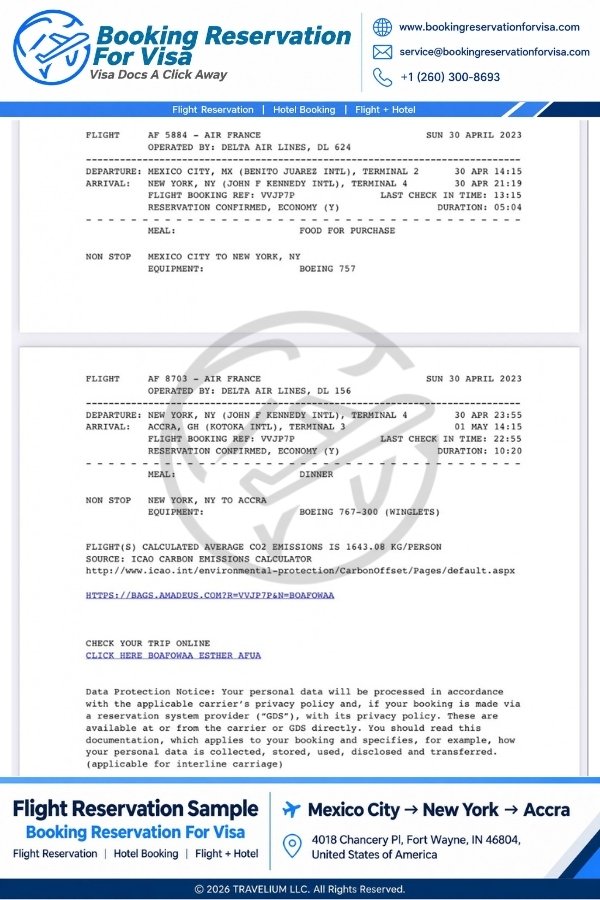
For example, Mexico–New York–Accra is an onward international journey. Presenting only Mexico–New York would omit the sector explaining why the traveler is passing through the United States.
Do not assume that remaining in an airport automatically removes U.S. immigration requirements. Check the permission needed for the actual transit and passport before using the route.
C-2 and C-3 Diplomatic Transit Categories
C-2 relates to qualifying transit connected with United Nations Headquarters, while C-3 concerns qualifying foreign-government officials and accompanying persons in transit.
Such travel should follow the official instructions and supporting communication for the assignment. If a flight reservation is used, it should reflect the authorized transit purpose and the actual onward movement.
D and Combined C-1/D Crew member Visas
D visas concern qualifying airline and vessel crew duties. Crew members traveling as passengers to join a vessel or aircraft may require transit permission as well, often through a combined C-1/D visa where applicable.
Prepare the flight reservation around the joining airport or port, employer instructions and any onward transport. A crew joining letter and the relevant employment evidence are separate from the airline reservation.
D-3 and C-4/D-3 Lightering Crew Arrangements
Specialized D-3 and C-4 arrangements concern qualifying ship-to-ship liquid-cargo operations, also known as lightering. These categories have their own conditions and are distinct from an ordinary visitor journey.
Where applicable, the flight reservation should follow the joining location and the employer’s schedule. Use the classification assigned for the actual work rather than assuming a standard C-1/D example fits every maritime role.
Other Nonimmigrant Visa Categories
I Visa: Foreign Media Representatives
I visas concern qualifying foreign media work, including relevant reporting and informational activities. A flight reservation should align with the assignment location, reporting period and genuine domestic travel.
Working journalists should not treat a tourist reservation as evidence that their professional activity is covered by a visitor visa. The intended work determines the category.
A-1, A-2 and A-3: Diplomatic and Government-Related Travel
A categories concern qualifying government officials, eligible family members and certain personal employees. Official assignment documents and diplomatic instructions guide the application.
Where a flight reservation is needed for planning, coordinate it with the sending authority. Official travel can have procedures different from an ordinary commercial visitor application.
G-1 to G-5 and NATO-1 to NATO-7
G categories concern qualifying international-organization travel and employment. NATO classifications concern qualifying representatives, personnel, accompanying persons and relevant employees.
The flight reservation should support the actual official assignment and reporting dates. Use the instructions associated with the assigned category instead of a generic tourist checklist.
S, T and U: Specialized Witness and Victim Categories
S classifications concern qualifying witnesses or informants; T concerns trafficking victims; U concerns qualifying victims of criminal activity. Relevant family classifications also exist.
These are specialized immigration matters. A routine flight reservation order does not establish eligibility or resolve the travel consequences of a pending or approved case. Arrange travel only after confirming the applicable permission with the responsible authority or qualified adviser.
N-8, N-9 and Legacy V Categories
N-8 and N-9 concern certain relatives associated with specified special-immigrant classifications. V-1, V-2 and V-3 involve a narrow, older family-based framework rather than a general option for newly filed family cases.
Where such a classification applies, confirm the individual case instructions before arranging a flight reservation. A visa symbol appearing in a historical document is not enough to establish eligibility today.
Border Crossing Cards for Eligible Mexican Travelers
A Border Crossing Card is relevant to qualifying Mexican visitor travel, with rules that depend on the proposed journey and entry method. Air travel should be checked against the passport and visa-document requirements that actually apply.
A flight reservation from Mexico can describe the route, but it does not expand the scope of a Border Crossing Card or replace another required travel document.
K Visas: Immigration-Related Travel in a Nonimmigrant Classification
K visas are technically nonimmigrant visas, even though their purpose is connected with family immigration. Keeping that distinction clear helps applicants avoid copying a tourist itinerary into a relocation case.
Flight Reservation for K-1 Fiancé(e) and K-2 Children
K-1 concerns a qualifying fiancé(e) of a U.S. citizen, with marriage required within 90 days of arrival. K-2 concerns eligible children.
A flight reservation should represent the intended arrival to join the petitioner and proceed with the applicable process. A one-way journey can fit this purpose; an invented holiday return is not a useful substitute for an accurate plan.
Wait for the visa outcome and the actual permission to travel before making final arrangements. A desired wedding date does not guarantee that the case will finish in time.
Flight Reservation for K-3 and K-4
K-3 and K-4 concern particular spouse and child arrangements connected with U.S.-citizen family immigration. They are distinct from CR-1 and IR-1 immigrant visas.
Prepare the flight reservation according to the classification and instructions actually assigned to the case. Do not assume that every married applicant follows the K route or that the travel documents for one family case automatically apply to another.
Immigrant Visas: Flight Reservations for Permanent Residence in the USA
Immigrant travel should reflect the intention to establish permanent residence. A short holiday return should not be added solely to make a relocation application resemble a visitor file.
Before visa issuance, a flight reservation can help with tentative planning if travel information is useful or requested. Final relocation arrangements should wait for the visa decision, passport return and confirmation of the permission to travel.
Flight Reservation for IR-1 and CR-1 Spouse Visas
IR-1 and CR-1 concern qualifying spouses of U.S. citizens. For travel planning, the important point is that the applicant is preparing to immigrate rather than undertake an ordinary temporary family visit.
A one-way flight reservation may reflect the genuine intended move. Choose the arrival airport around the planned U.S. home and the sponsor’s practical arrival arrangements. If a domestic flight is needed after international entry, include it in the proposed route.
Do not order a reservation months before it is useful simply because the family hopes for a particular relocation date. Consular processing can continue beyond an expected timeline.
Flight Reservation for IR-2, CR-2 and IR-5 Family Cases
IR-2 and CR-2 concern qualifying child cases, while IR-5 concerns qualifying parents of U.S. citizens. Prepare the travel document according to the actual family relationship and assigned classification.
For a child traveling with a parent or guardian, coordinate the passenger list and journey carefully. For an older parent, consider whether the proposed connection and onward transport are practical.
The flight reservation should explain arrival into the family arrangement. It does not replace relationship documents, sponsorship evidence or any travel consent requirements that apply to the individual traveler.
Flight Reservation for F1, F2A, F2B, F3 and F4 Family Preference Visas
Family preference categories cover qualifying relationships involving U.S. citizens and lawful permanent residents. The categories include F1, F2A, F2B, F3 and F4, with case-specific principal and derivative classifications.
Family-based F1 is different from the nonimmigrant F-1 student category. The similar lettering should not lead applicants to use the wrong application instructions or travel assumptions.
For an immigrant family preference case, arrange the flight reservation around the actual consular stage and intended move. Where relatives travel at different times, show the genuine accompanying or later joining plan. An approved petition does not mean a departure date is ready to be fixed.
Adoption Visas: IR-3, IR-4, IH-3 and IH-4
These classifications concern qualifying intercountry adoption arrangements. The child’s status, adoption process and case instructions determine the appropriate category.
A flight reservation should reflect the approved travel arrangement and the people actually accompanying the child. Wait for the necessary documents and permissions before finalizing the journey, particularly when more than one passport, authority or country is involved.
An adoption flight reservation is a logistical document; it does not establish that the adoption or immigration process is complete.
Flight Reservation for EB-1 Employment-Based Immigration
EB-1 is the first employment-based preference and includes qualifying extraordinary-ability applicants, outstanding professors or researchers, and multinational managers or executives.
The proposed journey should align with the intended permanent move and genuine U.S. destination. Where an employer or institution has a preferred reporting period, use it for planning without treating it as a guarantee of visa issuance.
For an EB-1 flight reservation, one-way travel may accurately describe relocation. A reservation cannot resolve an outstanding petition, visa-number issue or consular requirement.
Flight Reservation for EB-2 and National Interest Waiver Cases
EB-2 concerns qualifying advanced-degree professionals and individuals of exceptional ability. A National Interest Waiver, where applicable, is part of the EB-2 immigration framework, not a separate airline or travel permission.
Prepare the flight reservation around the actual consular case and intended arrival location. If the applicant’s work is connected with several U.S. sites, distinguish the first place of residence from possible future professional travel.
Avoid presenting a tentative route as a fixed relocation commitment before visa issuance. Travel-document preparation and immigration approval are separate stages.
Flight Reservation for EB-3 Skilled Workers, Professionals and Other Workers
EB-3 covers qualifying skilled workers, professionals and other workers. The eventual route should connect the applicant with the planned residence and employment destination.
An employer’s suggested start date can help with planning, but the flight reservation should allow for the actual immigration process. Do not arrange an unrealistic arrival because an appointment has been scheduled or a petition has been approved.
Include necessary onward travel after the international airport and coordinate genuine family arrivals where relevant.
Flight Reservation for EB-4 Special Immigrants
EB-4 includes several special-immigrant groups, including qualifying religious-worker and other statutory categories. The relevant case documents determine the precise classification.
Prepare any flight reservation according to the individual case, rather than applying one generic EB-4 travel checklist. A temporary R-1 religious-worker application and an immigrant religious-worker case are distinct processes even when they involve a similar organization.
Flight Reservation for EB-5 Immigrant Investors
EB-5 concerns qualifying immigrant investors. It is different from the nonimmigrant E-2 treaty-investor category.
For a planned permanent move, the flight reservation can describe the intended arrival and family journey. It does not establish that investment requirements have been met or that a visa is available.
Choose the route around the real proposed U.S. residence and wait for the completed visa process before committing to final travel arrangements.
Special Immigrant Visa Programs, Including SI and SQ Classifications
Certain Special Immigrant Visa programs involve qualifying service connected with the U.S. government, including relevant Iraqi and Afghan cases. Their availability, eligibility and travel instructions depend on the program and current government policy.
Do not assume that a general flight reservation service should replace an authorized relocation arrangement. Where transport is coordinated through an official program, follow that program’s instructions and confirm whether independent booking is appropriate.
Flight Reservation for Diversity Visa Applicants
The Diversity Visa program is an immigrant route for eligible selected applicants, subject to the applicable year’s instructions, qualifications and visa availability. Selection does not itself issue a visa.
A flight reservation is not needed to enter the lottery. At a later visa stage, tentative travel planning may be useful, but final arrangements should follow visa issuance and the actual validity printed on the visa.
Check the current program notices before relying on an old article. Diversity Visa processing is time-sensitive, and historic selection, interview or issuance information should not be mistaken for the rules governing a new program year.
Flight Reservation for SB-1 Returning Resident Visas
SB-1 concerns qualifying returning lawful permanent residents whose extended stay abroad meets the applicable requirements. A new flight reservation may describe the intended return, but evidence of earlier travel and the circumstances of the absence can also matter to the case.
Do not confuse the proposed return booking with proof of past departure dates or reasons for remaining abroad. Arrange the final journey after confirming the returning-resident process and travel documents applicable to the individual.
Adjustment of Status, Refugees, Asylees and Travel Documents
Adjustment of status inside the United States is different from applying abroad for an immigrant visa. A flight reservation should not be purchased merely because someone has filed an immigration application within the country.
Refugee admission, asylum matters, advance parole, refugee travel documents and re-entry permits involve separate rules. They are not interchangeable with visitor or immigrant visa applications. Before planning international travel in these circumstances, confirm the permission required and the possible effect on the pending case or status.
Flight Reservation for USA Visa From Key Departure Countries
The following country sections explain how to prepare proposed USA journeys from ten departure countries, including the markets and route examples discussed in this guide.
Your departure country, passport nationality and country of lawful residence can be different. A flight reservation describes the journey; it does not establish the interview location or remove nationality-based restrictions.
Flight Reservation for USA Visa From India
For a flight reservation for USA visa from India, begin with the visa purpose and the genuine departure airport. Travelers may be planning a B-1/B-2 visit, an F-1 or J-1 program, authorized work, or family and employment immigration.
An applicant attending meetings should align the dates with the business schedule. A student should plan around the institution’s start date and permitted arrival period. An immigrant should use an arrival plan that reflects relocation.
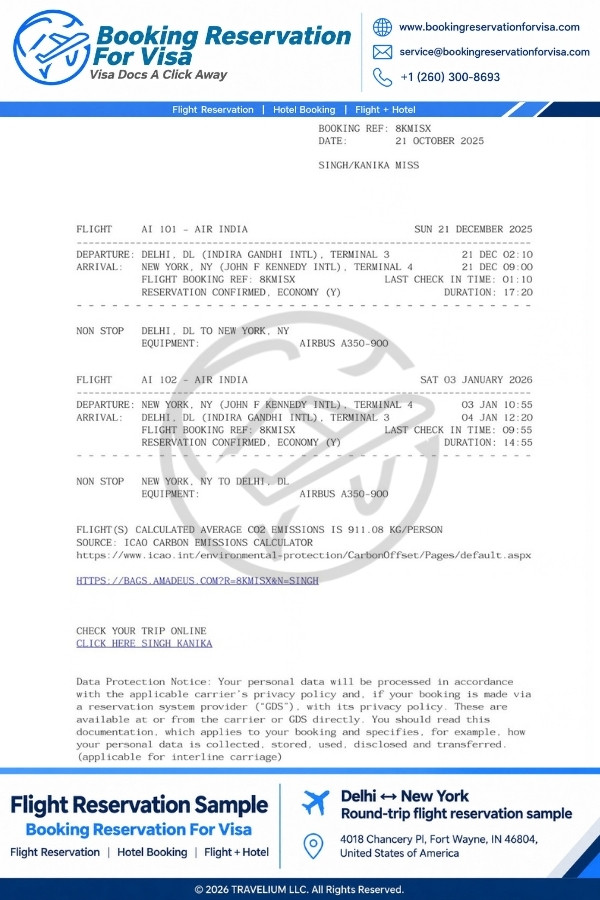
Specify the airport and any connections rather than requesting an unspecified India–USA document. The sample section below includes a Delhi–New York return example; it illustrates a format and should not determine another applicant’s dates or flight choices.
Flight Reservation for USA Visa From China
A flight reservation for USA visa from China should show the full journey, including any overseas connection and onward U.S. sector. Passenger naming and airport selection deserve careful review.
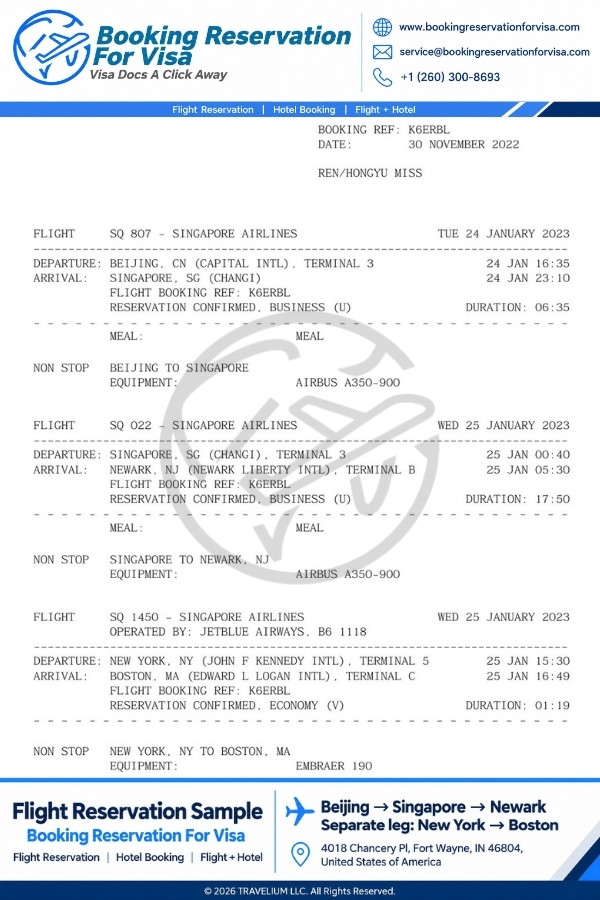
The reference example in this guide shows Beijing–Singapore–Newark followed by New York JFK–Boston. Newark and JFK are different airports, so that journey includes a ground transfer between U.S. airports. An itinerary with such a transfer should leave realistic time and explain the movement clearly.
Chinese travelers holding qualifying 10-year B-1, B-2 or B-1/B-2 visas in People’s Republic of China passports also need to check the applicable EVUS enrollment requirement before travel. A flight reservation is separate from that enrollment.
Flight Reservation for USA Visa From Mexico
For a flight reservation for USA visa from Mexico, first distinguish a U.S. visit from transit through the United States. The inbound flight alone may not explain an onward international journey.
The Mexico sample below shows Mexico City–New York–Accra. Its onward Ghana sector makes it a different travel example from a Mexico–USA–Mexico holiday return. Applicants should choose the category and route appropriate to their actual purpose.
Mexican applicants may also encounter Border Crossing Card or TN-related questions depending on the journey and intended activity. Check the applicable travel-document requirements; a flight reservation does not grant permission to enter under a different category.
Flight Reservation for USA Visa From Brazil
A flight reservation for USA visa from Brazil should identify the U.S. arrival point and any domestic sectors needed for the intended visit or relocation.
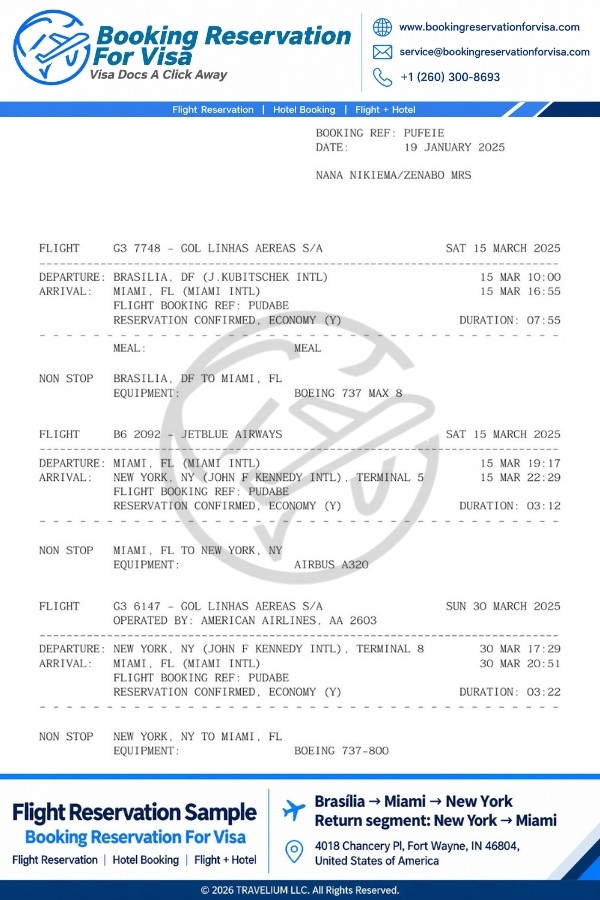
The reference sample includes Brasília–Miami–New York and a return-side New York–Miami sector. It is useful for showing how international and domestic flights can appear in one booking document. The supplied excerpt should not be described as proof of a complete return to Brazil unless the final Brazil sector is also included.
For a visitor application, coordinate the planned stay with the actual cities visited. For an immigrant case, prepare the arrival around the intended U.S. residence. The same departure country does not make those two journeys equivalent.
Flight Reservation for USA Visa From Pakistan
For a flight reservation for USA visa from Pakistan, provide the actual departure airport, proposed U.S. destination, intended dates and any connection preference. Keep that route consistent with the reason given in the application.
A visitor seeing relatives, a student reporting to a university and a worker joining an employer will have different planning priorities. If a route connects through a third country, check the transit requirements for the passport and journey involved.
Do not copy another country’s appointment or processing assumptions. Use the instructions for the U.S. post handling the case and arrange the flight reservation near the stage when it is genuinely useful.
Flight Reservation for USA Visa From Russia
A flight reservation for USA visa from Russia requires attention to both the proposed journey and the visa-processing location. Current U.S. nonimmigrant post guidance directs Russian applicants without another relevant residence arrangement to designated processing locations, including Warsaw and Astana.
Travel to an interview location and travel to the United States are separate journeys. A flight reservation for the U.S. trip does not establish permission to enter the country where an interview takes place.
Check current airline availability and third-country entry or transit requirements before choosing the proposed route. Do not rely on an old direct-flight example or assume that a routing available to another passport holder is usable for yours.
Flight Reservation for USA Visa From the Philippines
A flight reservation for USA visa from the Philippines may concern a visitor, student, exchange, employment, crew or immigrant journey. Match the route to the actual application rather than using one standard return template for every traveler.
For a student, identify the destination closest to the school and plan any onward transport. For a crew member, coordinate the airport with the employer’s joining instructions. For a family-based immigrant, prepare a route that reflects the intended move.
When traveling with relatives, check each passenger’s name and whether everyone will depart together. A family relationship does not automatically mean identical travel arrangements.
Flight Reservation for USA Visa From Nigeria
Before ordering a flight reservation for USA visa from Nigeria, check current visa-issuance and entry restrictions for the passport and category involved. At the time of writing, published U.S. policy restricts specified visitor, student, exchange and immigrant visa issuance for Nigerian nationals, subject to its applicability and limited exceptions.
Someone searching for an F-1 flight reservation from Nigeria therefore needs an eligibility check before a booking task. Departing from another country does not, by itself, remove a nationality-based restriction.
Where the applicant can lawfully proceed, prepare the route around the genuine school, host, employer or proposed residence. A flight reservation cannot override a suspension, establish an exception or secure visa approval.
Flight Reservation for USA Visa From Indonesia
For a flight reservation for USA visa from Indonesia, specify the genuine departure airport and intended U.S. destination. A journey may involve an overseas connection, a later U.S. domestic flight or both.
Review the route as a complete sequence. Check whether the connection involves immigration, baggage collection, an overnight stay or an airport change, and verify the requirements for the passport involved.
A student heading to a campus outside the international arrival city should plan the onward journey. A visitor traveling between several U.S. cities should keep the accommodation dates aligned with those movements.
Flight Reservation for USA Visa From the United Kingdom
A flight reservation for USA visa from the United Kingdom can concern a British citizen or a resident holding another nationality. Those travelers may have different permission requirements even when they depart from the same airport.
Some qualifying British citizens can use the Visa Waiver Program for eligible short business or tourism visits, subject to ESTA and all program conditions. Other purposes, including qualifying study, work and immigration, require the appropriate process.
For residents who need a U.S. visa, choose the flight reservation according to the actual application and trip. UK residence does not automatically confer the travel privileges associated with a British passport.
Flight Reservation for USA Visa From Schengen Countries
Travelers departing from France, Spain, Italy, Malta, Germany or another Schengen country should distinguish where they live or depart from from which passport they hold.
Many qualifying nationals of Visa Waiver Program countries may travel for eligible short visits with approved ESTA rather than a B visa. A noncitizen resident in the same country does not automatically receive that privilege. Study, authorized employment, exchange programs and permanent immigration also have their own requirements.
For example, an Indian citizen living in France and applying for an F-1 visa should plan around the U.S. institution, the student’s documents and the appropriate application post. An applicant preparing an immigrant visa from Malta should prepare a relocation plan rather than a short tourist return.
A flight reservation for USA visa from Italy, France or Malta should therefore be tailored to the applicant, not merely labelled with the departure country. The sample section includes a Milan–New York return route as a Schengen-origin example.
The Schengen state rules apply to all member states including Austria, Belgium, Bulgaria, Croatia, Czechia, Denmark, Estonia, Finland, France, Germany, Greece, Hungary, Iceland, Italy, Latvia, Liechtenstein, Lithuania, Luxembourg, Malta, the Netherlands, Norway, Poland, Portugal, Romania, Slovakia, Slovenia, Spain, Sweden and Switzerland.
Flight Reservation for USA Visa From Any Country: Worldwide Country List
BRFV’s online ordering process can be used to request a flight reservation for a proposed USA journey from different departure countries, subject to service availability and the applicable conditions. Select the actual route and visa purpose rather than looking for a different booking product for every nationality.
The regional table below covers countries worldwide and additional commonly searched travel origins. The table is an origin-country index: it does not mean every passport holder needs a U.S. visa, can currently receive one, or must submit a flight reservation.
| Region | Countries and travel origins covered by this guide |
| Africa | Algeria, Angola, Benin, Botswana, Burkina Faso, Burundi, Cabo Verde, Cameroon, Central African Republic, Chad, Comoros, Republic of the Congo, Democratic Republic of the Congo, Côte d’Ivoire, Djibouti, Egypt, Equatorial Guinea, Eritrea, Eswatini, Ethiopia, Gabon, The Gambia, Ghana, Guinea, Guinea-Bissau, Kenya, Lesotho, Liberia, Libya, Madagascar, Malawi, Mali, Mauritania, Mauritius, Morocco, Mozambique, Namibia, Niger, Nigeria, Rwanda, São Tomé and Príncipe, Senegal, Seychelles, Sierra Leone, Somalia, South Africa, South Sudan, Sudan, Tanzania, Togo, Tunisia, Uganda, Zambia, Zimbabwe |
| South, East and Southeast Asia | Afghanistan, Bangladesh, Bhutan, Brunei, Cambodia, China, India, Indonesia, Japan, Laos, Malaysia, Maldives, Mongolia, Myanmar, Nepal, North Korea, Pakistan, Philippines, Singapore, South Korea, Sri Lanka, Taiwan, Thailand, Timor-Leste, Vietnam |
| Middle East | Bahrain, Iran, Iraq, Israel, Jordan, Kuwait, Lebanon, Oman, Palestine and Palestinian travel-document holders, Qatar, Saudi Arabia, Syria, United Arab Emirates, Yemen |
| Central Asia and the Caucasus | Armenia, Azerbaijan, Georgia, Kazakhstan, Kyrgyzstan, Tajikistan, Turkmenistan, Uzbekistan |
| Europe: Schengen countries | Austria, Belgium, Bulgaria, Croatia, Czechia, Denmark, Estonia, Finland, France, Germany, Greece, Hungary, Iceland, Italy, Latvia, Liechtenstein, Lithuania, Luxembourg, Malta, Netherlands, Norway, Poland, Portugal, Romania, Slovakia, Slovenia, Spain, Sweden, Switzerland |
| Europe and Eurasia: other countries | Albania, Andorra, Belarus, Bosnia and Herzegovina, Cyprus, Ireland, Kosovo, Moldova, Monaco, Montenegro, North Macedonia, Russia, San Marino, Serbia, Türkiye (Turkey), Ukraine, United Kingdom, Vatican City (Holy See) |
| North America, Central America and the Caribbean | Antigua and Barbuda, Bahamas, Barbados, Belize, Canada, Costa Rica, Cuba, Dominica, Dominican Republic, El Salvador, Grenada, Guatemala, Haiti, Honduras, Jamaica, Mexico, Nicaragua, Panama, Saint Kitts and Nevis, Saint Lucia, Saint Vincent and the Grenadines, Trinidad and Tobago, United States |
| South America | Argentina, Bolivia, Brazil, Chile, Colombia, Ecuador, Guyana, Paraguay, Peru, Suriname, Uruguay, Venezuela |
| Oceania | Australia, Fiji, Kiribati, Marshall Islands, Micronesia, Nauru, New Zealand, Palau, Papua New Guinea, Samoa, Solomon Islands, Tonga, Tuvalu, Vanuatu |
| Additional travel origins and territories | Hong Kong, Macao (Macau), Bermuda, Greenland, Faroe Islands, Puerto Rico, U.S. Virgin Islands and other territories, subject to their distinct passport, status and route arrangements |
Regional grouping is for convenient navigation. It does not determine nationality, diplomatic recognition, immigration jurisdiction or visa eligibility.
U.S. citizens do not need a U.S. visa to enter the United States. Canadian citizens and some other travelers have particular visa-exemption rules, while eligible Visa Waiver Program travelers must meet the relevant conditions. Foreign nationals already in the United States should distinguish visa issuance abroad from status changes or other immigration procedures inside the country.
For any listed origin, check the rules for the passport and visa category involved. Current restrictions, designated processing posts, service availability and any required exception remain separate from the ability to request a proposed flight reservation.
Flight Reservation Samples for USA Visa Applications
The five sample spaces below are arranged around the supplied route references. They demonstrate how travel details can be displayed; they are not active bookings for a reader’s own journey. Use a newly arranged flight reservation with your own passenger details and dates where appropriate.
Flight Reservation Sample From Brazil to the United States
This example illustrates an international arrival from Brasília to Miami and an onward domestic flight to New York. The supplied excerpt also shows a New York–Miami return-side sector. It is useful for explaining a journey with more than one U.S. city.
Flight Reservation Sample From Brazil to the United States – Brasília, Miami and New York Route Example.
 Flight Reservation Sample From Mexico to the United States
This example shows Mexico City–New York followed by New York–Accra. The onward Ghana sector is important because the document illustrates travel through the United States rather than a return journey ending in Mexico.
Flight Reservation Sample From Mexico to the United States – Mexico City–New York, With Onward Travel to Accra.
Flight Reservation Sample From China to the United States
This example displays Beijing–Singapore–Newark and a separate New York JFK–Boston sector. It demonstrates why travelers should review the complete itinerary, including a ground transfer when connecting flights use different airports.
Flight Reservation Sample From China to the United States – Beijing–Singapore–Newark, Followed by JFK–Boston.
Flight Reservation Sample From India to the United States
This sample shows a Delhi–New York journey with a return to Delhi. It provides a clear example of how outbound and return sectors can appear in a flight reservation for a temporary proposed visit.
Flight Reservation Sample From India to the United States – Delhi–New York Round-Trip Route Example.
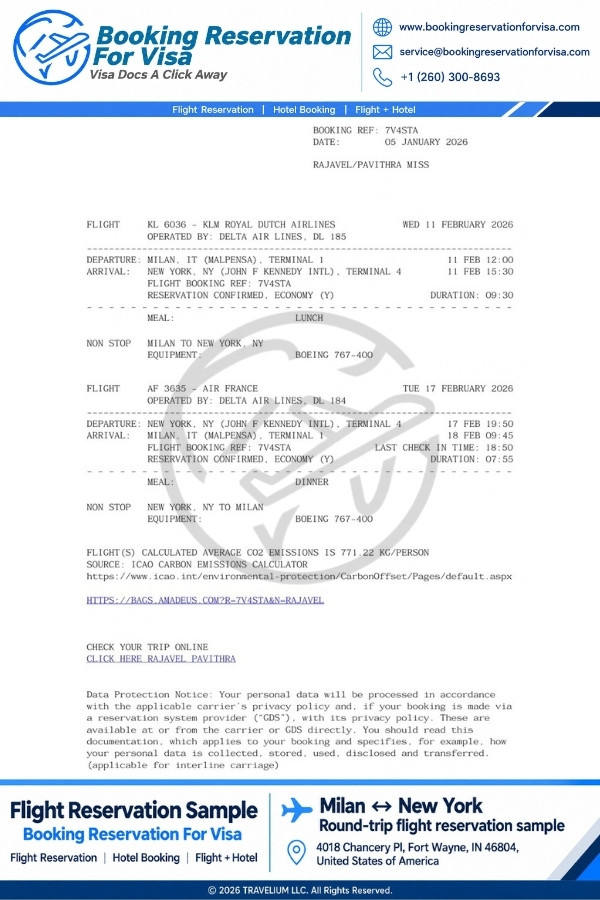
 Flight Reservation Sample From a Schengen Country to the United States
The Schengen-origin reference shows a Milan–New York return journey. It demonstrates a European departure route and should not be interpreted as proof that every Schengen resident follows the same U.S. visa process.
Flight Reservation Sample From Italy in the Schengen Region to the United States – Milan–New York Return Route.
How to Verify a Flight Reservation Before Using It
Start with the airline or verification channel identified for the actual booking. Do not use an unrelated website solely because it accepts a booking reference field.
- Identify the airline and, where relevant, the operating carrier shown on the document.
- Open the airline’s official booking-management section or the supplied verification channel.
- Enter the relevant booking reference and passenger surname as instructed.
- Compare the passenger name, airports, dates and flight sectors with the delivered document.
- Check the displayed booking status and any expiry or ticketing information available.
- Contact BRFV promptly if the record cannot be found or the details do not agree.
Some journeys involve codeshares, agency references or different airline record locators. The reference on the document may not be the identifier used by every carrier in the journey. Ask for the correct locator and instructions before concluding that an unsuccessful search proves the booking is invalid.
Equally, a successful lookup does not prove that a ticket has been issued. Confirm the ticket status separately when you are arranging actual travel.
A useful verification check answers two different questions: does the booking record exist, and does it match the document you intend to use? Both matter.
When Should You Order the Flight Reservation?
Arrange the flight reservation after the proposed purpose, destination and dates are reasonably clear, and near the stage when the document will be useful. Leave enough time to review it and request a correction.
Do not order an active reservation months before an appointment solely to complete an early planning checklist. Its validity period may end before the document is needed. A tentative itinerary can help with initial planning without being presented as an active airline booking.
BRFV advertises validity of up to 14 days, but the actual reservation conditions should be confirmed for the order. Calculate the intended delivery and use dates against that window.
If an interview is postponed, contact the service provider and check what can be arranged. Do not assume the same booking reference can always be retained or extended. If administrative processing continues after the reservation expires, respond to any consular request with accurate current information rather than presenting the old record as active.
One-Way or Return Flight Reservation for a USA Visa?
The best choice is the journey you actually intend to make. The visa purpose helps explain that choice, but it does not create one universal booking format.
A visitor with a settled temporary stay may find a return flight reservation useful. Someone moving permanently after immigrant visa issuance may have a genuine one-way arrival plan. A student beginning a long program may not yet have a reasonably settled return date. A transit traveler needs the onward movement that explains passage through the United States.
Do not create a return sector solely to make an immigrant case look temporary. Do not omit a genuine onward sector when the application concerns transit. For employment, follow the authorized arrangement and the applicant’s actual plan rather than copying visitor-visa assumptions.
Where plans remain approximate, describe them honestly. The booking should help clarify the proposal, not force the application into dates or movements the traveler cannot explain.

Hotel Booking for USA Visa Applications
A hotel booking may help organize a genuine planned stay, but accommodation should reflect the traveler’s circumstances. There is no universal rule requiring every U.S. visa applicant to reserve a hotel.
Tourists visiting several cities may want hotel bookings that follow the route. Business travelers may stay near the meeting venue. Someone visiting relatives may use the host’s address. Students may have campus housing or another actual arrangement, while workers and immigrants may initially stay with an employer, sponsor or family member.
If hotel support is appropriate, BRFV offers hotel-booking and combined-service options. Provide the guest details, cities and check-in and check-out dates that match the proposed journey.
Check the stay against the local arrival date, not just the departure date in the country of origin. Time zones and overnight flights can change the calendar day. Also account for any domestic movement between U.S. cities so that one hotel stay does not overlap incorrectly with another.
Do not describe a hotel booking as evidence of permanent housing, and do not substitute it for a genuine host or university arrangement already stated in the application.

Connections, U.S. Entry Airports and Domestic Travel
A flight reservation should remain understandable when read sector by sector. The first U.S. arrival point and the final U.S. destination may be different.
For ordinary international arrivals, immigration and customs formalities generally occur at the first U.S. arrival airport. Preclearance arrangements can change where those formalities take place. Either way, a connection should allow for the procedures that actually apply.
Check whether baggage needs to be collected and rechecked, whether terminals are connected, and whether flights use the same airport. A Newark arrival followed by a JFK departure involves a ground transfer across the New York area, not simply a change of gates.
Domestic travel should also have a clear role. If the applicant intends to stay in Boston, an international arrival in Miami needs a realistic onward plan. If the journey includes a holiday in two cities, the hotel dates should follow the movement between them.
Transit through another country requires its own checks. A flight reservation through the United Kingdom, Canada, the Schengen area or an Asian hub does not establish that the traveler meets that country’s transit or entry conditions.
Current USA Visa Rules to Check Before Booking
Nationality-based restrictions, visa-issuance policies, designated interview posts and screening requirements can affect whether and how an applicant proceeds. A worldwide flight reservation service does not remove those conditions.
Check the latest instructions for the passport, category and post involved. Some current restrictions distinguish between visitor, student, exchange, employment and immigrant categories. Existing visas, residence status and specified exceptions can also matter; a general country list cannot determine an individual case.
Certain B-1/B-2 applicants may be directed by a consular officer to post a visa bond. Such a bond is a government requirement separate from a flight reservation or BRFV service payment. Follow the official instructions and payment channel supplied for the case.
Additional screening can affect categories beyond tourism. Keep application information accurate and comply with the instructions given by the responsible post. A reservation showing convenient dates does not shorten screening or establish eligibility.
For immigrant and Diversity Visa cases, review current program and issuance notices rather than relying on a historic headline. Policies can be amended after an article or search result was published.
Common Flight Reservation Mistakes in USA Visa Preparation
Treating a Reservation as a Universal Requirement
Applicants sometimes order documents before reading their U.S. instructions. That can create unnecessary expense without addressing the actual requirements. Start with the category and the post’s guidance, then decide whether a flight reservation serves the application.
Using Names That Do Not Match the Passport
Shortened names, omitted given names and passenger mix-ups can disconnect a booking from the application. Check each traveler separately and ask for guidance on single-name passports or unusual naming fields.
Confusing Booking Status With Ticket Status
A reference that retrieves a booking does not automatically establish that a paid ticket exists. Describe the flight reservation according to the actual record and arrange ticketing separately when ready to travel.
Choosing Dates That Conflict With the Purpose
A student arrival outside the permitted period, a business arrival after the event or a hotel stay ending before the proposed visit finishes creates avoidable confusion. Review dates across the application and supporting documents.
Omitting Connections or Airport Transfers
A journey should not appear complete when a necessary sector or ground transfer has been left unexplained. Review the full route, including changes between airports and onward travel after entering the United States.
Using an Expired Reservation as Though It Were Active
A saved PDF can retain the original appearance after the underlying booking has expired. Check the status when needed and obtain accurate current information if the consulate requests it.
Copying a Sample Into a Personal Application
Samples illustrate structure. Their passenger names, dates and booking references belong to the reference document and should not be reused as though they describe another traveler’s booking.
Expecting the Reservation to Guarantee Visa Approval
A flight reservation explains a proposed journey. It cannot establish eligibility, overcome a nationality restriction, replace an approved petition or resolve a refusal based on other circumstances.
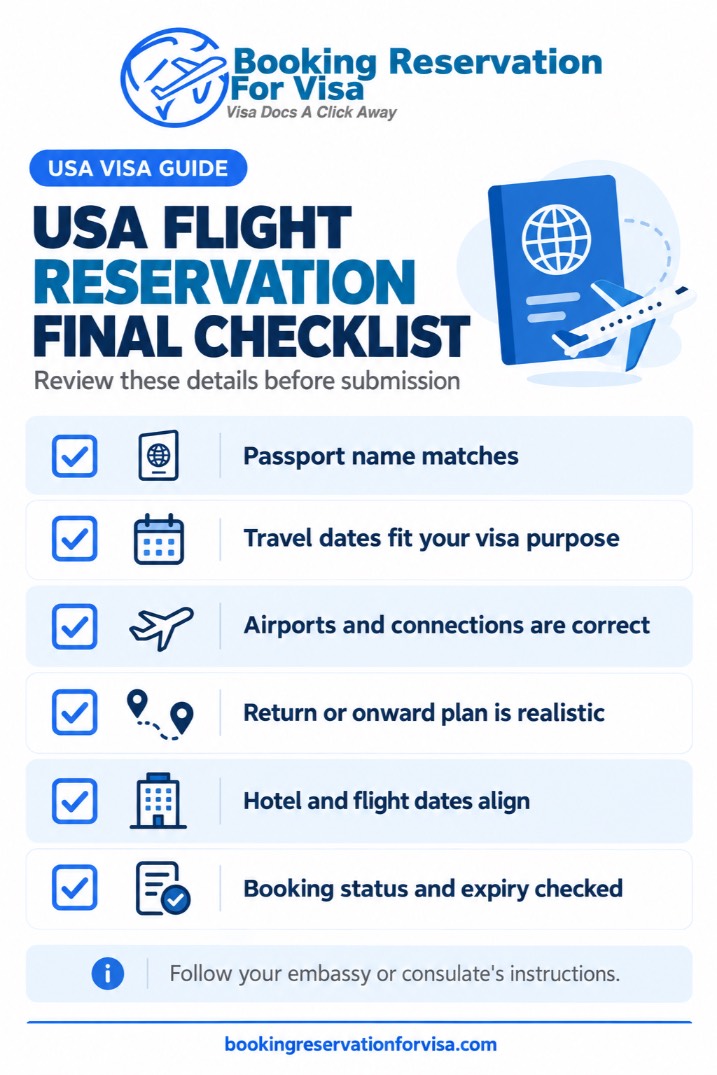
Flight Reservation Checklist
Before using the document, check the following:
- The visa category matches the actual travel purpose.
- The document is useful or requested for the relevant stage of the application.
- Passenger names correspond with the passports.
- Departure, connection and arrival airports are correctly identified.
- The proposed dates fit the visit, program, assignment or relocation plan.
- Return or onward sectors represent the genuine intended journey.
- Accommodation details agree with the arrival dates and cities visited.
- Any airport change or ground transfer is understood.
- The booking record matches the delivered flight reservation.
- The current status and validity are accurately described.
- The applicant can explain the plan without relying on copied sample details.
After visa issuance, review the visa, passport, permitted travel dates and current entry conditions before buying or finalizing the ticket. Confirm the actual journey with the airline and arrange any required transit permissions.
Frequently Asked Questions
- How do I get a flight reservation for USA visa application online?
Check the instructions for your visa category, then use BRFV’s flight reservation form when a reservation is useful or requested. Enter the passenger names, route, intended dates and appointment timing, review the order and complete the service payment. Check the delivered document and booking record before use.
- Must I buy a flight ticket before applying for a U.S. visa?
A paid ticket is not a universal application requirement. U.S. visitor guidance advises applicants to avoid final travel plans and ticket purchases before visa issuance. Follow the specific instructions for your case; a flight reservation can organize proposed travel where appropriate.
- Can I complete the DS-160 without a confirmed flight reservation?
The DS-160 guidance refers to an itinerary if travel arrangements have already been made. Do not manufacture confirmed details when plans are tentative. Answer the actual questions accurately and use intended travel information where the form requests it.
- How do I get a flight reservation for a B1/B2 USA visa from India?
Select the actual departure airport, U.S. destination and proposed stay. If you have a genuine return plan, request a round-trip flight reservation through BRFV and enter the passport names and dates. Keep the route consistent with the business, tourism, medical or family-visit purpose explained in the application.
- How do I get a flight reservation for an F1 USA visa from Nigeria?
First check current restrictions and eligibility for the Nigerian passport and F-1 category involved. If the applicant can lawfully proceed, prepare the proposed arrival around the Form I-20, school location and permitted arrival period. A flight reservation does not establish an exception to a restriction.
- How do I get a flight reservation for a USA immigrant visa from Malta?
Prepare the journey around the actual consular case and intended U.S. residence. A one-way flight reservation may fit permanent relocation when travel information is useful or requested. Wait for visa issuance and confirmation of the travel permission before finalizing the move.
- Can I request a flight reservation for USA visa from Pakistan, Indonesia or the Philippines?
You can submit the proposed departure airport, destination, dates and passenger details through BRFV’s online order process, subject to the applicable service conditions. The visa category, passport rules and consular instructions still determine whether the applicant can proceed and what evidence is needed.
- Do France or Italy residents automatically qualify for ESTA?
No. Eligibility depends on the traveler’s passport nationality and all Visa Waiver Program conditions, not residence alone. A resident holding another nationality may need a U.S. visa, and study, work or permanent immigration may require a different process regardless of departure country.
- Is a one-way flight reservation suitable for a student visa?
A one-way reservation may accurately describe an initial study journey when the eventual return date is not settled. It does not establish student visa eligibility or replace the required education documents. Follow the applicable arrival rules and the school’s instructions.
- Should an immigrant visa applicant request a return flight reservation?
Choose the journey that reflects the genuine plan. Permanent relocation may involve one-way travel, while some applicants have other real arrangements. An invented short return should not be added simply to make an immigrant case resemble a tourist application.
- Can BRFV arrange a multi-city USA flight reservation?
BRFV’s flight reservation form includes a multiple-city option. Describe each intended sector and date in travel order. Check availability and the order conditions, and make sure the route matches any hotel bookings or onward travel arrangements.
- How long is a BRFV flight reservation valid?
BRFV advertises validity of up to 14 days. Confirm the actual booking conditions and expiry for your order. The reservation window is separate from U.S. visa processing time and should be planned around when the document will be useful.
- How quickly will I receive the flight reservation?
BRFV advertises standard delivery within one to two hours after payment confirmation. Confirm the arrangements for an urgent or complex order and leave time to review the document. Delivery timing does not affect the government appointment or visa-decision timeline.
- Can I request changes after delivery?
Contact BRFV promptly if the passenger details, route or dates need correction. Its published guidance recommends early review and generally identifies the first three to four days as the practical correction window. Confirm the available change arrangements for the specific booking.
- Does a booking reference mean that the airfare has been paid?
No. A booking reference identifies a reservation record. Ticket issuance and payment status are separate questions. Check the actual ticketing information when arranging travel rather than assuming that an active flight reservation is a paid airline ticket.
- What should I do if the airline website cannot find the booking?
Recheck the surname, booking reference and airline. A codeshare or agency booking may use a different airline locator. Ask BRFV for the correct verification instructions and clarification of the booking status before using the document as an active reservation.
- Can I use the sample booking reference in my own application?
No. A sample reference does not create a booking for another traveler. Request a flight reservation with your own details where appropriate. The examples in this article explain document structure and route presentation.
- Do I need a hotel booking for a USA visa if I am staying with family?
Use the genuine host arrangement and the application instructions. There is no universal requirement for every U.S. applicant to reserve a hotel. An unrelated hotel booking can create inconsistency if the application says the traveler will stay with relatives.
- Can a flight reservation help with a C1/D crew member application?
It can help organize the proposed flight to the joining location when relevant. The route should follow the employer’s instructions and the applicable crew and transit category. The reservation does not replace a joining letter or establish that the applicant qualifies for crew permission.
- Do I need a flight reservation to enter the Diversity Visa lottery?
No. A flight reservation does not form part of entering the lottery. Travel planning concerns a later stage for a selected applicant who proceeds through the required process. Selection alone does not authorize travel or guarantee visa issuance.
- Will buying a flight reservation improve or guarantee my visa approval?
No reservation service can guarantee a visa. A clear route can help explain the proposed journey where that information is useful, but the decision depends on eligibility and the evidence relevant to the application. Buying more travel documents does not automatically resolve a weak case.
- Can a flight reservation overcome a previous visa refusal?
A reservation alone does not resolve a refusal. Consider the stated grounds, any requested evidence and changes in the applicant’s circumstances. A clearer route may address a travel-planning question, but it cannot replace the eligibility evidence required for a new or continuing case.
- What happens if my interview is postponed or processing takes longer?
Check the booking expiry and contact BRFV about available arrangements. Do not assume an extension is automatic or that the same reference will always remain available. If current travel evidence is requested later, provide accurate updated information.
- Is there a standard B3 USA visitor visa?
The usual visitor categories discussed in this guide are B-1, B-2 and combined B-1/B-2. Do not choose a supposed B3 tourist category based on a search phrase or a typing error. Use the visa classification appropriate to the intended activity.
- Is the BRFV service fee the same as a U.S. visa fee or visa bond?
No. The BRFV fee pays for the selected reservation service. Government visa fees and any consular-directed bond are separate. Pay official requirements through the channels given for the application and review the BRFV order total independently.
- Can I travel using only the reservation PDF?
A reservation PDF alone does not establish that a ticket has been issued or that you meet the visa and entry requirements. Arrange the appropriate airline ticket and travel documents before departure. The booking used during planning may have expired or may need to be replaced with the final travel purchase.
Arrange Your USA Flight Reservation Around the Application You Actually Have
A good flight reservation for USA visa preparation makes the proposed journey understandable. It identifies the traveler, route and dates and agrees with the purpose explained in the application. A visitor plan, student arrival, crew connection and permanent move should each be presented according to their real circumstances.
Start with the U.S. instructions for your visa category and passport. Decide whether a flight reservation is useful or requested, choose a genuine one-way, return or multi-city journey, and arrange delivery near the stage when you need the document.
BRFV offers flight reservations and optional hotel-booking support through its online order process. Provide accurate passenger details, describe the intended route, review the delivered document and verify the booking. Once the visa position is confirmed, arrange the final ticket and accommodation around the journey you will actually make.
Ready to organize your proposed USA journey? Choose Flight Reservation with Booking Reservation for Visa, enter your route and travel details, and add hotel-booking support when it fits your stay.