Planning an international trip normally begins with searching for flights. Applying for a visa, however, changes the order in which those decisions should be made.
A traveler may find a suitable flight, compare the fare, select the dates and then hesitate at the payment page. Should the entire ticket price be paid before the visa application is submitted? Will the embassy accept a flight reservation instead? Does a fully paid ticket make the application appear more credible? What happens to the airfare if the visa is delayed or refused?
These are reasonable concerns because airline tickets can represent one of the largest expenses in an international trip. A low-cost, restrictive fare may be difficult to refund. A flexible fare may protect the traveller from cancellation losses, but it can cost substantially more. Even when a ticket permits changes, the passenger may still have to pay a fare difference, a reissue charge or an agency service fee.
For most visa applications, a fully paid airline ticket is not automatically mandatory. What the applicant is commonly expected to provide is evidence of an intended journey: the proposed route, departure and return dates, airline information and, where required, a valid booking reference.
A professionally prepared flight reservation or flight itinerary for visa application purposes can provide this information without requiring the applicant to pay the complete airfare before the visa decision.
This distinction is particularly important for a Schengen visa application. Official Schengen checklists used by some consular authorities explicitly request a confirmed round-trip reservation while advising applicants not to purchase the actual ticket before the visa has been issued. For example, Swiss Schengen checklists state that applicants should submit a round-trip flight reservation and should not purchase the airline ticket yet because the embassy cannot be responsible for financial losses.
The correct approach can therefore be summarized as follows:
At the visa application stage, demonstrate a realistic and coherent travel plan. Purchase the final airline ticket when the visa has been granted, unless the responsible embassy or visa centre specifically requires something different.
The individual document checklist issued for the applicant’s nationality, country of residence, visa category and destination must always take priority.
Is a Fully Paid Flight Ticket Mandatory for a Visa Application?
Not in every case.
There is no single global rule requiring every visa applicant to purchase a non-refundable airline ticket before applying. Different immigration authorities use different documentary systems.
Some visa authorities ask for:
- A round-trip flight reservation
- A proposed flight itinerary
- Proof of onward travel
- A transport booking
- A travel schedule
- A confirmed booking reference
- An explanation of the intended route
Others do not require a flight booking at the initial application stage at all.
Even within the Schengen system, applicants must follow the locally applicable checklist. Schengen countries apply a common visa framework, but supporting-document lists can be adapted according to the applicant’s location, purpose of travel and individual circumstances. The European Commission’s visa guidance explains that supporting documents should establish the purpose of the journey, accommodation, financial capacity and the applicant’s intention to leave before the requested visa expires. It also confirms that documents must be assessed in relation to the individual application.
This means a flight document is not valuable merely because it is expensive. Its value lies in what it proves.
A suitable flight itinerary can help demonstrate:
- Where the journey begins
- How the applicant intends to enter the destination
- The proposed arrival date
- The intended departure date
- Whether the stay fits within the requested visa period
- Whether the applicant has planned to leave before the permitted stay expires
- Whether the route corresponds with accommodation and other travel documents
- Whether any transit or additional destination has been considered
A fully paid ticket may contain all this information, but a genuine flight reservation can often provide the same application-stage travel structure at a much lower financial exposure.
What Is a Fully Paid Airline Ticket?
A fully paid airline ticket is an issued travel document created after the passenger has completed payment and the airline or authorized ticketing agent has issued the ticket.
It normally contains two important booking elements:
A Passenger Name Record
The Passenger Name Record, commonly called a PNR or booking reference, is the booking record containing the passenger and itinerary information.
An E-Ticket Number
The e-ticket number confirms that ticket issuance has taken place. It is different from the PNR.
A PNR represents the reservation record, while an e-ticket confirms the ticketed travel contract. Amadeus, a major travel technology provider, explains that the PNR is the internal booking record, whereas the ticket confirms the passenger’s seat and completes the ticketing relationship between the airline and traveller.
Therefore, an actual paid ticket normally includes:
- Passenger’s full name
- Booking reference or PNR
- E-ticket number
- Airline name
- Flight numbers
- Origin and destination airports
- Departure and arrival dates
- Departure and arrival times
- Cabin or booking class
- Baggage entitlement, where applicable
- Fare conditions
- Ticket status
- Payment and issuing information
The e-ticket can be used for the actual journey, subject to the visa, passport, entry requirements and airline conditions being satisfied.
A flight reservation prepared only for the application stage normally does not include an issued e-ticket number because the full airfare has not yet been paid.
What Is a Flight Reservation for a Visa?
A flight reservation for a visa is a documented booking record showing the applicant’s proposed air journey without necessarily completing the final ticket purchase.
It may also be described as:
- Flight itinerary for visa
- Flight booking for visa
- Air itinerary
- Reserved flight itinerary
- Schengen visa flight reservation
- Proof of proposed air travel
- Round-trip reservation
- Travel itinerary for visa application
A properly prepared reservation should be based on a real and workable route. It should not be an invented document, an edited screenshot or a self-designed ticket template.
Depending on the reservation method, it can include:
- The applicant’s full name
- Airline or airlines
- Flight numbers
- Departure and arrival airports
- Dates and times
- Connecting flights
- Booking class
- Round-trip, one-way or multi-city sectors
- A booking reference or PNR
- Reservation status
- Issuing agency information, where relevant
The dummy flight supports the visa application, but it is not a boarding pass and not an issued ticket. It cannot be used to check in or fly unless the itinerary is subsequently ticketed and an e-ticket is issued.
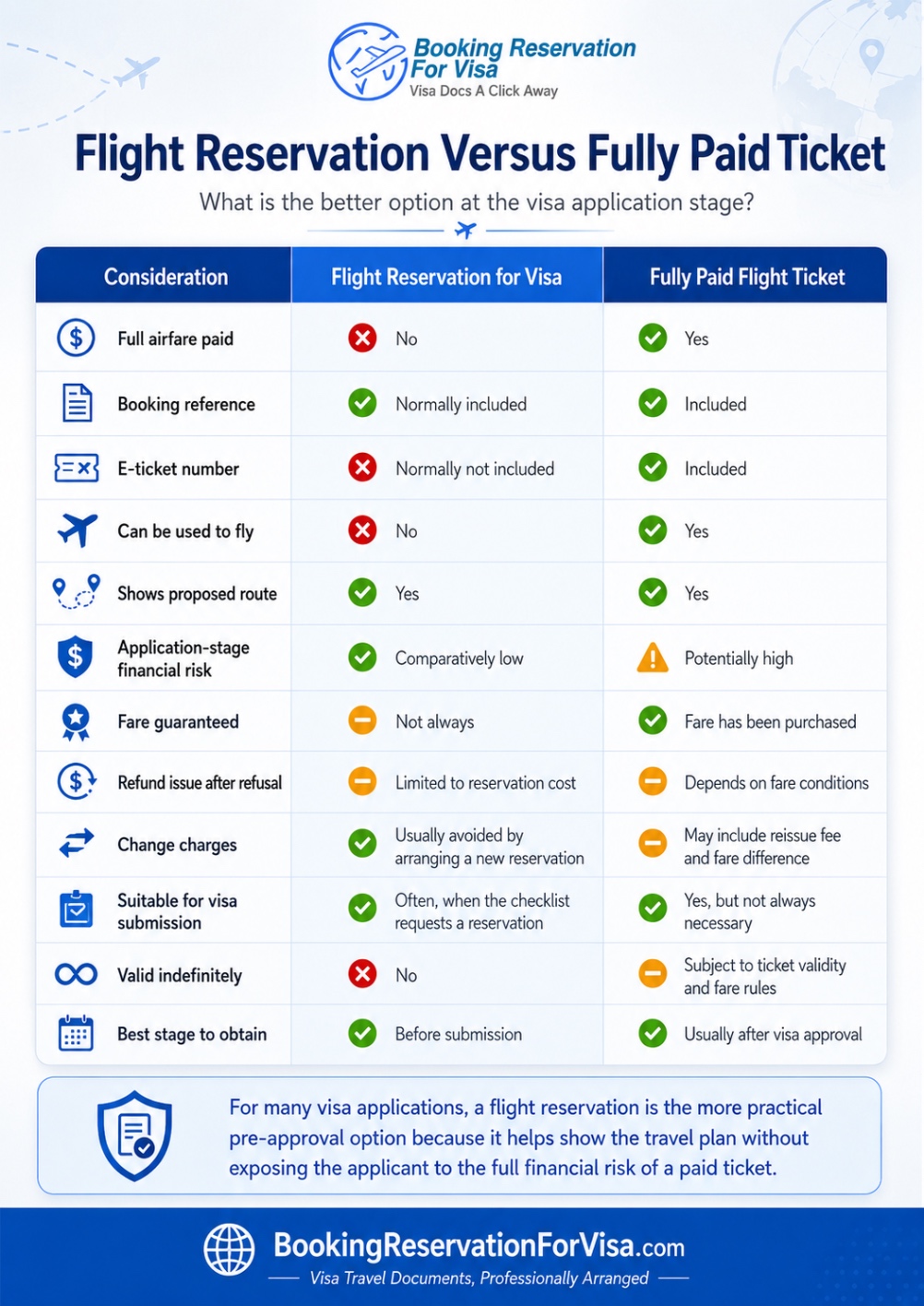
Flight Reservation, Fare Hold and Paid Ticket Are Not the Same Thing
These three terms are frequently confused.
Flight Itinerary for Visa
This is intended to document a proposed route for the visa file. It may remain active for a defined period, depending on the airline, route, booking class, reservation system and provider.
Airline Fare Hold
A fare hold is an option offered by certain airlines that temporarily protects a selected fare before payment.
For example, Emirates offers a limited hold option on eligible bookings, while Qatar Airways allows some passengers to hold eligible bookings for 24, 48 or 72 hours for a fee. Availability depends on the route and booking conditions.
A short airline hold can be helpful when a traveller needs time to complete payment. However, a hold lasting only one to three days may not be sufficient for a visa application that will remain under consideration for considerably longer.
Fully Paid Ticket
This is an issued ticket with an e-ticket number. It can be used for travel once all immigration and airline requirements have been met.
A key distinction is that a reservation does not necessarily lock the fare. Unless the provider or airline specifically offers price protection, the airfare can change before the applicant purchases the final ticket.
What Is a Schengen Visa and What Are Its Types?
A Schengen visa allows eligible travellers to enter one or more countries within the Schengen Area under the conditions stated on the visa. The appropriate category depends on the purpose, route and intended length of stay.
The main types are:
- Type A – Airport Transit Visa: Permits eligible travellers to remain within the international transit zone of a Schengen airport while continuing to a non-Schengen destination.
- Type C – Short-Stay Visa: Covers tourism, family visits, business trips and other temporary stays of up to 90 days within a 180-day period.
- Type D – National Long-Stay Visa: Issued by an individual Schengen country for longer stays such as employment, education, research or family reunification.
- Limited Territorial Validity Visa: Restricts travel to the country or countries specifically stated on the visa.
Identifying the correct category is important because the journey shown in the application must suit the purpose and structure of the proposed stay. This article primarily addresses Type C applicants, who are most likely to question whether they should buy an actual airline ticket or provide a flight reservation during the application process.
Do I Need a Fully Paid Flight Ticket for a Schengen Visa?
In many Schengen cases, the applicant is expected to provide a round-trip flight reservation or transport itinerary, not necessarily a fully paid and non-refundable ticket.
Several official Schengen checklists make this distinction clear.
A Swiss tourist visa checklist requests a confirmed dummy flight ticket containing the applicant’s name, followed by a warning not to buy the ticket before the visa is issued. Another Swiss checklist instructs applicants to provide round-trip air travel and any applicable intra-Schengen transport while stating that the airline ticket should not yet be purchased.
German consular guidance has similarly stated in a business visa context that only a flight reservation is necessary and that purchasing a booked ticket does not result in preferential application processing.
These instructions reveal two important principles.
First, the consulate wants to understand the journey.
Second, purchasing an expensive ticket does not buy a faster decision or create an entitlement to visa approval.
What the Schengen Flight Reservation Should Demonstrate
A suitable Schengen visa flight reservation should help the decision-maker understand:
- The applicant’s intended entry into the Schengen Area
- The applicant’s intended exit
- The total length of the visit
- The principal destination
- Connections between the applicant’s home country and destination
- Any travel between Schengen countries
- Any transit through a non-Schengen country
- The relationship between flight dates and accommodation dates
- Whether the journey fits within the requested visa validity
For a single-country visit, the route may be straightforward.
For a multi-country trip, the itinerary may need to show a more detailed structure. The international flights, internal flights, trains and hotel bookings should form one continuous and understandable journey.
Example of a Consistent Schengen Route
Suppose an applicant intends to spend:
- Five nights in France
- Three nights in Belgium
- Two nights in the Netherlands
A coherent set of documents might show:
- Arrival in Paris on 10 September
- Hotel accommodation in Paris from 10 to 15 September
- Train or flight to Brussels on 15 September
- Hotel accommodation in Brussels from 15 to 18 September
- Travel to Amsterdam on 18 September
- Hotel accommodation in Amsterdam from 18 to 20 September
- Return flight from Amsterdam on 20 September
This is an open-jaw itinerary because the applicant enters through one city and departs from another.
There is no reason to force the applicant to return to Paris merely to create a conventional return booking when departure from Amsterdam is more logical. The route must, however, be explained clearly in the cover letter and daily itinerary.
Does a Fully Paid Ticket Improve the Chances of Schengen Visa Approval?
A paid ticket does not guarantee approval.
The visa decision is based on the complete application, not on the amount spent on a flight.
The consulate may assess:
- Purpose of travel
- Financial means
- Employment or business position
- Family and economic ties
- Previous travel history
- Accommodation
- Insurance
- Authenticity of supporting documents
- Intention to return
- Consistency across the application
- Compliance with the requested visa category
A fully paid ticket cannot correct weak finances, unexplained deposits, contradictory dates, an unclear travel purpose or insufficient evidence of return ties.
It is also incorrect to assume that a visa officer will approve an application simply because refusing it would cause the traveller to lose money. Visa authorities do not base decisions on the applicant’s voluntary financial exposure.
Paying the airfare may prove that a transaction occurred. It does not prove that every other visa condition has been met.
Actual Flight Ticket and Flight Reservation Samples: How to Identify the Difference
The appearance of a flight document can vary according to the airline, travel agency and reservation system used to create it. Some documents are compact, while others include detailed flight sectors, booking references, terminals, baggage information and passenger data.
The decisive difference is not the design of the document. It is whether the booking has been ticketed.
A fully paid airline ticket normally contains both a booking reference or PNR and an electronic ticket number. A dummy flight generally contains a valid booking reference and confirmed itinerary details but does not contain an issued e-ticket number. The following samples demonstrate how these differences appear in practical travel documents.
Sample 1: Fully Paid and Ticketed Flight Confirmation
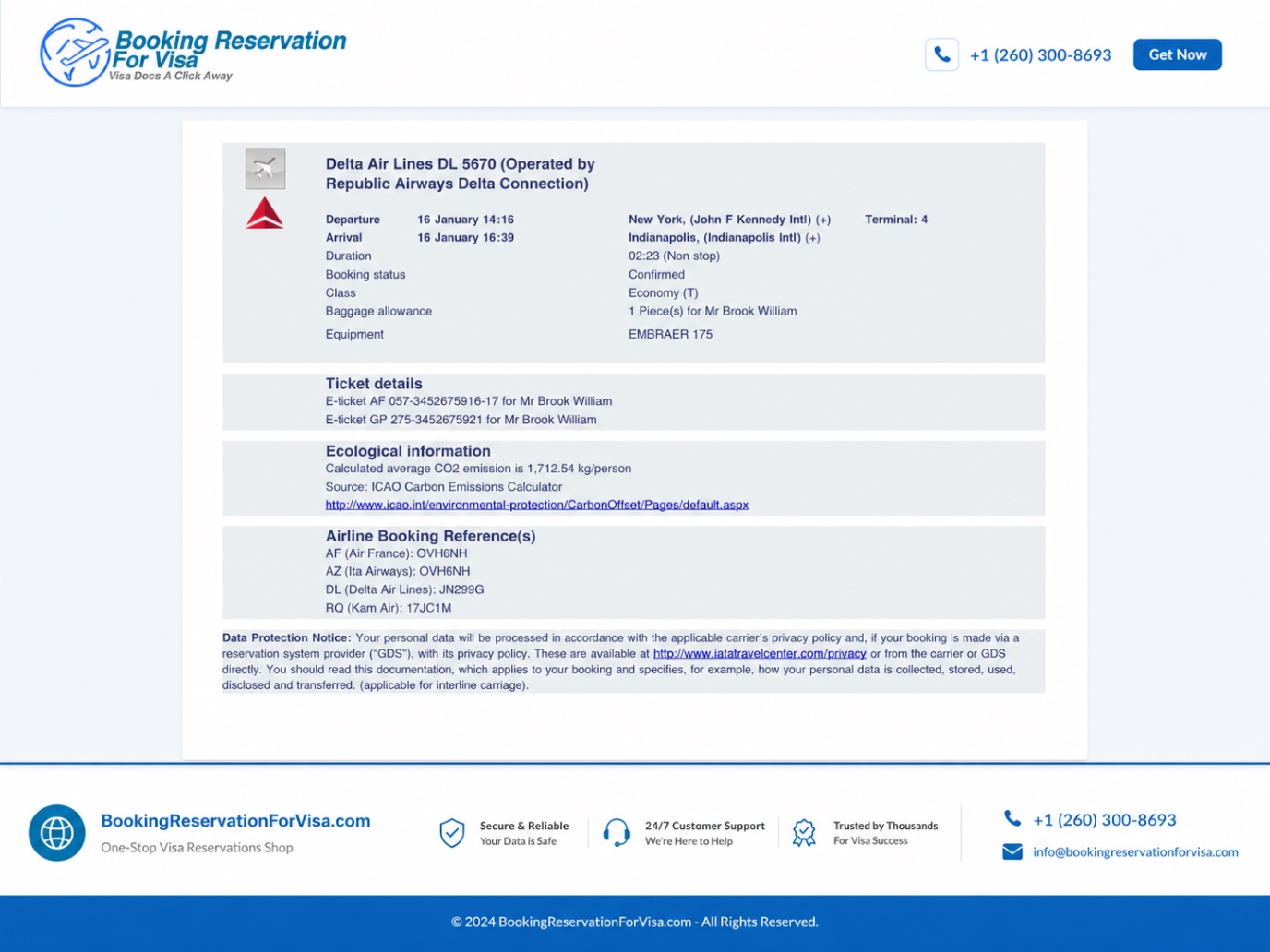
This sample illustrates a flight booking that has progressed beyond the reservation stage and has been formally ticketed. In addition to the airline booking references, confirmed flight status and passenger information, the document includes electronic ticket numbers in the Ticket Details section.
The presence of the e-ticket numbers is the most important feature because it indicates that ticket issuance has taken place after payment. Subject to the passenger holding the required passport, visa and entry documents, this type of ticket can be used for actual travel.
The sample also displays:
- Passenger name
- Airline and flight number
- Departure and arrival airports
- Travel date and time
- Cabin class
- Baggage allowance
- Aircraft information
- Booking references
- Electronic ticket numbers
Although a fully paid ticket provides strong confirmation of the intended flight, purchasing it before receiving a visa can expose the applicant to cancellation charges, fare differences or a financial loss if the visa is refused or delayed.
Sample of a fully paid airline ticket containing both booking references and issued electronic ticket numbers.
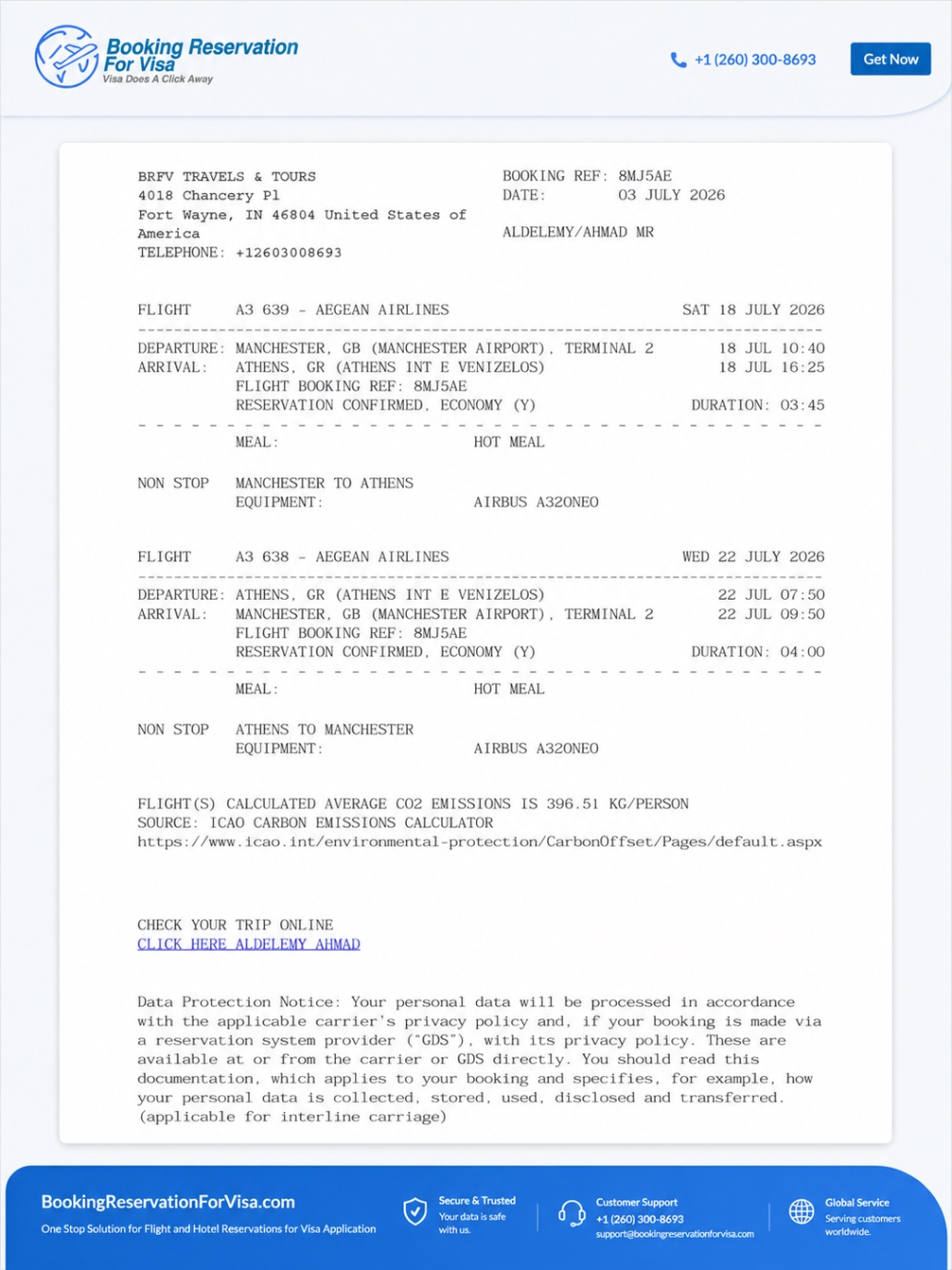
Sample 2: Round-Trip Flight Reservation with a Confirmed Booking Reference
This sample shows a straightforward round-trip flight reservation between Manchester and Athens. Both the outbound and return flights appear under the same booking reference, allowing the visa authority to understand when the passenger intends to enter and leave the destination.
The document includes the passenger’s name, booking date, confirmed reservation status, cabin class, flight numbers, airport codes, departure times, arrival times and journey duration. However, it does not show an issued electronic ticket number.
This is the principal distinction between the document and a fully paid airline ticket. The itinerary records a genuine proposed journey, but the complete airfare has not necessarily been paid and the reservation cannot be used for boarding.
A round-trip reservation of this kind is particularly suitable for short-stay visa applications because it clearly demonstrates:
- The proposed date of departure
- The intended date of return
- The total duration of the visit
- A logical return to the passenger’s country of residence
- A confirmed booking reference that may be checked through the relevant reservation channel
Sample round-trip flight reservation with a confirmed PNR but no issued e-ticket number.
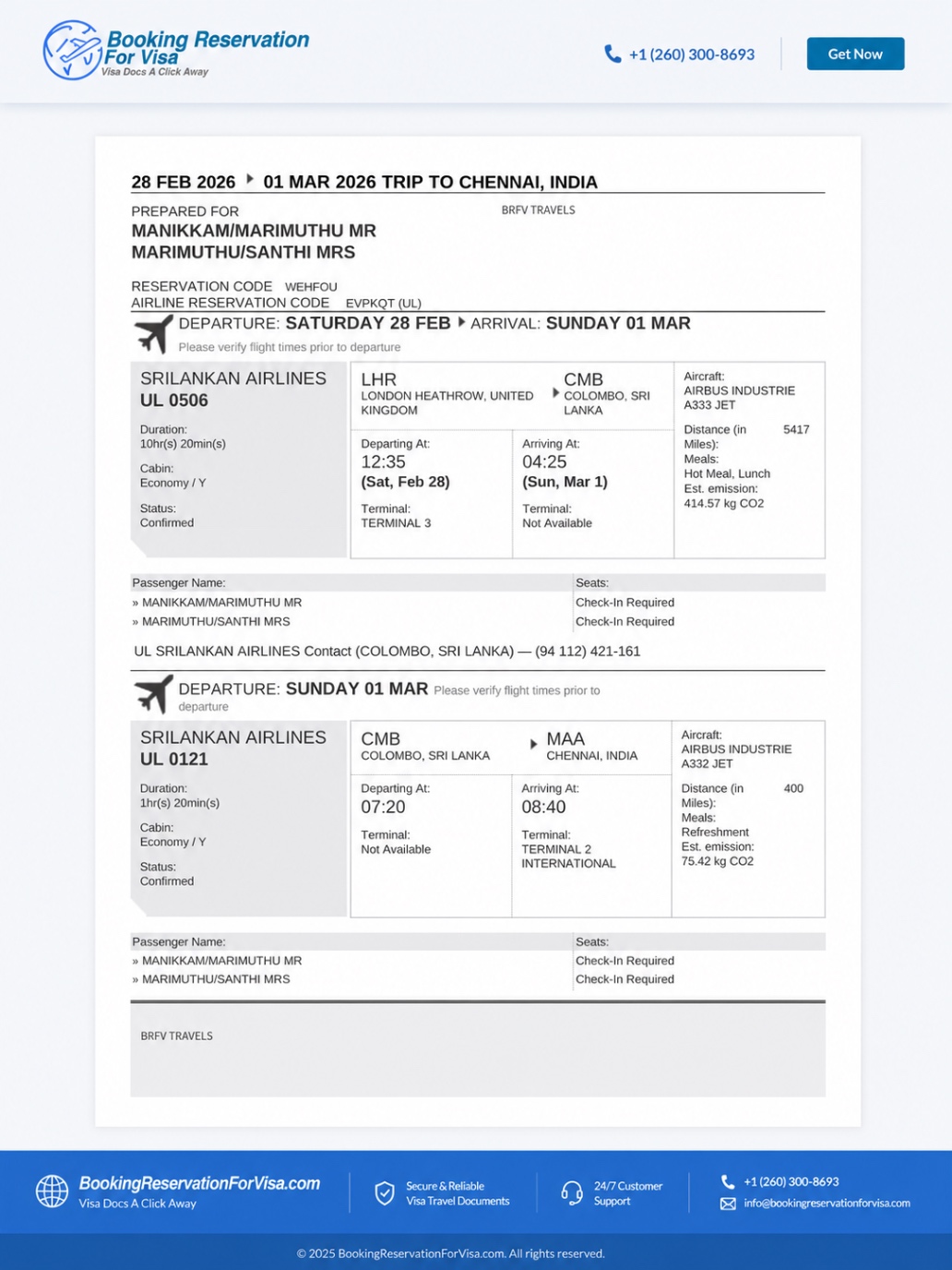
Sample 3: Connecting Flight Reservation for Two Passengers
This sample demonstrates how a flight reservation can present a more complex journey involving multiple passengers and connecting sectors.
The itinerary begins at London Heathrow, connects through Colombo and continues to Chennai. Instead of presenting the trip as a single unexplained route, the document separates each flight sector and displays the corresponding airline, flight number, airport, date, time, terminal, cabin and estimated duration.
It also includes:
- Names of both passengers
- A general reservation code
- An airline-specific reservation code
- Confirmed flight status
- Separate details for each connecting sector
- Aircraft and meal information
- Contact information associated with the itinerary
This format is valuable when an applicant cannot reach the final destination through a direct flight. It enables the visa officer to see the entire journey from the original departure airport to the final destination rather than reviewing only one section of the route.
The reservation code confirms that a booking record has been created, while the absence of an electronic ticket number indicates that it is an application-stage flight itinerary rather than a fully issued ticket.
Sample connecting flight reservation for two passengers, displaying each sector and the relevant booking codes.
Sample 4: One-Way Flight Reservation with Galileo and Agency References
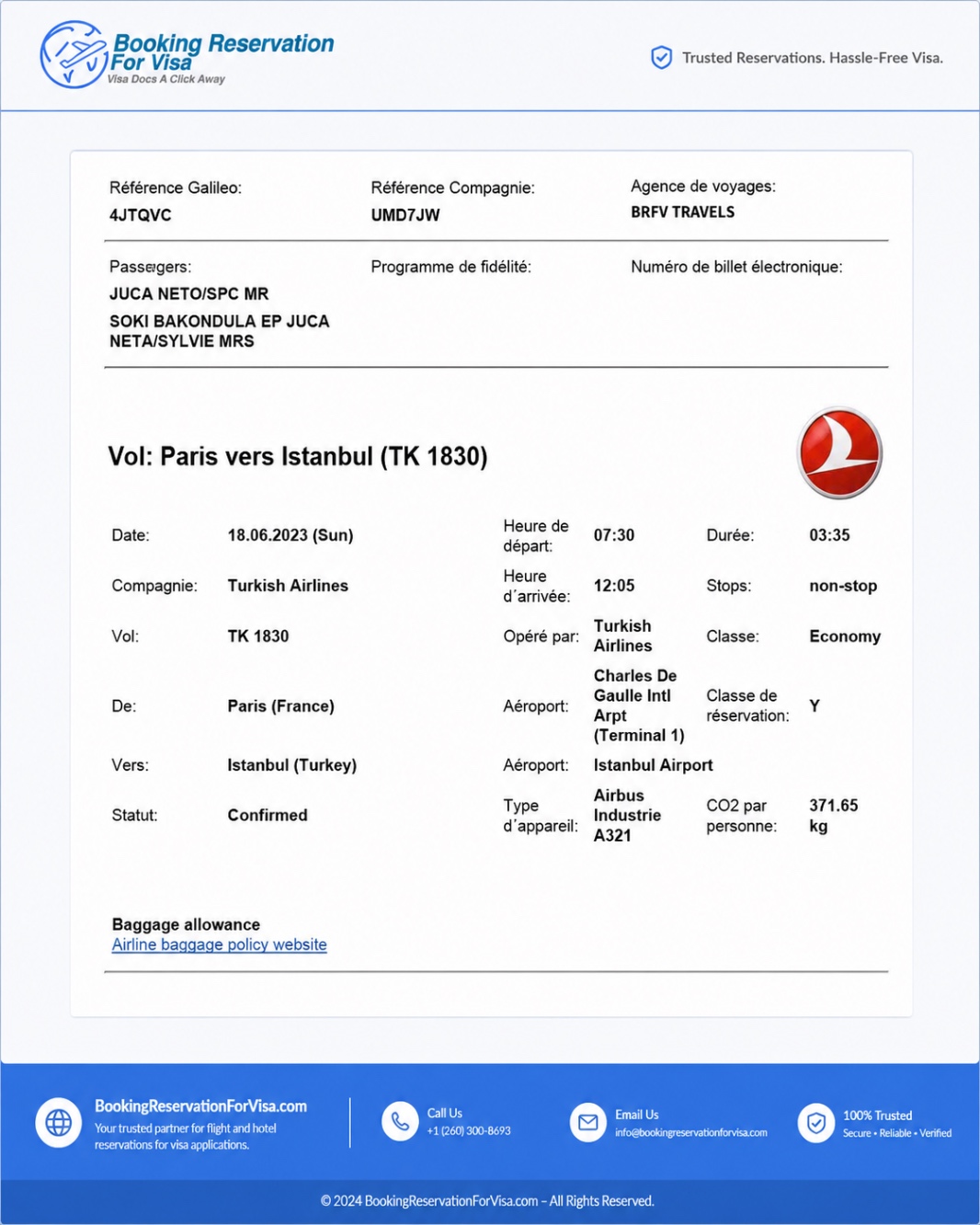
This sample presents a one-way itinerary from Paris to Istanbul. It includes a Galileo reservation reference, a company reference, passenger details, flight status, airline information, airport terminals, booking class and aircraft information.
A particularly useful feature is the Electronic Ticket Number field, which is left blank. This makes the document’s status easy to understand: a flight reservation exists, but the booking has not been converted into a paid airline ticket.
One-way reservations may be appropriate for certain:
- Long-stay visa applications
- Work visa applications
- Study visa applications
- Residence permit applications
- Family-reunification cases
- Journeys with separately arranged onward travel
For an ordinary short-stay tourist application, however, a one-way itinerary may not sufficiently demonstrate the applicant’s intended departure. In such cases, the applicant may also need a return or onward reservation unless the visa checklist states otherwise.
This sample therefore illustrates an important principle: the correct flight document is determined not only by whether it is a reservation or ticket, but also by whether the route matches the applicant’s visa category and stated travel plan.
Sample one-way flight reservation showing active booking references but no electronic ticket number.
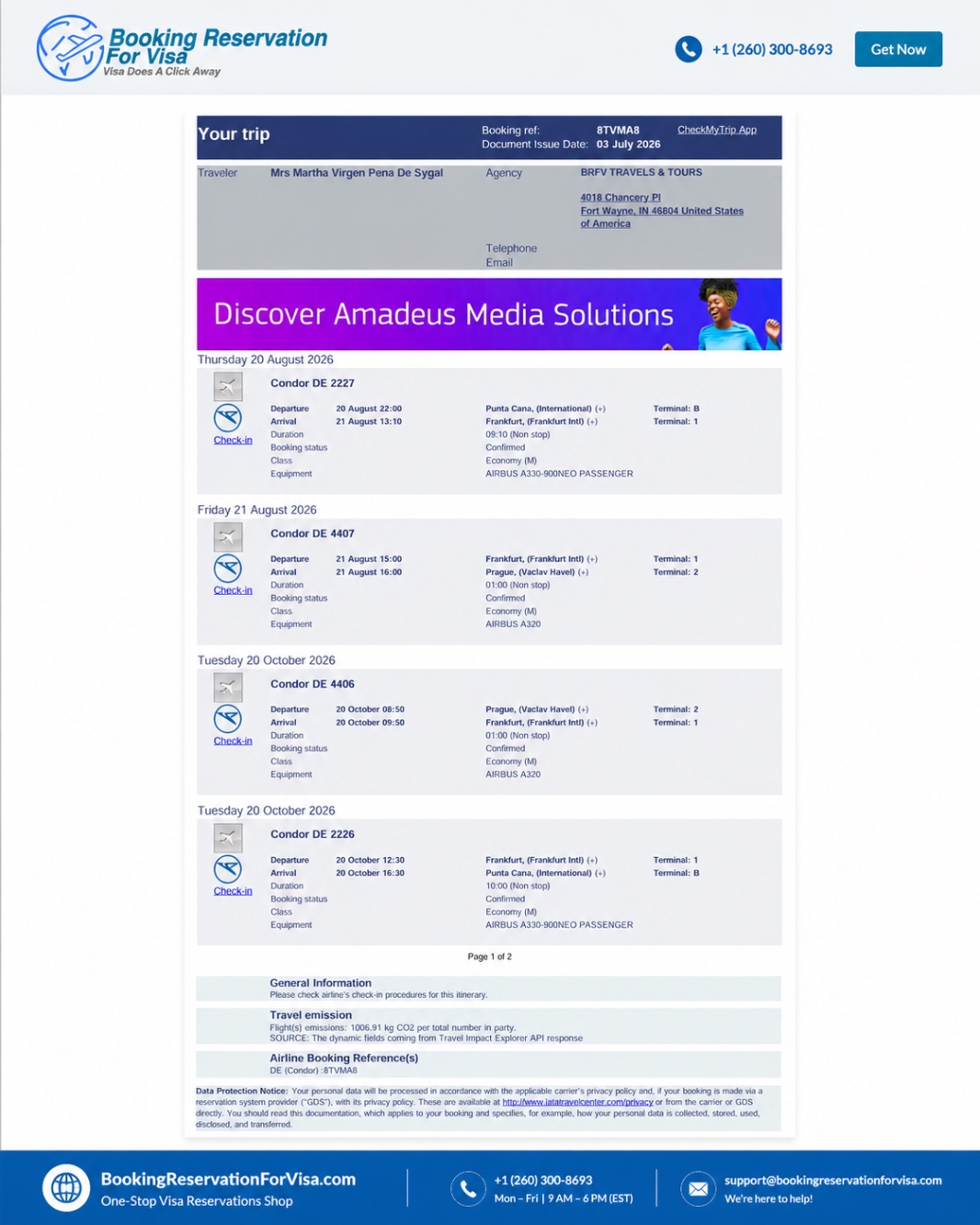
Sample 5: Multi-City Flight Reservation for a Complex International Journey
This sample demonstrates a multi-city itinerary involving four separate flight sectors:
- Punta Cana to Frankfurt
- Frankfurt to Prague
- Prague to Frankfurt
- Frankfurt to Punta Cana
All sectors are organised within one clearly structured itinerary and connected through the same principal booking reference.
This type of reservation is useful when a traveller’s intended route cannot be represented accurately through a simple one-way or conventional return booking. It may be required where the applicant is visiting several destinations, connecting through an international hub or returning through a different travel sequence.
The document provides:
- Passenger name
- Booking reference
- Document issue date
- Four individual flight sectors
- Departure and arrival times
- Airport and terminal information
- Flight duration
- Aircraft type
- Booking status
- Airline-specific booking reference
A professional travel reservation provider can be especially helpful for this type of journey because every flight sector must be coordinated correctly. The connections should be operational, sufficiently spaced and consistent with the applicant’s hotels, internal travel arrangements and overall visa itinerary.
As no electronic ticket number is displayed, the sample represents a flight reservation rather than a paid and issued airline ticket.
Sample multi-city flight reservation combining four international flight sectors under one booking reference.
What These Samples Demonstrate
These examples show that a visa flight reservation does not need to imitate the appearance of a boarding pass or claim to be a fully paid ticket. Its purpose is to present the proposed journey in a professional, organized and verifiable format.
Regardless of the document layout, applicants should check that it contains:
- The correct passenger name
- Suitable departure and return dates
- Complete flight sectors
- Correct airport codes
- Airline and flight numbers
- A booking reference or PNR
- A realistic route
- Information consistent with the rest of the visa application
The first sample contains electronic ticket numbers and therefore represents a ticketed booking. The remaining samples contain reservation references and confirmed itinerary information without issued ticket numbers, demonstrating how dummy tickets can support different travel plans without requiring the applicant to pay the complete airfare before the visa decision.
The Financial Risks of Buying a Flight Ticket Before Visa Approval
The main disadvantage of purchasing too early is not that the ticket is invalid. A fully issued ticket is authentic and usable.
The problem is that the traveller accepts the airline’s fare conditions before knowing whether permission to travel will be granted in time.
- Non-Refundable or Partially Refundable Fares
Many lower-priced tickets contain restrictive conditions.
Depending on the fare, the passenger may receive:
- No refund
- Only a refund of certain unused taxes
- A partial refund after cancellation charges
- A travel credit rather than cash
- A refund restricted to the original payment method
- A refund only before departure
- No refund after a no-show
Airlines make refund-ability and flexibility dependent on the fare purchased. Emirates, for example, explains that some tickets are non-refundable, some carry cancellation charges and different fare types have different change and refund conditions.
- Cancellation Penalties
A “refundable” ticket does not always mean the entire amount is returned without deductions.
The airline or agent may deduct:
- Cancellation penalty
- Service charge
- Refund processing fee
- Agency fee
- No-show penalty
- Non-refundable surcharge
- Previously used ancillary charges
Qatar Airways’ conditions, for example, provide for applicable service charges, cancellation fees, date-change fees and no-show fees when refunds are calculated.
- Fare Difference When Dates Change
Applicants sometimes believe that a changeable ticket allows unlimited free changes. That is not always correct.
A ticket may permit a date change, but the traveller can still be required to pay:
- A change or reissue fee; and
- The difference between the original fare and the fare available on the new date.
The fare difference can become substantial during weekends, public holidays, school vacations, religious festivals, major events or peak travel seasons.
Official airline guidance confirms that passengers may have to pay both applicable change charges and the difference where the revised itinerary is more expensive.
- Visa Processing Delays
The applicant may purchase a flight for a date that initially appears reasonable, but the decision may take longer than expected.
Possible causes include:
- Appointment delays
- Peak-season application volumes
- Requests for additional documents
- Additional security checks
- Administrative processing
- Passport delivery delays
- Public holidays
- Incomplete documentation
- Interview requests
Even if the visa is eventually granted, the original flight may no longer be practical.
- Changes in the Visa Appointment
A scheduled visa appointment can be moved because of:
- Visa centre closures
- Technical problems
- Applicant illness
- Missing documentation
- Rescheduling by the service provider
- Biometrics-related issues
- Local emergencies
- Changes in consular operations
- When a paid ticket has already been issued, moving the appointment can create an immediate conflict between the ticket date and the visa timeline.
- Visa Refusal
No applicant can assume that a visa will be approved.
A refusal can turn a non-refundable ticket into a direct financial loss. Even when part of the fare is recoverable, cancellation charges and administrative deductions can significantly reduce the amount returned.
Official authorities in several countries warn travellers against finalizing travel before a visa decision. The United States advises visitor visa applicants not to make final travel plans or purchase tickets until the visa has been issued. Australia similarly suggests booking flights after the visa is granted.
- Losses Affecting Every Family Member
The risk increases when several applicants travel together.
A cancellation penalty of a few hundred dollars may be difficult for one passenger. For a family of four or five, the combined loss can become substantial.
The financial exposure may include:
- Multiple airline fares
- Seat-selection fees
- Baggage charges
- Travel-agent charges
- Payment processing charges
- Cancellation penalties per traveller
- Fare differences per ticket
- Non-refundable connecting flights
- Ancillary Services May Follow Separate Rules
Baggage, seat selection, lounge access, priority boarding and meals may not automatically follow the same refund conditions as the main fare.
Even when the base ticket is refundable, some optional services may remain non-refundable.
- Currency Conversion and Banking Costs
International air tickets may be charged in a foreign currency.
The applicant can potentially lose money through:
- Exchange-rate movement
- Foreign transaction fees
- Card conversion charges
- Differences between the purchase and refund exchange rates
- Bank processing deductions
- Refund Delays
Even when a refund is approved, the funds may not return immediately. Processing can involve the airline, ticketing agent, card network and bank.
For an applicant who needs the money to purchase a revised flight, a delayed refund can create a second financial burden.
A Practical Formula for Understanding Ticket Risk
The true amount at risk is not always the headline ticket price.
It can be estimated as:
Potential Ticket Loss = Non-Refundable Fare + Cancellation Penalty + Fare Difference + Lost Ancillaries + Agency Charges + Currency Costs
Consider a hypothetical example:
- Ticket price: $850
- Cancellation penalty: $250
- Non-refundable seat and baggage charges: $80
- Agency refund fee: $40
- Currency and bank cost: $20
Even if the remaining fare is refundable, the applicant may still lose $390.
By comparison, the financial exposure of an application-stage flight reservation is normally limited to the reservation service cost and any optional update requested later.
This is why a reservation is not merely a “cheaper document.” It is a form of pre-approval risk control.
Are There Any Benefits to Buying the Actual Ticket Early?
Yes. A balanced decision requires acknowledging them.
A paid ticket can provide:
- An issued e-ticket number
- A completed purchase
- A confirmed ticketed journey
- The ability to travel, subject to immigration requirements
- Protection against later fare increases
- Access to seat selection or other services
- Greater stability than an unticketed booking
- Clear fare and baggage conditions
- Possible reward points or miles
- Immediate certainty where the visa is already valid
Buying early may be reasonable when:
- The traveller already holds the required visa
- The ticket is genuinely fully refundable
- The traveller accepts the cancellation conditions
- The journey is urgent and the visa outcome is already highly predictable
- The embassy has specifically requested an issued ticket
- An employer, sponsor or organization is paying for a flexible fare
- The traveller has adequate insurance or contractual protection
- The fare is unusually favorable and the traveller can afford the risk
Even in these cases, the fare rules should be read carefully.
“Flexible,” “changeable” and “refundable” do not always mean the same thing.

Why a Flight Reservation Is Usually the Better Application-Stage Alternative
A flight reservation occupies the space between having no travel plan and committing to the full ticket.
It gives the application a documented route while preserving the applicant’s ability to change plans if the visa date, appointment or decision changes.
- It Reduces Financial Exposure
The applicant does not place the complete airfare at risk before the decision.
This is especially valuable for:
- Long-haul flights
- Family applications
- Peak-season travel
- Multi-country trips
- Applicants with uncertain processing times
- Routes involving several airlines
- Applicants whose appointments may be rescheduled
- It Presents the Travel Plan Formally
A search-results screenshot does not present the same level of structure as an organised reservation.
A proper flight itinerary can show:
- Passenger name
- Route
- Dates
- Flight numbers
- Connections
- Airline details
- Reservation reference
This gives the visa officer a readable document rather than a collection of informal search results.
- It Can Be Aligned With the Complete File
A reservation can be selected after the applicant has finalized:
- Hotel dates
- Leave approval
- Event dates
- Invitation dates
- Insurance period
- Day-to-day itinerary
- Intended entry and departure points
This allows the route to support the application rather than forcing the entire application to conform to a prematurely purchased ticket.
- It Is More Adaptable
When the appointment changes before submission, a new or updated reservation can usually be arranged without reissuing an expensive ticket.
- It Is Suitable for Complex Itineraries
A professional reservation provider can assist with:
- Round trips
- One-way journeys
- Multi-city travel
- Open-jaw routes
- Multiple airlines
- Long connections
- Intra-Schengen flights
- Transit arrangements
- Group and family travel
- It Separates Visa Evidence From Final Purchasing
The best flight at the application stage is not always the flight the traveller eventually buys.
Schedules, prices and availability can change before the visa is issued. A reservation allows the applicant to demonstrate the intended journey first and purchase the most suitable available ticket after approval.
How Does a Flight Reservation Work?
A flight reservation generally moves through the following lifecycle.
Stage 1: The Route Is Selected
The traveller provides:
- Full name as written in the passport
- Departure city
- Destination
- Intended departure date
- Intended return date
- Number of passengers
- Required route type
- Any preferred airline or schedule
- Transit considerations
Stage 2: A Booking Record Is Created
The itinerary is entered into an airline or travel reservation system.
A PNR or reservation reference may then be generated.
Stage 3: The Reservation Becomes Active
During the active period, the booking details may be retrievable through the relevant airline or reservation channel, subject to the system and airline involved.
Stage 4: The Ticketing Deadline Approaches
Unticketed reservations do not remain active indefinitely.
The airline or reservation system can impose a deadline by which payment and ticket issuance must occur. If the ticket is not issued, the reserved sectors may be cancelled automatically.
Stage 5: The Reservation Expires or Is Cancelled
Expiry does not turn the reservation into a paid ticket. It means the temporary booking record is no longer active.
Stage 6: The Traveller Purchases the Final Ticket
After visa approval, the traveller searches for the best available fare and purchases the actual ticket.
The final ticket may use:
- The same route
- The same airline
- Similar dates
- A different schedule
- A more economical or convenient option
The issued ticket will contain an e-ticket number.

Does a Flight Reservation Lock the Flight Price?
Not necessarily.
This is one of the most important distinctions for applicants to understand.
A flight reservation prepared as travel evidence may show a fare or itinerary, but the price is not automatically guaranteed until ticketing. Airline inventory is dynamic. The booking class shown in the reservation can become unavailable, and the fare can change.
A separate airline fare-hold product may lock a price for a short period, but those services generally operate for limited durations such as 24, 48 or 72 hours.
Applicants should therefore treat the reservation as evidence of the intended route, not as a permanent promise that the same fare will remain available after the visa decision.
How Long Should a Visa Flight Reservation Remain Valid?
There is no universal validity period that applies to every airline, route or visa authority.
The duration can depend on:
- Airline inventory controls
- Booking class
- Departure date
- Number of passengers
- Route complexity
- Whether partner airlines are involved
- The reservation system
- Ticketing time limits
- Provider arrangements
Booking Reservation for Visa currently advertises flight itineraries with a confirmed booking reference and validity of up to approximately two weeks. They also provides support for applicants who need assistance with the document.
Applicants should order the reservation close enough to the submission date that it remains useful during the relevant application stage.
The Correct Timing Principle
The reservation should not be obtained so early that it expires before the application is submitted.
A practical sequence is:
- Confirm the embassy and visa category.
- Check the current document checklist.
- Secure the visa appointment.
- Finalize accommodation and trip dates.
- Prepare the cover letter and itinerary.
- Obtain the flight reservation shortly before submission.
- Verify every detail.
- Submit the application.
What If the Reservation Expires While the Application Is Being Processed?
A temporary booking can expire while a visa application is under consideration.
This does not automatically mean that the application will be refused. Supporting documents are assessed as part of the complete application, and the consulate may request updated evidence where it considers this necessary.
However, the applicant should remain prepared to respond if the embassy asks for:
- A current flight reservation
- Revised travel dates
- A new itinerary
- Clarification of the route
- An updated accommodation booking
- A newly aligned insurance certificate
The applicant should not submit an expired reservation knowingly if the document is no longer valid on the submission date.
How Can an Applicant Verify a Flight Reservation?
Verification can vary according to the airline and reservation system.
Possible methods include:
- Airline “Manage Booking” facility
- Airline customer service
- The issuing travel agency
- The reservation-system interface
- A supported itinerary retrieval platform
The applicant may need:
- Booking reference or PNR
- Passenger surname
- E-mail address
- Route information
Verification Is Not the Same as Ticketing
A reservation can be visible in the booking system without an e-ticket being issued.
The presence of a PNR means that a booking record exists. The presence of an e-ticket number means the booking has progressed to ticket issuance.
Applicants should not be alarmed merely because a visa reservation does not display an e-ticket number. An e-ticket number would normally indicate that the airfare has been ticketed.
Verification Can Differ Between Airlines
Some airlines allow passengers to retrieve bookings created by authorized agents. Others limit what can be viewed on the public website.
A reservation may also involve:
- A validating carrier
- An operating carrier
- A codeshare flight
- More than one airline booking reference
- A global reservation-system reference
For this reason, applicants should follow the verification instructions supplied with their itinerary rather than assuming every booking must appear in exactly the same way on every airline website.
What Must a Good Flight Reservation Contain?
A useful visa flight itinerary should be complete enough to explain the journey without unnecessary ambiguity.
Passenger Information
The name should match the passport.
Applicants should check:
- First name
- Middle name
- Surname
- Order of names
- Spelling
- Title, where shown
Even a minor inconsistency should be corrected before submission.
Flight Information
The document should show:
- Airline
- Flight number
- Departure airport
- Arrival airport
- Date
- Departure time
- Arrival time
- Connection, where applicable
Reservation Information
Where available, it should contain:
- Booking reference
- Reservation status
- Issuing information
- Date of booking
Complete Route
Every necessary sector should be included.
For example, an applicant travelling from New Delhi to Paris through Doha should not submit only the Doha–Paris sector if the actual journey begins in New Delhi.
Return or Onward Travel
For short-stay tourism and visitor applications, a return or onward journey is commonly more appropriate than an unexplained one-way route.
A one-way reservation may be suitable for certain long-stay, work, study, residence or family-reunification categories, but the applicant must follow the relevant checklist.
When Should You Use an Airline Website and When Should You Use a Reservation Service?
Direct Airline Booking May Work When:
- The route is simple
- The airline offers a suitable hold facility
- The required reservation duration is short
- The traveller is prepared to complete payment
- The airline provides an acceptable itinerary document
- Only one airline is involved
However, airline holds are frequently short. A 24- or 72-hour fare hold may expire before the visa appointment or shortly after submission.
A Professional Reservation Service Is More Useful When:
- A longer application-oriented reservation is needed
- The trip contains several sectors
- Different airlines are involved
- The journey is multi-city
- The applicant needs an open-jaw itinerary
- Transit arrangements require careful coordination
- Several family members are travelling
- The route must match hotels in several countries
- The applicant requires urgent document delivery
- The applicant needs help correcting dates or names
Booking Reservation for Visa prepares visa-focused flight itineraries rather than requiring the applicant to risk the complete airfare at the application stage. The current service describes airline-verifiable reservations, confirmed booking references, fast delivery and validity of up to approximately two weeks.
How to Select the Correct Route for a Visa Application
The cheapest route is not always the best route for the visa file.
The itinerary should also be believable, practical and consistent.
Direct Route
A direct flight can make the journey easier to explain, but it is not compulsory when connecting flights are more realistic.
Connecting Route
Check:
- Transit airport
- Connection duration
- Airport-terminal changes
- Whether baggage must be collected
- Whether the applicant needs a transit visa
- Whether the connection operates on the selected date
Round Trip
This is commonly suitable for short tourism, business and visitor journeys where the applicant plans to return to the country of residence.
One-Way Route
This may be appropriate for:
- Long-stay study
- Employment
- Residence
- Family reunification
- Permanent relocation
It should not be used merely to reduce the itinerary cost when the visa category expects return or onward travel.
Multi-City Route
A multi-city booking may be suitable where the applicant:
- Enters through one country
- Visits several destinations
- Leaves from another country
It should follow the actual travel sequence.
Open-Jaw Route
An open-jaw itinerary allows entry through one city and departure from another.
For example:
- Islamabad to Rome
- Paris to Islamabad
This can be practical where the traveller moves overland through Europe.
Multiple-Airline Route
Different airlines can sometimes produce a more logical or economical journey. However, separate bookings can create:
- Unprotected connections
- Baggage-transfer problems
- Different terminal requirements
- Separate booking references
- Transit complications
A professional itinerary should make the relationship between the sectors clear.
The Consistency Test: What Visa Officers May Notice
A strong flight reservation does not work in isolation.
It should be compared with every date and destination in the file.
Onward Flight Ticket and Visa Form
The arrival and departure dates should correspond with the dates stated in the application form.
Dummy Flight Reservation and Hotel Booking
The applicant should not:
- Arrive before accommodation begins without explanation
- Leave after accommodation ends without explanation
- Show accommodation in a country not included in the route
- Book more hotel nights than the planned stay permits
- Leave unexplained gaps between destinations
Dummy Flight and Travel Insurance
The insurance should cover the required period under the applicable checklist.
Flight Reservation and Cover Letter
The cover letter should describe the same:
- Dates
- Countries
- Travel purpose
- Entry point
- Exit point
- Duration
Flight Booking and Leave Letter
An employee should not submit flights extending beyond the approved leave period unless the difference has been explained.
Flight Itinerary and Invitation
A business event, conference, wedding or family visit should occur within the travel period.
Flight Travel Confirmation and Financial Evidence
The route should be proportionate to the applicant’s financial position.
An elaborate premium itinerary combined with limited available funds can raise questions about how the trip will be financed.
Common Flight-Document Mistakes That Can Weaken a Visa Application
Submitting a Search Screenshot
A screenshot of flight-search results may show available flights, but it does not necessarily represent a booking made in the applicant’s name.
Creating a Fake Ticket
Applicants should never alter documents, invent booking references or edit a ticket belonging to another passenger.
The European Commission’s visa guidance recognizes that false or fraudulent documents may be retained as evidence for appeal or further proceedings.
Using the Wrong Name
The itinerary should match the passport exactly.
Showing Impossible Connections
A connecting flight should allow sufficient time for transit, terminal transfer and any immigration requirement.
Ignoring Transit Visas
A traveller may need permission to transit through a particular country even without leaving the airport.
Using Contradictory Dates
Flight, hotel, insurance, invitation and leave dates should form one coherent schedule.
Applying to the Wrong Schengen Country
A flight entering one Schengen country does not automatically determine where the applicant should apply. The principal destination and length of stay must also be considered.
Submitting an Expired Reservation
The applicant should check that the document remains usable when submitted.
Confusing Reservation With Ticket
A reservation cannot be used to fly unless it is ticketed.
Assuming a Paid Ticket Guarantees Approval
It does not.
Should You Buy a Refundable Ticket Instead?
A genuinely refundable ticket is safer than a non-refundable one, but it is not always the most economical option.
Before purchasing, check:
- Is the complete fare refundable?
- Is only the base fare refundable?
- Are surcharges refundable?
- Are baggage and seats refundable?
- Is there a cancellation penalty?
- Does “refund” mean cash or travel credit?
- Must cancellation occur before departure?
- Is there a no-show fee?
- How long will processing take?
- Will the travel agent charge an additional fee?
- Will currency conversion reduce the returned amount?
A refundable fare may cost significantly more than the lowest restrictive fare. The additional amount is effectively the price of flexibility.
Where an embassy accepts a flight reservation, paying a premium for a refundable ticket may still be unnecessary.
Flight Ticket Requirements for Visas Outside the Schengen Area
United Kingdom
UK guidance warns applicants that submitting supporting documents does not guarantee approval and that this should be considered before making bookings. Previous official UKVI guidance has also stated that flight tickets are not required with a standard visit visa application.
United States
The United States Department of State advises visitor visa applicants not to make final travel plans or buy tickets until the visa has been issued.
Australia
Australia’s Department of Home Affairs recommends submitting the application in advance and suggests booking the flight after the visa is granted.
Canada
Canadian guidance for certain travel authorizations and visa processes similarly advises travellers to obtain the relevant permission before finalizing flight arrangements.
These examples reinforce an important point: purchasing the ticket before approval is not a universal visa requirement.
A Decision Guide: Ticket or Reservation?
Choose a Flight Reservation When:
- The embassy asks for a reservation or itinerary
- The visa has not yet been approved
- The fare is non-refundable
- Processing time is uncertain
- Several passengers are applying
- Travel dates may change
- The appointment may be rescheduled
- The trip involves several destinations
- You want to protect most of the travel budget
- You need formal route evidence without ticketing
Consider a Fully Paid Ticket When:
- The visa has already been granted
- The authority explicitly requires an issued ticket
- The fare is fully refundable under clear conditions
- A sponsor accepts the financial risk
- The departure is urgent
- You are comfortable with all cancellation terms
- You can afford a possible loss
- The ticket is protected under a suitable arrangement
Do Not Use Either Until You Have:
- Identified the correct visa authority
- Read the official checklist
- Confirmed the intended dates
- Checked passport validity
- Considered transit requirements
- Matched the route with accommodation
- Prepared a financially realistic trip
How to Obtain a Flight Reservation Through Booking Reservation for Visa
Applicants who do not want to purchase the complete airline ticket can obtain a visa-focused itinerary through Booking Reservation for Visa.
Step 1: Select the Flight Reservation Service
Choose the service required for the application.
Step 2: Enter the Passenger Details
Provide the name exactly as it appears in the passport.
Step 3: Provide the Travel Plan
Enter:
- Departure city
- Destination
- Travel dates
- Return date
- Number of travellers
- Preferred route, where applicable
- Multi-city details, if required
Step 4: Review the Information
Check every spelling, airport and date before completing the order.
Step 5: Complete the Service Payment
The applicant pays for preparation of the reservation rather than purchasing the complete airline fare.
Step 6: Receive the Itinerary
The document is delivered electronically and can be reviewed before being added to the application.
Step 7: Verify and Align It With the File
Compare it with:
- Visa form
- Hotel booking
- Cover letter
- Insurance
- Invitation
- Leave approval
- Day-to-day plan
Step 8: Request Necessary Corrections Promptly
Any error should be corrected before submission.
Why a Professionally Prepared Reservation Is Better Than a Random Sample
A sample itinerary can explain what a document looks like. It cannot support a real visa application because it does not contain the applicant’s genuine route and personal information.
A useful reservation must reflect:
- The real applicant
- The intended travel dates
- A workable flight schedule
- The appropriate route
- The correct visa category
- The correct entry and departure plan
Free templates and edited samples create unnecessary risk because they may contain:
- Invalid booking references
- Flights that do not operate
- Incorrect passenger details
- Expired schedules
- Impossible connections
- Unrelated routes
- Fabricated ticket numbers
A visa application should be supported with personalized travel evidence, not a generic ticket image downloaded from the internet.
Five Myths About Flight Tickets and Visas, Corrected
“A paid ticket proves I’m a serious traveler.” It proves you spent money. Consulates weigh the coherence of your whole file, funds, ties to home, purpose, accommodation, far more heavily than whether a ticket happens to be ticketed rather than reserved.
“Buying the ticket early gets my visa processed faster.” It doesn’t. Processing time is governed by the consulate’s own workload and the completeness of your file, not by how far in advance you’ve committed money to an airline.
“If it’s just a reservation, the embassy will know and reject me for it.” The opposite is closer to the truth, most consulates explicitly prefer a reservation at this stage, precisely because it doesn’t ask the applicant to gamble on an uncertain outcome.
“A dummy ticket and a real reservation are the same thing.” Only if the “dummy ticket” is actually a live booking with a checkable PNR. A static image with no reservation behind it is not the same thing at all, and consulates can generally tell the difference.
“One-way is always safer than round-trip, or vice versa.” Neither is universally safer, the right structure depends entirely on the visa type. A one-way reservation on a short-stay tourist application can raise more questions than it answers.
Frequently Asked Questions
- Do I need to buy a flight ticket before applying for a visa?
Usually not. Many authorities either request a proposed itinerary or advise applicants not to purchase final tickets before approval. Always check the official checklist for your visa category.
- Do I need a fully paid ticket for a Schengen visa?
Many Schengen checklists request a round-trip reservation rather than a fully paid ticket. Some expressly advise applicants not to purchase the ticket before visa issuance.
- Is a flight reservation accepted for a visa application?
It is commonly used where the checklist requests a flight reservation, itinerary or proposed transport booking. Acceptance depends on the specific embassy and application requirements.
- Can a flight reservation guarantee visa approval?
No. No flight document can guarantee approval. The visa authority assesses the complete application.
- Does an expensive ticket make my application stronger?
Not automatically. A paid ticket does not replace financial evidence, proof of purpose, accommodation, return ties or document consistency.
- What is the main difference between a flight reservation and a ticket?
A reservation contains a booking record and proposed itinerary. A ticket has been issued after payment and normally contains an e-ticket number.
- Does a visa flight reservation have an e-ticket number?
Normally not. An e-ticket number generally appears after the airfare has been paid and the ticket has been issued.
- Does a flight reservation have a PNR?
A genuine reservation can contain a PNR or booking reference, depending on the airline and reservation arrangement.
- Can I travel with a flight reservation?
No. A visa reservation is not an issued ticket or boarding pass. You must purchase an actual ticket before travelling.
- How long does a flight reservation remain valid?
Validity depends on the airline, route, booking class and provider. Booking Reservation for Visa currently advertises validity of up to approximately two weeks for its itinerary service.
- What happens if my reservation expires during processing?
The consulate may decide the application based on the documents submitted or request updated evidence. Be prepared to supply a current reservation when requested.
- Can the embassy verify the reservation?
The booking may be verifiable through the relevant airline, agency or reservation channel, depending on how it was created.
- Will an expired PNR automatically cause refusal?
Not necessarily. The complete application is assessed individually. However, applicants should submit a valid document and respond promptly if an updated itinerary is requested.
- Can I create my own itinerary in Microsoft Word?
You may create a personal travel schedule, but it is not the same as an airline reservation. Do not invent airline booking references or ticket numbers.
- Is a fare quotation enough for a visa?
A quotation only shows a possible price. It may not prove that a booking has been recorded in the applicant’s name.
- Should I submit a one-way or round-trip reservation?
Short-stay applications generally require a return or onward plan. A one-way route may be appropriate for some long-stay categories. Follow the specific checklist.
- Can I change my dates after receiving the visa?
You should first check the visa sticker’s validity, authorized stay and number of entries. Any revised trip must remain within the permission granted.
- Must I purchase the same flight shown in my visa reservation?
Not always. After approval, schedules and fares may have changed. The final journey should still respect the visa conditions and remain consistent with the lawful purpose of travel.
- Is a refundable ticket better than a reservation?
A refundable ticket can reduce risk, but it may cost much more and can still include conditions or deductions. Where a reservation is accepted, the extra expense may not be necessary.
- Can I use an airline’s 24-hour hold for my visa?
It may be possible, but short holds often expire too quickly for visa purposes. Check whether the document will remain suitable through the submission stage.
- Can I use different airlines for departure and return?
Yes, where the route is workable and clearly presented. The applicant should ensure that every sector and connection is properly explained.
- Should the reservation match my hotel booking?
Yes. Flight and accommodation dates should form a continuous and logical itinerary.
- What if the visa authority asks for a paid ticket later?
Follow the written request from the embassy. Do not ignore a specific instruction merely because a reservation was accepted initially.
- Is purchasing a ticket before a visa ever mandatory?
It can be required in a particular case or visa category. The responsible authority’s current checklist or direct written instruction is decisive.
Final Verdict: Should You Buy the Ticket Before Applying?
For most applicants, the safer answer is:
Do not purchase a costly, restrictive airline ticket merely because you assume that a visa application requires full payment.
First, read the official checklist.
Where the authority requests a flight reservation or itinerary, a professionally prepared reservation can provide the necessary route evidence without exposing the applicant to the full financial consequences of:
- Visa refusal
- Processing delays
- Appointment changes
- Ticket cancellation
- Date-change penalties
- Fare differences
- Non-refundable extras
A paid ticket is the correct document for travelling. A flight reservation is often the more appropriate document for demonstrating the intended journey while the visa remains undecided.
Booking Reservation for Visa allows applicants to obtain a structured flight itinerary with passenger details, travel dates, route information and a booking reference without purchasing the complete airline ticket at the application stage.
That gives the applicant what a strong visa file actually needs: a coherent travel plan, professionally presented, with substantially less money placed at risk before approval.