Introduction
Europe tends to arrive in a traveler’s imagination long before it ever appears on a boarding pass. For someone in Myanmar, that image might be the canal houses of Amsterdam reflected in still water, the smell of espresso drifting out of a Milan side street, or the Alps rising sharply behind a Swiss train window. The dream is rarely the hard part. The hard part is figuring out, with real certainty, which Schengen mission in Yangon your file actually belongs to because Myanmar does not run on a single, unified visa system the way some countries do.
That distinction matters more here than almost anywhere else in the region. Myanmar does not have a single outsourced hub that handles every Schengen country under one roof. Instead, the country is served by a patchwork of arrangements: a handful of resident embassies that decide cases directly, a couple of embassies that quietly represent several neighboring Schengen states on top of their own, and a VFS Global center in Yangon that acts as the intake point for more countries than most applicants expect. Get the wrong door, and the appointment, the fee, and the week you spent assembling documents are all wasted.
This guide was built to remove that guesswork. It walks through the Schengen visa categories relevant to Myanmar travelers, the paperwork every application leans on, the submission sequence from start to finish, realistic fee expectations, and; country by country; exactly which office in Yangon is responsible for each Schengen destination. Whether the plan is a fortnight in France or a business trip built around Frankfurt, the goal here is simple: know precisely where to walk in before you ever leave the house.
Do Myanmar Passport Holders Actually Need a Schengen Visa?
Yes, without exception for short-term travel. Myanmar is not included among the nationalities exempted from Schengen visa requirements, so any Myanmar citizen intending to enter the Schengen Area for tourism, a family visit, a conference, a short course, or a business meeting needs a visa arranged in advance. There is no visa-on-arrival option and no digital travel authorization that substitutes for it at present.
Once granted, a Schengen short-stay visa is not confined to the single country that issued it. It permits movement across the entire Schengen Area for a combined stay of up to 90 days within any rolling 180-day window. A Myanmar traveler could, in principle, land in Vienna, continue by rail to Munich, and finish the trip in Zurich, all on one visa, provided the mission that issued it was correctly identified as the main destination of the journey to begin with.
Schengen Visa Categories Myanmar Applicants Should Understand
Before confirming flights, accommodation, insurance, or any paid travel arrangement, Myanmar applicants should first identify the correct Schengen visa category for their purpose of travel. Choosing the wrong visa type can delay the application, create documentation conflicts, or lead to refusal even when the applicant otherwise meets the basic requirements.
Category A – Airport Transit Visa
The Airport Transit Visa is the most limited Schengen visa category. It is intended only for travelers who are passing through the international transit area of a Schengen airport while continuing their journey to a country outside the Schengen Zone.
Key points to remember:
- It does not allow the traveler to enter the Schengen country.
- The holder must remain inside the airport’s international transit zone.
- It applies only to certain transit situations, not ordinary travel.
- Requirements may vary depending on the Schengen country used for the layover.
- Myanmar nationals should always confirm the latest transit rules with the relevant embassy or consulate before booking a route through a Schengen airport.
This visa is therefore suitable only when the traveler is changing flights in the Schengen Area without crossing border control or entering the country.
Category C – Short-Stay Schengen Visa
The Category C visa is the most common Schengen visa for Myanmar applicants and is usually the main visa type required for temporary travel to Europe. It permits short visits of up to 90 days within any 180-day period across the Schengen Area.
This visa may be used for purposes such as:
- Tourism and holidays
- Visiting family members or friends
- Business meetings or professional travel
- Conferences, exhibitions, or trade fairs
- Cultural, academic, or sporting events
- Short medical treatment
- Brief training programs or workshops
A Category C visa may be issued as:
- Single-entry, allowing one entry into the Schengen Area
- Double-entry, allowing two separate entries
- Multiple-entry, allowing repeated travel during the visa validity period
Multiple-entry visas may be valid for one year, two years, or in some cases up to five years. However, longer-validity visas are generally granted to applicants with a strong travel history and previous compliant visits to the Schengen Area.
Category D – National Long-Stay Visa
The Category D visa is a national visa issued by a specific Schengen country for stays longer than 90 days. Unlike the short-stay Schengen visa, this visa is not issued under a single Schengen-wide short-stay framework. It is controlled by the national immigration rules of the country where the applicant intends to live, study, work, or stay long term.
Myanmar applicants may need a Category D visa for purposes such as:
- University or degree-level study
- Employment or long-term work assignments
- Family reunification
- Extended internships
- Research programs
- Long-term residence plans
A Category D visa primarily authorizes the applicant to stay in the country that issued it. It does not function in the same way as a Category C visa for general short-term movement throughout the entire Schengen Area.
Applicants from Myanmar who plan to remain in a Schengen country for more than three months should follow the long-stay visa procedure of that specific country. The document checklist, processing time, appointment system, fee structure, and submission route may be different from the short-stay Schengen visa process.
The Golden Rule: Choosing the Right Schengen Country to Apply To
Nearly every avoidable rejection in this process traces back to one mistake: applying at the wrong mission. Schengen rules are unambiguous on this point. The application must be lodged with the country that is the main destination of the trip, meaning the country where the traveler will spend the greatest number of nights. If two or more countries receive an identical number of nights, the rule shifts to the country of first entry into the Schengen Area.
This is not a matter of convenience. If a Myanmar traveler’s itinerary is genuinely centered on the Netherlands, the file belongs with the Dutch channel, even if a friend mentions that the German queue moves faster. Submitting through the “easier” mission when it isn’t actually the main destination can read as inconsistent to a visa officer and undermine the credibility of an otherwise solid file.
In Myanmar’s case, this rule carries extra weight because of how representation works locally. Several Schengen countries do not operate their own visa desk in Yangon at all – they route through a neighboring embassy instead. Knowing who represents whom, covered in detail further down, is just as important as knowing the main-destination rule itself.

Documents Myanmar Applicants Must Prepare
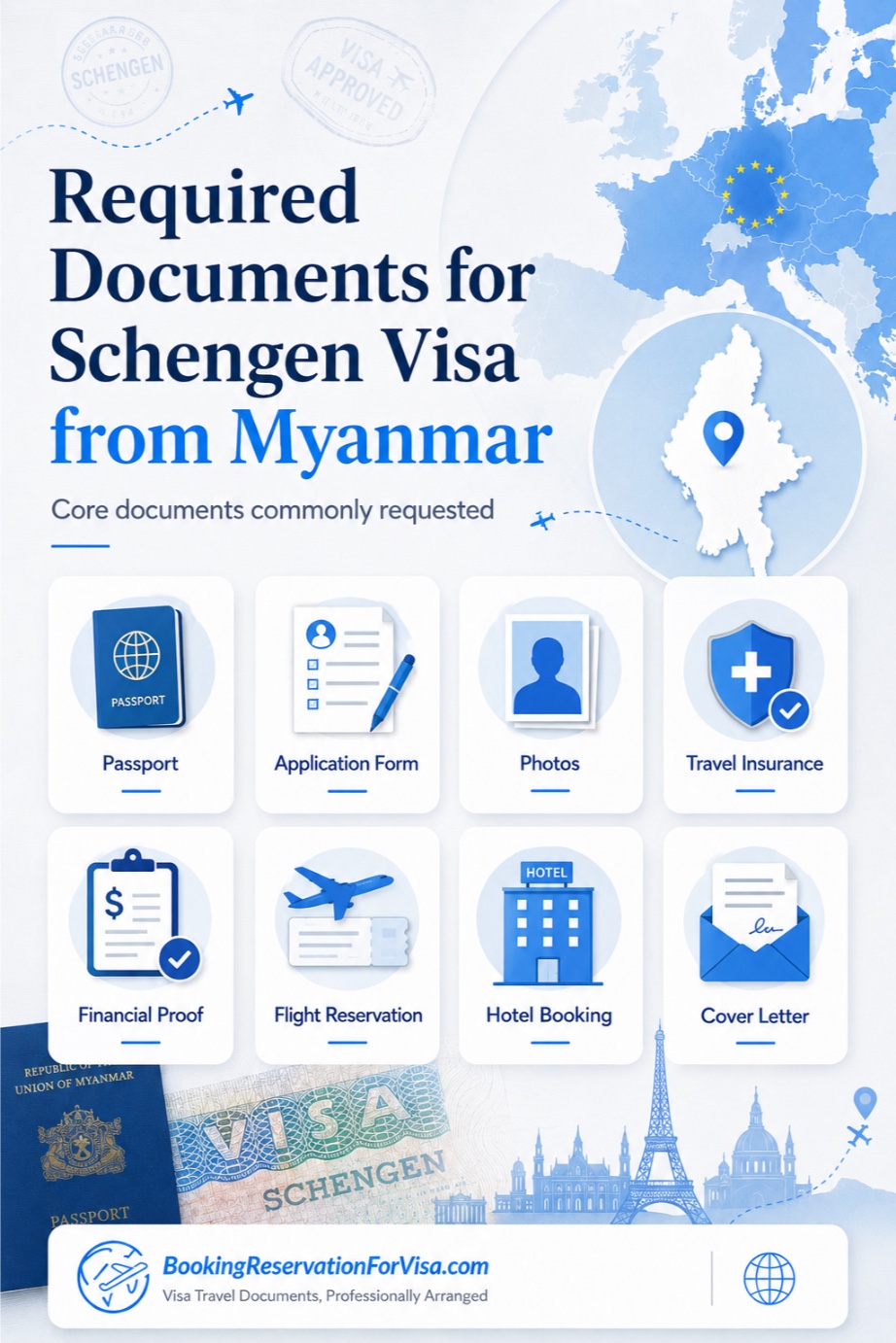
The paperwork required for a Category C application is broadly similar across Schengen missions, though each embassy can request extra items depending on the traveler’s situation and stated purpose. Myanmar applicants should have the following ready before booking any appointment:
- A Myanmar passport valid for at least three months beyond the planned departure from the Schengen Area, issued within the last ten years, and containing at least two free pages for the visa sticker. Several missions in Yangon prefer to see six months of remaining validity, so building in that margin avoids last-minute passport renewals.
- A completed Schengen visa application form, printed and signed, using the current harmonized EU format available through the relevant embassy or VFS portal.
- Two recent passport-style photographs that meet ICAO biometric standards – plain white background, neutral expression, no glasses, taken within the past three months.
- Schengen-compliant travel medical insurance covering a minimum of €30,000, valid for the entire Schengen Area (or worldwide), and running for the complete length of the trip including any transit days. Coverage limited to a single country, or missing emergency repatriation, will not be accepted.
- Financial evidence – usually three to six months of bank statements, plus a bank certificate confirming the current balance demonstrating that the traveler can genuinely afford the trip and return home without needing to work or seek assistance abroad.
- Confirmed accommodation for every night of the trip, whether through a hotel booking, a formal invitation from a host, or another accepted proof of lodging.
- Purpose-of-travel evidence, tailored to the trip: a structured flight itinerary, an invitation letter for business or family visits, an event registration, or conference documentation.
- Proof of ties to Myanmar, showing a genuine reason to return – an employment letter with approved leave dates, a business registration certificate, property documents, or family responsibilities documented in some verifiable way.
- Biometric enrollment – fingerprints and a digital photo taken in person at the time of submission, unless the applicant is under 12, is exempt by age in some jurisdictions, or has valid biometrics on file from a Schengen application within the past 59 months.
- Civil documents where relevant – marriage certificates, birth certificates, or family registration papers, depending on the purpose of the trip and whether dependents are included in the file.
Travel insurance in particular deserves a second look before submission. It is treated as a hard requirement, not a suggestion, and Yangon-based application desks will frequently return a file on the spot if the policy doesn’t clearly state the €30,000 minimum, the Schengen-wide or global coverage territory, and dates that fully bracket the trip.
Step-by-Step: How to Apply for a Schengen Visa from Myanmar
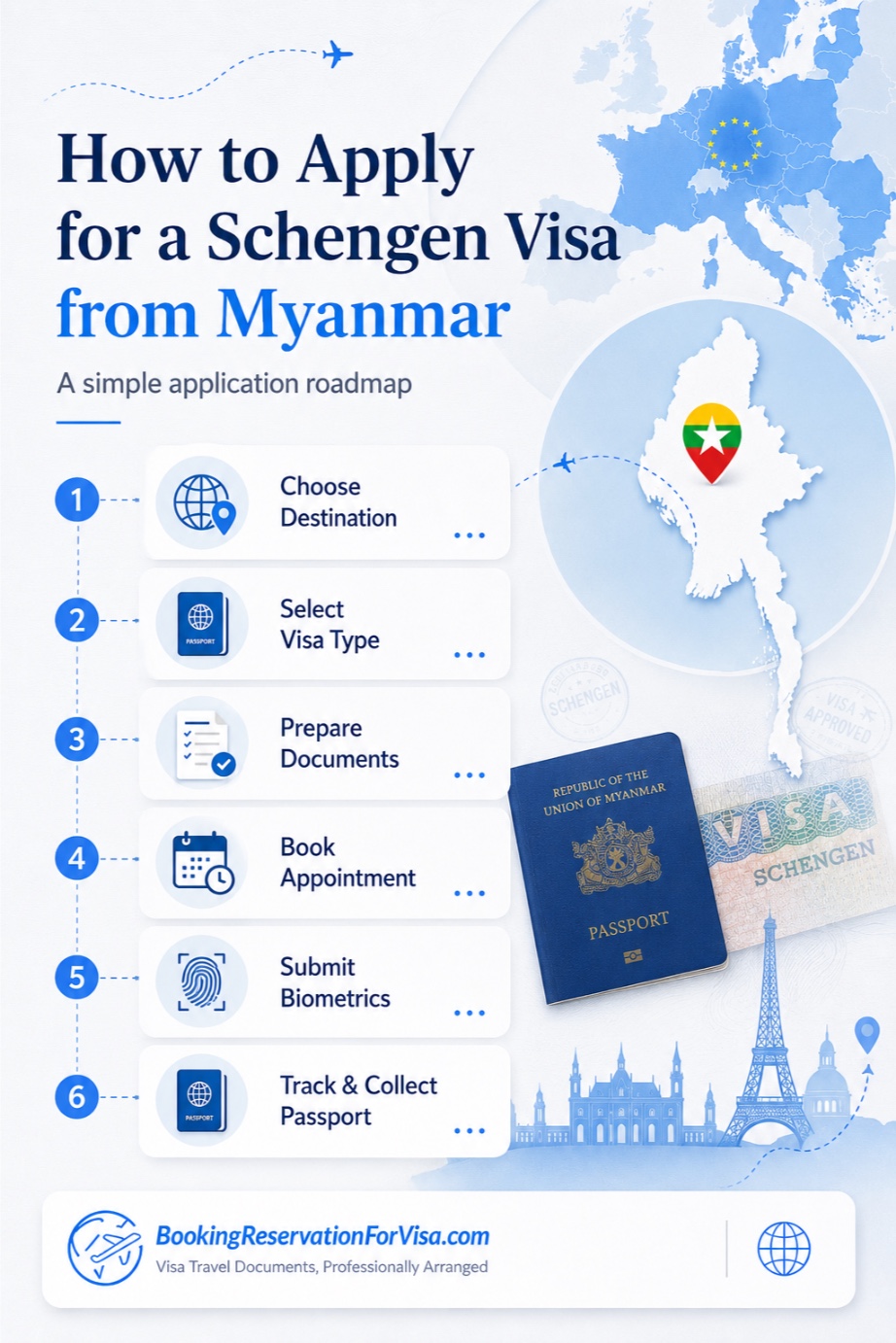
Step 1 – Confirm the main destination first. Everything downstream – which office, which fee schedule, which checklist – depends on this decision. Count the nights, apply the equal-nights/first-entry rule if needed, and lock in the destination before doing anything else.
Step 2 – Identify the correct Yangon channel. This is where Myanmar’s system differs sharply from countries with a single unified visa hub. As detailed in the directory below, some countries are handled directly by their own resident embassy, some route through VFS Global Yangon, and others are represented entirely by a neighboring country’s embassy. Confirming this before booking anything saves a wasted trip.
Step 3 – Book the appointment. Every channel operating in Myanmar requires a scheduled appointment; none accept walk-ins for Schengen submissions. Slots can tighten considerably ahead of the European summer season and around the year-end holiday period, so booking several weeks out is a sensible default rather than an overcautious one.
Step 4 – Assemble the file to the specific country’s checklist. General preparation is useful, but the actual checklist published by the responsible mission or VFS portal should be treated as the final word. Order matters too – some Yangon-based desks are known to be particular about how documents are arranged and will ask for corrections before accepting an incomplete or disordered file.
Step 5 – Attend in person. Fingerprints, a digital photo, the physical documents, and the applicable fees are all handled at this single appointment. There is no proxy submission for a first-time Category C applicant.
Step 6 – Track and collect. Processing decisions rest entirely with the embassy that reviews the case, generally within 15 calendar days of the file reaching them, occasionally extending to 30 days for more complex cases. Passports are typically collected in person or, where the service exists, returned by courier.
Schengen rules allow submission as early as six months before departure, with a recommended floor of 15 calendar days before travel. For Myanmar applicants specifically, four to six weeks of lead time is a far more realistic cushion, particularly for missions that route through a representing embassy in another city, where forwarding and consultation steps can add extra days.
Schengen Visa Fees for Myanmar Applicants
Two separate charges typically apply.
The standard Schengen visa fee, set by the European Commission, currently stands at €90 for adult applicants and €45 for children between six and eleven years old, with children under six exempt entirely. In Myanmar, this fee is commonly collected in US dollars, in cash, at the prevailing rate applied by the visa center or embassy on the day of the appointment – applicants are frequently advised to bring clean, undamaged notes, since worn or marked currency can be refused at the counter.
Where a case is submitted through VFS Global Yangon, a separate service fee applies on top of the visa fee itself, and this figure varies depending on which Schengen country the file is being submitted for. Where a case is submitted directly at an embassy – as is the case for France, Italy, and a few others – there is generally no third-party service charge, though optional add-ons such as passport courier return may still carry their own cost.
Both the visa fee and any service fee are non-refundable, regardless of the outcome. A refused application does not result in any portion of the fee being returned.

Where to Apply – Missions & Application Centers Serving Myanmar
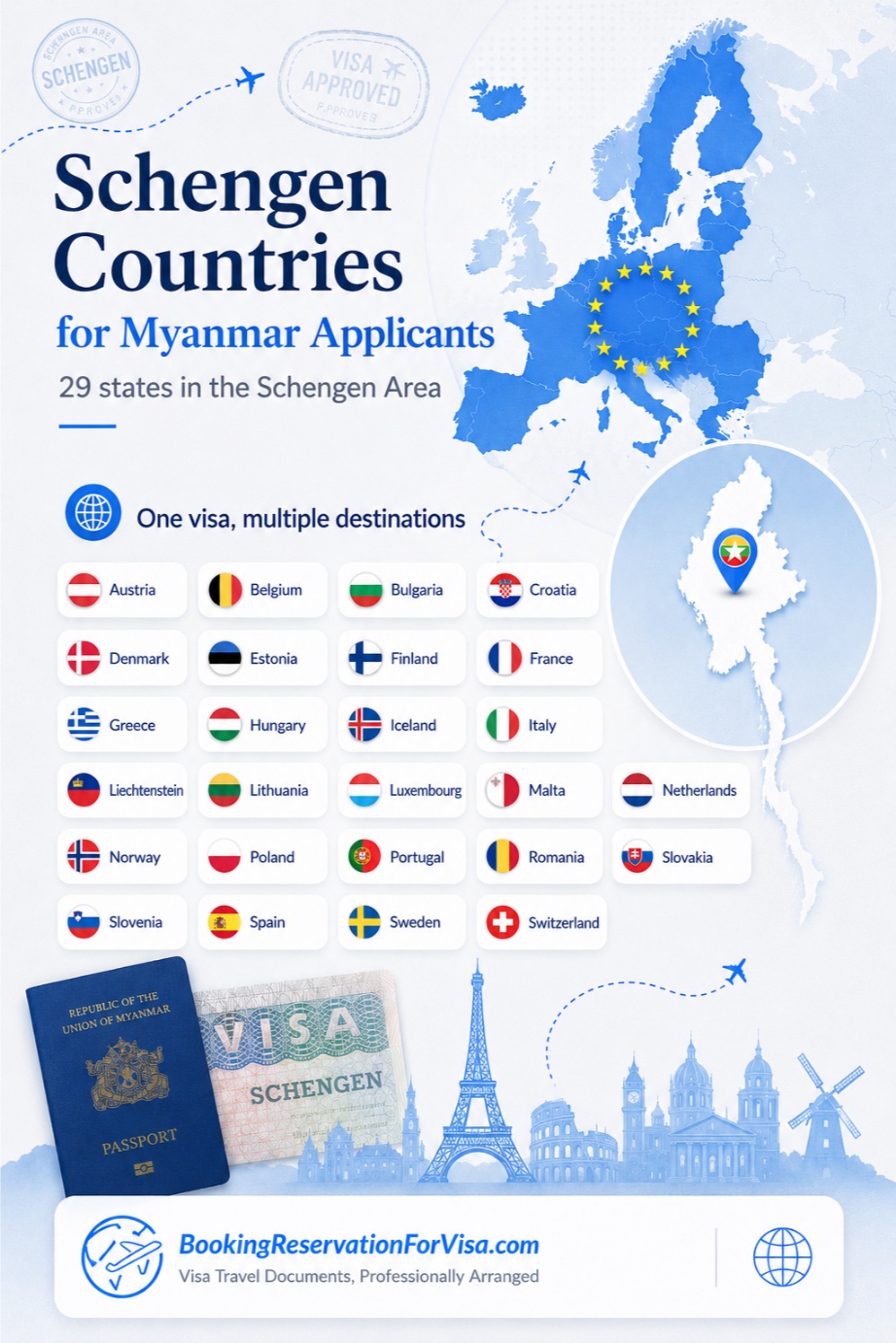
Myanmar’s Schengen landscape splits into three broad tracks: countries with their own resident decision-making embassy in Yangon, countries that submit through VFS Global Yangon, and countries that are represented by a neighboring embassy rather than maintaining any presence of their own. Below is the breakdown by destination.
Germany – Own Embassy, Filed via VFS Global Yangon
All Category C Schengen applications for Germany are lodged through the German Visa Application Center operated by VFS Global in Yangon, with the final decision resting solely with the Embassy of Germany in Yangon. Applicants complete the online VIDEX form before their appointment and attend the VFS center in person for document submission and biometrics.
Application Point: German Visa Application Centre, VFS Global Yangon Deciding Authority: Embassy of the Federal Republic of Germany, Yangon
Visa Application Centre
Hledan Centre Room No.(522),5th Floor, Corner of Pyay Road and Hledan Road, Kamayut Township,Yangon, 11041, Myanmar
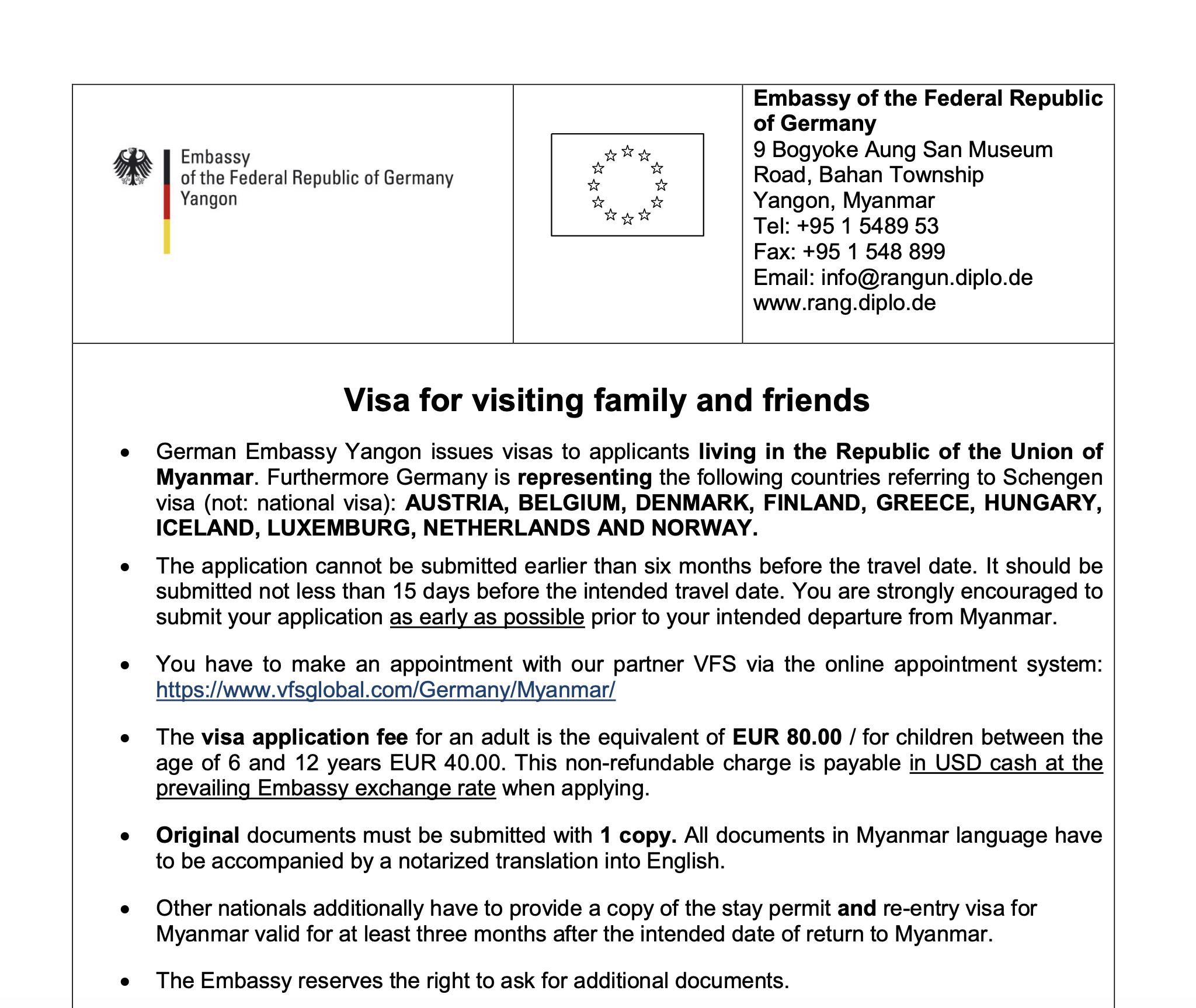
Austria, Belgium, Denmark, Finland, Greece, Hungary, Iceland, Luxembourg, Netherlands and Norway – Represented by Germany
This is one of the most important facts a Myanmar applicant can know before booking anything. The German Embassy in Yangon holds full Schengen visa representation for ten additional countries, meaning applicants heading primarily to any of these destinations submit through the same VFS Global German channel described above, with the German Embassy making the final call on the case.
Application Point: German Visa Application Centre, VFS Global Yangon Deciding Authority: Embassy of the Federal Republic of Germany, Yangon (on behalf of Austria, Belgium, Denmark, Finland, Greece, Hungary, Iceland, Luxembourg, Netherlands and Norway)
Applicants whose main destination is one of these eight countries should still confirm current representation status directly with VFS Global or the German Embassy before their appointment, since representation arrangements are occasionally adjusted.
Sweden – Own Embassy Section, Filed via VFS Global Yangon
Sweden maintains an Embassy Section Office in Yangon, co-located with several other Nordic missions in the same building. Schengen visa intake for Sweden runs through VFS Global’s dedicated Sweden counter in Yangon, with the Swedish mission making the final decision.
Application Point: Sweden Visa Application Centre, VFS Global Yangon Deciding Authority: Embassy of Sweden Section Office, Yangon
Visa Application Centre
Hledan Centre Room No.(522),5th Floor, Corner of Pyay Road and Hledan Road, Kamayut Township,Yangon, 11041, Myanmar
Italy – Direct Application at the Embassy of Italy
Italy does not use VFS Global or any outsourced center in Myanmar. Schengen visa applications are submitted directly to the Visa Office of the Embassy of Italy, with all correspondence, appointment requests, and document checklists managed through the embassy’s own official channels rather than a third-party portal. The embassy has publicly warned applicants against unofficial agents claiming to speed up or guarantee Italian visa outcomes.
Application Point: Visa Office, Embassy of Italy, Yangon Deciding Authority: Embassy of Italy, Yangon – 3, Inya Myaing Road, Golden Valley, Bahan Township 11201 – Yangon (Unione del Myanmar)
France – Direct Application at the Embassy of France
France also runs its own direct process rather than outsourcing to VFS or TLScontact in Myanmar. Applicants begin on the official France-Visas portal, book an appointment through the embassy’s own consulate booking system, and attend the Embassy of France in Yangon in person for submission. Appointments have been required for all visa categories at this mission since November 2024, with no walk-in submissions accepted.
Application Point: Visa Section, Embassy of France, Yangon Deciding Authority: Embassy of France, Yangon – 102, Pyidaungsu Yeithka Road, Dagon Township, Rangoun, Myanmar
Switzerland, Spain, Portugal, Latvia & Czech Republic – Represented by France
France holds Schengen representation for five additional countries in Myanmar, all channeled through the same embassy in Yangon. This includes full short-stay visa authority for Switzerland, and representation for Spain, Portugal, Latvia, and the Czech Republic. Spain in particular has confirmed a formal consular representation agreement with France covering both consular assistance and Schengen visa issuance, since Spain’s own diplomatic office in Yangon does not carry consular functions.
Application Point: Visa Section, Embassy of France, Yangon Deciding Authority: Embassy of France, Yangon (on behalf of Switzerland, Spain, Portugal, Latvia, and the Czech Republic)
Applicants heading to Switzerland should note one exception: certain categories – short-stay visas tied to paid work, study, or medical treatment, along with applications from non-Myanmar diplomatic or service passport holders – fall outside France’s representation authority and require a different route, which the French Embassy can clarify case by case.
Application Point: Visa Section, Embassy of France, Yangon Deciding Authority: Embassy of France, Yangon – 102, Pyidaungsu Yeithka Road, Dagon Township, Rangoun, Myanmar
Countries Without Direct or Delegated Representation in Myanmar
A handful of smaller Schengen states – including Croatia, Estonia, Lithuania, Malta, Poland, Slovakia, and Slovenia – do not currently maintain a resident visa-issuing presence in Myanmar and have no confirmed delegation arrangement with a Yangon-based embassy. Myanmar applicants whose main destination is one of these countries should contact that country’s nearest regional mission directly, most commonly located in Bangkok or New Delhi, to confirm the current submission pathway before making any travel plans. Representation arrangements for smaller Schengen states can shift without much public notice, so this is one area worth double-checking rather than assuming.
How Booking Reservation for Visa Supports Myanmar Applicants
A great deal of attention in a Schengen file goes toward financial proof and civil documents, but the travel-side evidence – the flight route and the accommodation record – carries just as much weight with a reviewing officer, because it is the part of the file that shows the trip has actually been thought through rather than assumed.
This is where Booking Reservation for Visa fits naturally into the Myanmar applicant’s preparation. If the itinerary side of the file still needs a formal, embassy-ready structure, a flight reservation for visa presents the route, dates, and booking reference clearly without requiring the full cost of a non-refundable ticket before the visa outcome is known. If accommodation proof is the missing piece, a hotel booking for visa application provides verifiable proof of stay that lines up with the travel dates shown elsewhere in the file. For applicants who prefer to handle both sides at once, the Flight + Hotel package keeps the route and the stay consistent with each other from the start.
None of these documents replace the visa application itself – they support it. For a Myanmar file, where the correct submission channel already varies country by country, having a clean, internally consistent travel record removes one more variable from an already detail-heavy process.

Practical Tips for Myanmar Applicants
Confirm representation before booking, not after. Because so many Schengen countries route through Germany or France in Myanmar rather than operating independently, applicants should verify the current representation status of their destination country directly with the relevant embassy before assuming last year’s arrangement still holds.
Build in extra time for forwarded cases. Applications decided outside Myanmar – Norway’s case is a clear example, decided in Bangkok rather than Yangon – need a wider buffer than locally-decided files. A few extra days for forwarding and review should be factored into any travel plan built around these destinations.
Bring clean currency. Since Schengen visa fees in Myanmar are frequently collected in cash, and several missions explicitly reject worn, torn, or heavily stamped notes, applicants should set aside fresh bills specifically for the appointment rather than relying on whatever cash happens to be on hand.
Keep the whole file pointed at one trip. The itinerary, the accommodation record, the insurance dates, and the financial evidence should all describe the same journey, at the same time, to the same place. A visa officer reading a file where the hotel dates don’t match the flight dates, or the insurance expires before the return leg, will notice immediately – and it rarely works in the applicant’s favor.
Treat travel insurance as non-negotiable. This is one of the most common reasons a Myanmar file gets sent back at the counter. The policy has to clearly state €30,000 minimum coverage, name the Schengen Area or the entire world as the coverage territory, and run for the full length of the trip without gaps.
Show financial stability, not a sudden deposit. A large lump sum appearing in a bank account the week before an appointment tends to draw more scrutiny than steady, unremarkable balances built up over several months. Consistency reads as more credible than a spike.
FAQs
Does every Schengen application in Myanmar go through VFS Global?
No. Germany, the Netherlands, Sweden, and Norway route through VFS Global Yangon, and Germany’s representation covers Austria, Belgium, Denmark, Finland, Greece, Hungary, Iceland, and Luxembourg through that same channel. Italy and France, by contrast, run their own direct embassy processes with no outsourced center involved, and France additionally represents Switzerland, Spain, Portugal, Latvia, and the Czech Republic through its own Yangon embassy.
What happens if my trip is split evenly between two countries?
When nights are split equally, the application must be lodged with the mission responsible for the country entered first on the itinerary. This rule applies in Myanmar exactly as it does everywhere else in the Schengen system.
Can someone else submit my application for me?
Generally, no. First-time Schengen applicants and anyone without valid biometrics on file from the past 59 months must appear in person for fingerprinting and photo capture. Limited exceptions exist for return applicants with recent biometric records, but these should be confirmed with the specific mission handling the case.
Is travel insurance really checked that carefully?
Yes. It is one of the first things reviewed at submission, not just at the decision stage, and several Yangon-based application points will not accept a file if the policy’s coverage amount, territory, or dates fall short of the requirement.
How long should I expect the whole process to take from Myanmar?
Officially, up to 15 calendar days once the deciding embassy has the file in hand, sometimes extending to 30 days for more complex cases. For applications forwarded to a representing embassy in another country, or for cases decided outside Yangon entirely, a longer buffer is the safer assumption.
What if my destination country isn’t listed with a clear Yangon contact?
A small number of Schengen states have no resident mission and no confirmed representation arrangement in Myanmar at present. Applicants in this position should reach out to the nearest regional mission for that country – commonly in Bangkok – to confirm the correct process before finalizing any travel dates.
Can Booking Reservation for Visa help with the travel documentation side of my file?
Yes. Flight reservations, hotel bookings, and combined flight-and-hotel packages built for visa use are available to support the travel-evidence portion of a Schengen application. These are preparation tools that strengthen the file – they are not a substitute for the visa application itself.
Conclusion
Applying for a Schengen visa from Myanmar rewards a very specific kind of preparation: figuring out exactly who is responsible for your destination country before you do anything else. Because Myanmar’s system runs on a mix of direct embassies, a shared VFS Global channel, and quiet representation arrangements between neighboring missions, the single biggest risk in this process isn’t a missing document – it’s walking into the wrong office entirely. Once that piece is settled, the rest of the process follows a fairly predictable rhythm: book early, assemble the file to the specific mission’s checklist, attend in person, and give the case enough time to move through review, especially if it’s being forwarded outside Yangon.
A Myanmar-based applicant who confirms the correct channel, keeps every document pointed at the same trip, and treats insurance and financial proof as seriously as the embassies do stands in a strong position – whatever corner of the Schengen Area the journey is ultimately headed toward.